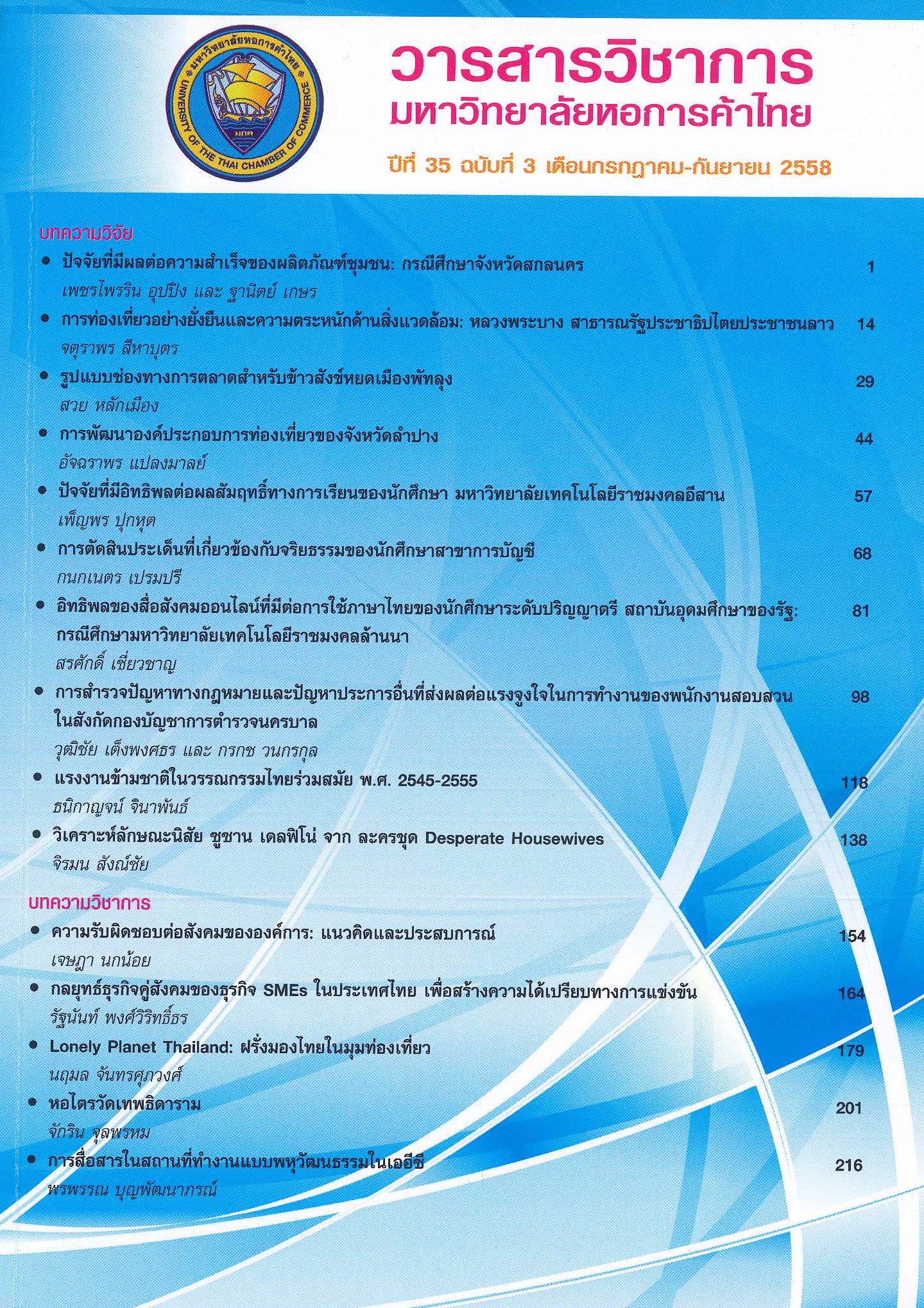
การสื่อสารในสถานที่ทำงานแบบพหุวัฒนธรรมในเออีซี
Article Sidebar
Main Article Content
บทคัดย่อ
การรวมตัวของประชาคมเศรษฐกิจอาเซียนจะมีผลในปลายปี 2015 โอกาสในการทำงานร่วมกับคนที่มาจากวัฒนธรรมอื่นมีมากขึ้น อันเป็นผลมาจากการเคลื่อนย้ายของแรงงานฝีมือในกลุ่มประเทศสมาชิก และจากประเทศต่าง ๆ ทั่วโลก ดังนั้น สถานที่ทำงานหลายแห่งจะเปลี่ยนแปลงเป็นสถานที่ทำงานแบบพหุวัฒนธรรม นอกเหนือจากความสามารถทางวิชาชีพแล้ว ความสามารถในการสื่อสารอย่างเหมาะสม ด้วยความนับถือผู้อื่นในสภาพเแวดล้อมแบบหลากหลายวัฒนธรรมจึงเป็นสิ่งสำคัญ เพราะในหมู่คนที่ทำงานร่วมกันมีความเชื่อ ค่านิยม จารีต และภูมิหลังที่แตกต่างกัน ซึ่งสามารถนำไปสู่การเข้าใจผิดและความสับสนได้ บทความนี้มุ่งที่จะชื้ให้เห็นความแตกต่างของวัฒนธรรมในหลายแง่มุมที่มีผลกระทบต่อประสิทธิภาพของการสื่อสาร และเสนอแนะวิธีการปรับให้เหมาะสมกับสภาพการทำงานแบบพหุวัฒนธรรม รวมทั้งข้อเสนอสำหรับผู้สอนในการเตรียมผู้เรียนเพื่อเข้าสู่โลกของการทำงานในบรรยากาศใหม่ที่ท้าทาย
Article Details

อนุญาตภายใต้เงื่อนไข Creative Commons Attribution-NonCommercial-NoDerivatives 4.0 International License.
ลิขสิทธิ์ของบทความ
ผลงานที่ได้รับการตีพิมพ์ถือเป็นลิขสิทธิ์ของมหาวิทยาลัยหอการค้าไทย ห้ามมิให้นำเนื้อหา ทัศนะ หรือข้อคิดเห็นใด ๆ ของผลงานไปทำซ้ำ ดัดแปลง หรือเผยแพร่ ไม่ว่าทั้งหมดหรือบางส่วนโดยไม่ได้รับอนุญาตเป็นลายลักษณ์อักษรจากมหาวิทยาลัยหอการค้าไทยก่อน
เอกสารอ้างอิง
Abolghasem, S.H.F. 2010. "Culture Assisted Language Learning (CALL) and Teaching General English." In EABR & ETLC
Conference, pp. 371-376. Ireland: Dublin.
Beamer, L., and Varner, I. 2001. Intercultural Communication in the Global Workplace. 2nd ed. Singapore: McGraw-Hill.
Bhasin, B. 24 April 2012. Asean's Diversity: Asset or Liability? [Online]. Available: www.bangkokpost.com/news/local/
290123/asean-diversity-asset-or-liability
Boonpattanaporn, P. 2014. "Opportunities for Practicing English: It is a Matter of Picking Them up." University of the Thai Chamber of Commerce Journal. 34, 3: 176-190.
Byram, M. 1997. Teaching and Assessing Intercultural Communication Competence. Clevedon: Multilingual Matters.
Byram, M., Gribkova, B., and Starkey, H. 2002. Developing the Intercultural Dimension in Language Teaching: A Practical Introduction for Teachers. Strasbourg: Council of Europe.
Collinsdictionary. 2014. Available: www.collinsdictionary.com/dictionary/American-cobuild-learners/cultural-awareness
Deardorff, D.K. 2006. "Identification and Assessment of Intercultural Competence as a Student Outcome of Internationali-zation." Journal of Studies in International Education. 10, 3: 241-266.
Education First. 2011. EF EPI Enalish Proficiency Index [Online]. Available: https://www.ef.co.th/sitecore/_//media/efcom/epi/pdf/EF-Epi-2011.pdf
Government of Canada. 2014. Canada's International Gateway [Online]. Available: https://www.canadainternational.gc.ca/ci-ci/index.aspx?lang=eng
Gunawan, M.H. 2014. Non-Verbal Communication: The Silent Cross-Cultural Contact with Indonesians [Online] Available: www.ialf.edu/kipbipa/papers/MuhamudHandiGunawan.doc
Hall, B.J. 2005. Among Culture: The Challenge of Communication. Belmont: Thomson Wadsworth.
Hall, E.T. 1976. Beyond Culture. Garden City: Doubleday.
Harper, A.M. 1997. "Cultural Adaptation and Intercultural Communication: Some Barriers and Bridges." In the Annual
Convention of the western Speech Communication Association, pp. 13. Monterey, CA.
Khan-Panni, P., and Swallow, D. 2003. Communicating Across Culture. Oxford: Howtobooks.
Kurylo, A. 2013. Intercultural Communication. Thousand Oaks: SAGE Publication.
Kwintessential. 2014. Global Etiquette [Online]. Available: www.kwintessential.co.uk/resources/global-Etiquette.html.
Liu, S., Volcic, Z., and Gallois, C. 2011. Introducing Intercultural Communication: Global Cultures AndContexts. London:
SAGE Publications.
Lustig, M.W., and Koester, J. 2013. Intercultural Competence: Interpersonal Communication Across Cultures. 7th ed.
ASA: Pearson Education.
The Nations Online Project. 2014. One world-Nations Online [Online]. Available: www.nationsonline.org
Neuliep, J.W. 2012. Intercultural Communication: A Contextual Approach. London: SAGE Publication.
Office of the Higher Education Commission. 2010. "Preparation for the ASEAN Community in 2015." Thai Higher
Education Review. 10, 33: 1-2.
Oliver, R.T. 1971. Communication and Culture in Ancient India and China. Syracuse: Syracuse University Press.
Patel, F., Li, M., and Sooknanan, P. 2011. Intercultural Communication: Building a Global Community. London: SAGE
Publication.
Ruben, B.D., and Kealey, D.J. 1979. "Behavioral Assessment of Communication Competency and the Prediction of Cross-Cultural Adaptation." International Journal of intercultural Relations. 3, 1: 15-47.
Samovar, L.A., Porter, R.E. and McDaniel, E.R. 2007. Communication Between Cultures. 6th ed. Belmont: Thomson
Wadsworth.
Sen, L. 2006. Communication Skills. New Delhi: Prentice-Hall.
Sorrells, K. 2013. Intercultural Communication: Globalization and Social Justice. Thousand Oaks: SAGE Publication.
Steinberg, S. 2006. Introduction to Communication. Cape Town: Juta.
Suthaceva, S., and Yuangsri, N. 2013. "Communication Problem Between Non-Thai and Thai Cabin Crew." In The 2nd
LITU International Graduate Conference Proceedings: Vol. 2, pp. 1042-1052. Bangkok: Thammasat University Press.
Tuleja, E. A. 2009. Intercultural Communication for Business. Canada: Nelson Education.
Vandenabeele, B. 2002. "The Need for Essences: On Non-Verbal Communication in First Intercultural Encounters." South African Journal of Philosophy. 21, 2: 85-96.
Wang, J. 2011. Communication and Cultural Competence: The Acquisition of Cultural Knowledge and Behavior
[Online]. Available: https://scholarworks.grsu.edu/orpc/vol7/iss1/3
