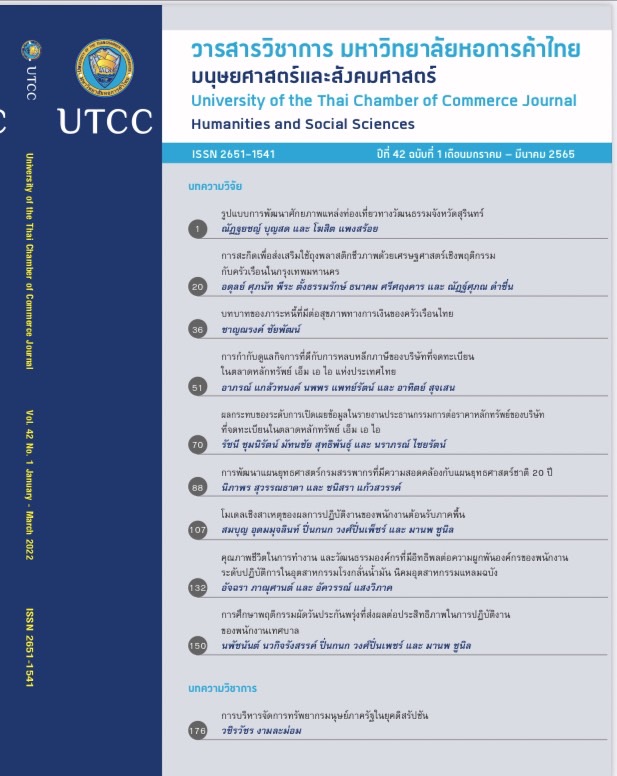
การศึกษาพฤติกรรมผัดวันประกันพรุ่งที่ส่งผลต่อประสิทธิภาพในการปฏิบัติงานของพนักงานเทศบาล
Article Sidebar
Main Article Content
บทคัดย่อ
การวิจัยครั้งนี้มีวัตถุประสงค์เพื่อศึกษาพฤติกรรมผัดวันประกันพรุ่งที่ส่งผลต่อประสิทธิภาพในการปฏิบัติงานของพนักงานเทศบาลภายใต้โครงสร้างเชิงองค์ประกอบพฤติกรรมผัดวันประกันพรุ่งของ Chu และ Choi (2005) โดยใช้การวิจัยแบบผสมผสาน ประกอบการวิจัยเชิงคุณภาพเพื่อสัมภาษณ์เชิงลึกแบบกึ่งโครงสร้างในผู้ให้ข้อมูลสำคัญจำนวน 12 คน และเชิงปริมาณที่มีกลุ่มตัวอย่างเป็นกลุ่มพนักงานเทศบาลนครนครปฐม เทศบาลนครนนทบุรี และเทศบาลเมืองรังสิต ซึ่งได้มาจากการสุ่มตัวอย่างแบบแบ่งชั้นภูมิ จำนวน 212 คน เครื่องมือที่ใช้ในการวิจัย ได้แก่ แบบสอบถามพฤติกรรมผัดวันประกันพรุ่ง เป็นแบบมาตรวัดประมาณค่า 5 ระดับ มีค่าความเชื่อมั่น .904 วิเคราะห์ข้อมูลโดยการวิเคราะห์องค์ประกอบเชิงยืนยัน ผลการวิจัยพบว่า พฤติกรรมผัดวันประกันพรุ่งในการปฏิบัติงานของพนักงานเทศบาล ประกอบด้วย 2 องค์ประกอบ ได้แก่พฤติกรรมผัดวันประกันพรุ่งในการปฏิบัติงานแบบไม่จงใจ และพฤติกรรมผัดวันประกันพรุ่งในการปฏิบัติงานแบบจงใจ โดยโมเดลพฤติกรรมผัดวันประกันพรุ่งในการปฏิบัติงานของพนักงานเทศบาลมีความสอดคล้องกับข้อมูลเชิงประจักษ์ โดยพิจารณาจากค่าสถิติไค-สแควร์ (c2) เท่ากับ 52.824 ที่องศาอิสระ (df) เท่ากับ 42 มีค่าความน่าจะเป็น (p) เท่ากับ .122 มีค่าดัชนีวัดระดับความกลมกลืนเปรียบเทียบ (CFI) เท่ากับ .996 ดัชนี Tuker-Lewis Index (TLI) เท่ากับ .993 ค่ารากของค่าเฉลี่ยกําลังสองของเศษเหลือในรูปคะแนนมาตรฐาน (SRMR) เท่ากับ .033 และค่ารากของค่าเฉลี่ยกําลังสองของความคลาดเคลื่อนโดยประมาณ (RMSEA) เท่ากับ .028 ซึ่งองค์ประกอบเหล่านี้สามารถนำไปใช้เป็นแนวทางสำหรับสร้างการรับรู้ผ่านกิจกรรมเชิงการปฏิบัติการต่าง ๆ เพื่อสร้างการรับรู้ที่นำไปสู่พฤติกรรมการปฏิบัติงานเชิงพฤติกรรมผัดวันประกันพรุ่งที่ส่งผลดีต่อการปฏิบัติงานของพนักงานเทศบาลต่อไป
Article Details

อนุญาตภายใต้เงื่อนไข Creative Commons Attribution-NonCommercial-NoDerivatives 4.0 International License.
ลิขสิทธิ์ของบทความ
ผลงานที่ได้รับการตีพิมพ์ถือเป็นลิขสิทธิ์ของมหาวิทยาลัยหอการค้าไทย ห้ามมิให้นำเนื้อหา ทัศนะ หรือข้อคิดเห็นใด ๆ ของผลงานไปทำซ้ำ ดัดแปลง หรือเผยแพร่ ไม่ว่าทั้งหมดหรือบางส่วนโดยไม่ได้รับอนุญาตเป็นลายลักษณ์อักษรจากมหาวิทยาลัยหอการค้าไทยก่อน
เอกสารอ้างอิง
ชูวงศ์ ฉายะบุตร. (2539). การปกครองท้องถิ่นไทย. กรุงเทพฯ: กรมการปกครอง.
พรรณวดี สมกิตติกานนท์. (2560). มุมมองเชิงบวกของการผัดวันประกันพรุ่งกับสุขภาวะ. วารสารพยาบาลทหารบก, 18(2), 16-23.
มุทิตา วรกัลยากุล. (2556). ความสำเร็จในการบริหารงานของเทศบาลนครรังสิต จังหวัดปทุมธานี. วารสารวิทยบริการ, 24(1), 144-158.
ลัดดาวัลย์ เพชรโรจน์, สุภมาส อังศุโชติ, และอัจฉรา ชำนิประศาสน์. (2550). สถิติสำหรับการวิจัยและเทคนิคการใช้ SPSS (ฉบับปรับปรุง). กรุงเทพฯ: มิชชั่น มิเดีย.
Batool, S. S, Khursheed, S., & Jahangir, H. (2017). Academic procrastination as a product of low self-esteem: A mediational role of academic self-efficacy. Pakistan Journal of Psychological Research, 32(1), 195-211.
Bond, M. J., & Feather, N. T. (1988). Some correlates of structure and purpose in the use of time. Journal of Personality and Social Psychology, 55(2), 321-329.
Chen, B.-B., & Kruger, D. (2017). Future orientation as a mediator between perceived environmental cues in likelihood of future success and procrastination. Personality and Individual Differences, 108, 128-132.
Choi, J., & Moran, S. V. (2009). Why not procrastinate? Development and validation of a new active procrastination scale. Journal of Social Psychology, 149(2), 195-211.
Chu, A. H. C., & Choi, J. N. (2005). Rethinking procrastination: Positive effects of “active” procrastination behavior on attitudes and performance. Journal of Social Psychology, 145(3), 245-264.
Cömert, M., & Dönmez, B. (2019). A qualitative study on the perceptions of administrators and teachers on procrastination behavior and workload of school administrators. Journal of Education and Training Studies, 7(2), 129-136.
Duru, E., & Balkis, M. (2017). Procrastination, self-esteem, academic performance, and well-being: A moderated mediation model. International Journal of Educational Psychology, 6(2), 97-119.
Ellis, A., & Knaus, W. J. (1977). Overcoming procrastination. New York, NY: Signet.
Emerson, R. W. (2013). The happiness experiment. London, England: Simple Web.
Fernie, B. A., Bharucha, Z., Nikcevic, A. V., & Spada, M. M. (2016). The unintentional procrastination scale. Journal of Rational-Emotive & Cognitive-Behavior Therapy, 35(2), 136-149. doi:10.1007/s10942-016-0247-x
Hair, J. F., Black, W. C., Babin, B. J., & Anderson, R. E. (2010). Multivariate data analysis (7th ed.). Cranbury, NJ: Pearson Education.
Harriott, J., & Ferrari, J. (1996). Prevalence of procrastination among samples of adults. Psychological Reports, 78(2), 611-616. doi:10.2466/pr0.1996.78.2.611
Hensley, L. (2013). The fine points of working under pressure: Active and passive procrastination among college students (Unpublished doctoral dissertation). The Ohio State University.
Klassen, R. M., Krawchuk, L. L., Lynch, S. L., & Rajani, S. (2008). Procrastination and motivation of undergraduates with learning disabilities: A mixed methods inquiry. Learning Disabilities Research & Practice, 23(3), 137-147.
Kline, R. B. (2005). Principles and practice of structural equation modeling (2nd ed.). New York, NY: The Guilford Press.
Knaus, W. J. (2000). Procrastination, blame, and change. Journal of Social Behavior and Personality, 15(5), 153-166.
Metin, U. B., Taris, T. W., & Peeters, M. C. W. (2016). Measuring procrastination at work and its associated workplace aspects. Personality and Individual Differences, 101, 254-263. doi:10.1016/j.paid.2016.06.006
Nabelkova, E., & Ratkovska, J. (2015). Academic procrastination and factors contributing to its overcoming. The New Educational Review, 39(1), 107-118.
Ng, B. (2018). Exploring procrastination and self-regulated learning through motivational beliefs. Journal of Research Initiatives, 3(3), 1-16.
Pahlavani, M., Nezhad, F. N., & Nezhad, N. N. (2015). Relationship between self-esteem with procrastination and self-efficacy among employers of professional and technical organization of Zahedan. Indian Journal of Fundamental and Applied Life Sciences, 5(S1), 4882-4891.
Perry, J. (2012). The art of procrastination: A guide to effective dawdling, lollygagging, and postponing, or getting things done by putting them off. New York, NY: Workman.
Pintrich, P. R., & De Groot, E. V. (1990). Motivational and self-regulated learning components of classroom academic performance. Journal of Educational Psychology, 82(1), 33-40.
Rabin, L.A., Fogel, J., & Nutter-Upham, K. E. (2011). Academic procrastination in college students: The role of self-reported executive function. Journal of Clinical and Experimental Neuropsychology, 33(3), 344-357. doi:10.1080/13803395.2010.518597
Rosenberg, M. (1965). Society and the adolescent self-image. Princeton, NJ: Princeton University Press.
Saplavska, J., & Jerkunkova, A. (2018). Academic procrastination and anxiety among students. In Proceedings 17th International Scientific Conference Engineering for Rural Development, 23-25 May 2018, Jelgava, Latvia (pp. 1192-1197). Jelgava, Latvia: Latvia University of Life Sciences and Technologies.
Solomon, L. J., & Rothblum, E. D. (1984). Academic procrastination: Frequency and cognitive-behavioral correlates. Journal of Counseling Psychology, 31(4), 503-509.
Steel, P. (2007). The nature of procrastination: A meta-analytic and theoretical review of quintessential self-reguratory failure. Psychological Bulletin, 133(1), 65-94.
Tice, D., & Baumeister, R. F. (1997). Longitudinal study of procrastination, performance, stress, and health: The cost and benefits of dawdling. Psychological Science, 8(6), 454-458.
Wells, A., & Matthews, G. (2015). Attention and emotion: A clinical perspective (Classic ed.). East Sussex, England: Psychology Press.
