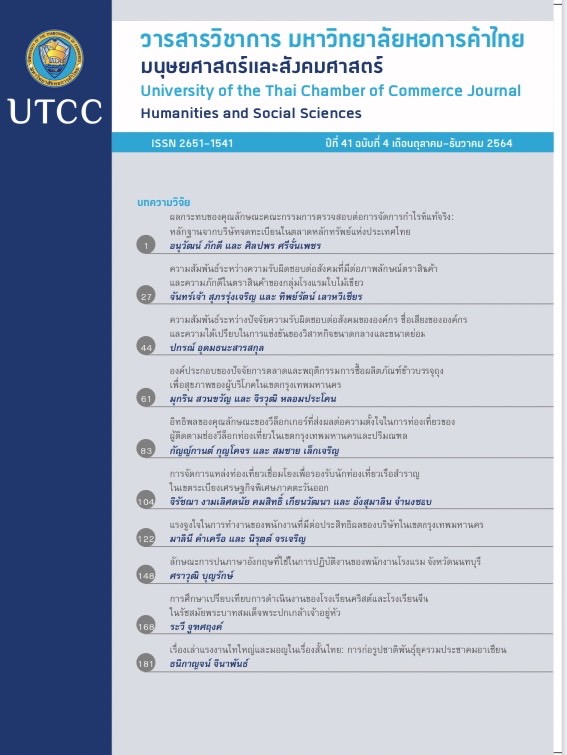
ความสัมพันธ์ระหว่างความรับผิดชอบต่อสังคมที่มีต่อภาพลักษณ์ตราสินค้าและความภักดี ในตราสินค้าของกลุ่มโรงแรมใบไม้เขียว
Article Sidebar
Main Article Content
บทคัดย่อ
การศึกษานี้มีวัตถุประสงค์เพื่อศึกษาระดับความคิดเห็นของผู้รับบริการจากโรงแรมเกี่ยวกับความรับผิดชอบต่อสังคม ภาพลักษณ์ตราสินค้า และความภักดีในตราสินค้าของกลุ่มโรงแรมใบไม้เขียว และเพื่อศึกษาความสัมพันธ์ระหว่างความรับผิดชอบต่อสังคมและภาพลักษณ์ตราสินค้า ความรับผิดชอบต่อสังคมและความภักดีในตราสินค้า ความสัมพันธ์ระหว่างภาพลักษณ์ตราสินค้าและความภักดีในตราสินค้า จากการใช้แบบสำรวจและทดสอบสมมติฐานด้วยสถิติวิเคราะห์ ซึ่งได้แก่ Independent Sample t-test, one-way ANOVA (F-test), Regression Analysis, Pearson’s Correlation Coefficient และ Spearman rank correlation พบว่าผู้ตอบแบบสอบถามที่มีเพศ สถาพภาพ และระดับการศึกษาที่แตกต่างกันมีความคิดเห็นเกี่ยวกับความรับผิดชอบต่อสังคมของกลุ่มโรงแรมใบไม้เขียวไม่แตกต่างกัน ในขณะที่ผู้ตอบแบบสอบถามที่มีอายุระหว่าง 26-33 ปี และรายได้ต่อเดือนรายได้ต่อเดือนในช่วงระหว่าง 25,001-35,000 บาท มีความคิดเห็นเกี่ยวกับความรับผิดชอบต่อสังคมของกลุ่มโรงแรมใบไม้เขียวแตกต่างกัน นอกจากนี้ผลการวิเคราะห์ยังพบว่าความรับผิดชอบต่อสังคมมีความสัมพันธ์เชิงบวกกับภาพลักษณ์ตราสินค้าและความภักดีในตราสินค้า และภาพลักษณ์ตราสินค้ามีความสัมพันธ์เชิงบวกกับความภักดีในตราสินค้า
Article Details

อนุญาตภายใต้เงื่อนไข Creative Commons Attribution-NonCommercial-NoDerivatives 4.0 International License.
ลิขสิทธิ์ของบทความ
ผลงานที่ได้รับการตีพิมพ์ถือเป็นลิขสิทธิ์ของมหาวิทยาลัยหอการค้าไทย ห้ามมิให้นำเนื้อหา ทัศนะ หรือข้อคิดเห็นใด ๆ ของผลงานไปทำซ้ำ ดัดแปลง หรือเผยแพร่ ไม่ว่าทั้งหมดหรือบางส่วนโดยไม่ได้รับอนุญาตเป็นลายลักษณ์อักษรจากมหาวิทยาลัยหอการค้าไทยก่อน
เอกสารอ้างอิง
กรมพัฒนาธุรกิจการค้า. (2561). จำนวนธุรกิจโรงแรมและทุนจดทะเบียน. สืบค้นเมื่อ 25 ธันวาคม 2561,จาก https://www.dbd.go.th/index.php
กรมส่งเสริมคุณภาพสิ่งแวดล้อม. (2562). คู่มือและเกณฑ์โรงแรมสีเขียว. สืบค้นเมื่อ 8 พฤศจิกายน 2562, จาก https://datacenter.deqp.go.th/service-portal/g-green/greenhotel/download/
ชุติมา วุ่นเจริญ. (2556). ความรับผิดชอบต่อสังคมกับธุรกิจโรงแรม. วารสารวิทยาการจัดการ, 30(1), 143-158.
ปวีณา สินขาว. (2556). ความรับผิดชอบต่อสังคมและสิ่งแวดล้อมที่ส่งผลต่อภาพลักษณ์ของบริษัทไทยน้ำทิพย์ จำกัด จังหวัดปทุมธานี (การค้นคว้าอิสระปริญญามหาบัณฑิต ไม่ได้ตีพิมพ์). มหาวิทยาลัยเทคโนโลยีราชมงคลธัญบุรี, ปทุมธานี.
มูลนิธิใบไม้เขียว. (ม.ป.ป.ก). โครงการใบไม้เขียว. สืบค้นเมื่อ 8 พฤศจิกายน 2562, จาก http://www.greenleafthai.org/th/ green_ programs /project_overview/
มูลนิธิใบไม้เขียว. (ม.ป.ป.ข). โรงแรมใบไม้เขียว. สืบค้นเมื่อ 8 พฤศจิกายน 2562, จาก http://greenleafthai.org/th/green_hotel/
ยุทธศักดิ์ สุภสร. (2562). ทิศทางท่องเที่ยวไทยในปี 2562. สืบค้นเมื่อ 30 พฤศจิกายน 2562, จาก https://www.tatreviewmagazine. com/article/ tourism-thailand-2562/
ศิลปพร ศรีจั่นเพชร. (2560). การบัญชีตามความรับผิดชอบต่อสังคม. วารสารวิชาการบริหารธุรกิจ, 6(1), 25-32.
ศิริวรรณ เสรีรัตน์. (2538). พฤติกรรมผู้บริโภคฉบับพื้นฐาน. กรุงเทพฯ: โรงพิมพ์พัฒนาการศึกษา.
สมาคมโรงแรมไทย. (ม.ป.ป.). มูลนิธิใบไม้เขียว. สืบค้นเมื่อ 8 พฤศจิกายน 2562, จาก http://www.thaihotels.org/16782254/green-leaf-foundation-ใบไม้เขียว
สานิตย์ หนูนิล (2562). ผลกระทบของความรับผิดชอบต่อสังคมที่มีต่อผลการดำเนินงานขององค์กร: การศึกษาเชิงประจักษ์โรงแรมที่เป็นสมาชิกมูลนิธิใบไม้เขียว. วารสารบริหารธุรกิจเทคโนโลยีมหานคร, 16(2), 40-58.
หทัยชนก รัตนถาวรกิติ, ฐานิดา สิทธิเสือ, และคเชนทร์ วัฒนะโกศล. (2560). ความรับผิดชอบต่อสังคมกับธุรกิจโรงแรมในยุค 4.0. วารสารวิชาการมหาวิทยาลัย มหาสารคาม, 6(2), 161-167.
อรอุมา เกิดศรีเหล็ก. (ม.ป.ป.). โรงแรมที่เป็นมิตรกับสิ่งแวดล้อม. สืบค้นเมื่อ 8 พฤศจิกายน 2562, จาก http://bangkokgreencity.bangkok.go.th/Knowledge-Based/Article/GreenSpace/%E0%B9%82%E0%B8%A3%E0%B8%87%E0%B9%81%E0%B8%A3%E0%B8%A1%E0%B8%97%E0%B9%80%E0%B8%9B%E0%B8%99%E0%B8%A1%E0%B8%95%E0%B8%A3%E0%B8%81%E0%B8%9A%E0%B8%AA%E0%B8%87%E0%B9%81%E0%B8%A7%E0%B8%94%E0%B8%A5%E0%B8%AD%E0%B8%A1.aspx?lang=en-US
Aaker, D. A. (1991). Managing brand equity; capitalizing on the value of a brand-name. New York, NY: The Free Press.
Alexander, A., Francis, A., Kyire, L., & Mohammed, H. (2014). The effect of corporate social responsibility on brand building. International Journal of Marketing Studies, 6(3), 126-138. doi:10.5539/ijms.v6n3p126
Andreani, F., Taniaji, T. L., & Puspitasari, R. N. M. (2012). The impact of brand image towards loyalty with satisfaction as a mediator in McDonald’s. Journal of Management and Entrepreneurship, 14(1), 64-71.
Andreassen, W., & Lindestad, B. (1998). Customer loyalty and complex services: The impact of corporate image on quality, customer satisfaction and loyalty for customer with varying degrees of service expertise. International Journal of Service Industry Management, 9(1), 7–23.
Becker-Olsen, K. L., Cudmore, B. A., & Hill, R. P. (2006). The impact of perceived corporate social responsibility on consumer behavior. Journal of Business Research, 59(1):46-53. https://doi.org/10.1016/j.jbusres.2005.01.001
Bloemer, J., & and de Ruyter, K. (1998). On the relationship between store image, store satisfaction and store loyalty. European Journal of Marketing, 32(5/6), 499-513. https://doi.org/10.1108/03090569810216118
Carroll, A. B. (2004). Managing ethically with global stakeholders: A present and future challenge. Academy of Management Executive, 18(2), 114-120.
Chan, E. S. W. (2013a). Gap analysis of green hotel marketing. International Journal of Contemporary Hospitality management, 25(7), 1017-1048. https://doi.org/10.1108/IJCHM-09-2012-0156
Chan, E. S. W. (2013b). Managing green marketing: Hong Kong hotel managers’ perspective. International Journal of Hospitality Management, 34, 442-461. https://doi.org/10.1016/j.ijhm.2012.12.007
Davies, G., & Chun, R. (2002). Gaps between the internal and external perceptions of the corporate brand. Corporate Reputation Review, 5(2/3), 144-158. https://doi.org/10.1057/palgrave.crr.1540171
Grewal, D., Monroe, K. B., & Krishnan, R. (1998). The effects of price comparison advertising on buyers' perceptions of acquisition value and transaction value. Journal of Marketing, 62(2), 46-59. https://doi.org/10.1177/002224299806200204
Harris, L. C., & Goode, M. M. H. (2004). The four levels of loyalty and the pivotal role of trust: A study of online service dynamics. Journal of Retailing, 80(2), 139-158.https://doi.org/10.1016/j.jretai.2004.04.002
He, Y., & Lai, K. K. (2014). The effect of corporate social responsibility on brand loyalty: The mediating role of brand image. Total Quality Management & Business Excellence, 25(3-4), 249-263. https://doi.org/10.1080/14783363.2012.661138
Hoonakker, P. L. T., & Carayon, P. (2009). Questionnaire survey nonresponse: A comparison of postal mail and internet surveys. International Journal of Human Computer Interaction, 25(5), 348-373. doi:10.1080/10447310902864951
Hoq, M. Z., Sultana, N., & Amin, M. (2010). The effect of trust, customer satisfaction and image on customers' loyalty in Islamic banking sector. South Asian Journal of Management, 17(1), 70-93.
Keller, K. L. (1993). Conceptualizing, measuring and managing customer-based brand equity. Journal of Marketing, 57(1), 1-22. https://doi.org/10.2307/1252054
Keller, K. L. (2003). Strategic brand management: Building, measuring and managing brand Equity. Upper Saddle River, NJ: Pearson Education.
Knox, S., & Walker, D. (2003). Empirical developments in the measurement of involvement, brand loyalty and their relationship in grocery markets. Journal of Strategic Marketing, 11(4), 271-286. https://doi.org/10.1080/0965254032000159072
Kotler, P., & Lee, N. (2015). Social marketing: Changing behaviors for good (5th ed.). Newbury Park, CA: SAGE.
Martínez, P., Pérez, A., & del Bosque, I. R. (2014). CSR influence on hotel brand image and loyalty. Academia Revista Latinoamericana de Administración, 27(2), 267-283.https://doi.org/10.1108/ARLA-12-2013-0190
Nawaz, N.-U.-A., & Usman, A. (2011). What makes customers brand loyal: A study on telecommunication sector of Pakistan. International Journal of Business and Social Science, 2(14), 213-221.
Oliver, R. L. (2014). Satisfaction: A behavioral perspective on the consumer (2nd ed.). New York, NY: McGrawHill.
Park, C. W., Jaworski, B. J., & MacInnis, D. J. (1986). Strategic brand concept- image management. Journal of Marketing, 50(4),135-145. https://doi.org/10.1177/002224298605000401
Pivato, S., Misani, N., & Tencati, A. (2008). The impact of corporate social responsibility on consumer trust: The case of organic food. Business Ethics: A European Review, 17(1), 3-12.
Porter, M. E., & Kramer, M. R. (2006). Strategy and society the link between competitive advantage and corporate social responsibility. Harvard Business Review, 84(12), 78-92, 163.
Rudez, H. N. (2010). Integration of corporate social responsibility into loyalty program in the tourismindustry. Tourism & Hospitality Management, 16(1), 101.
Smith, W. J., Wokutch, R. E., Harrington, K. V., & Dennis, B. S. (2001). An examination of the influence of diversity and stakeholder role on corporate social orientation. Business and Society, 40(3), 266–294.
Van Marrewijk, M. (2003). Concept and definitions of CSR and corporate sustainability: Between agency and communion. Journal of Business Ethics, 44, 95–105.
