
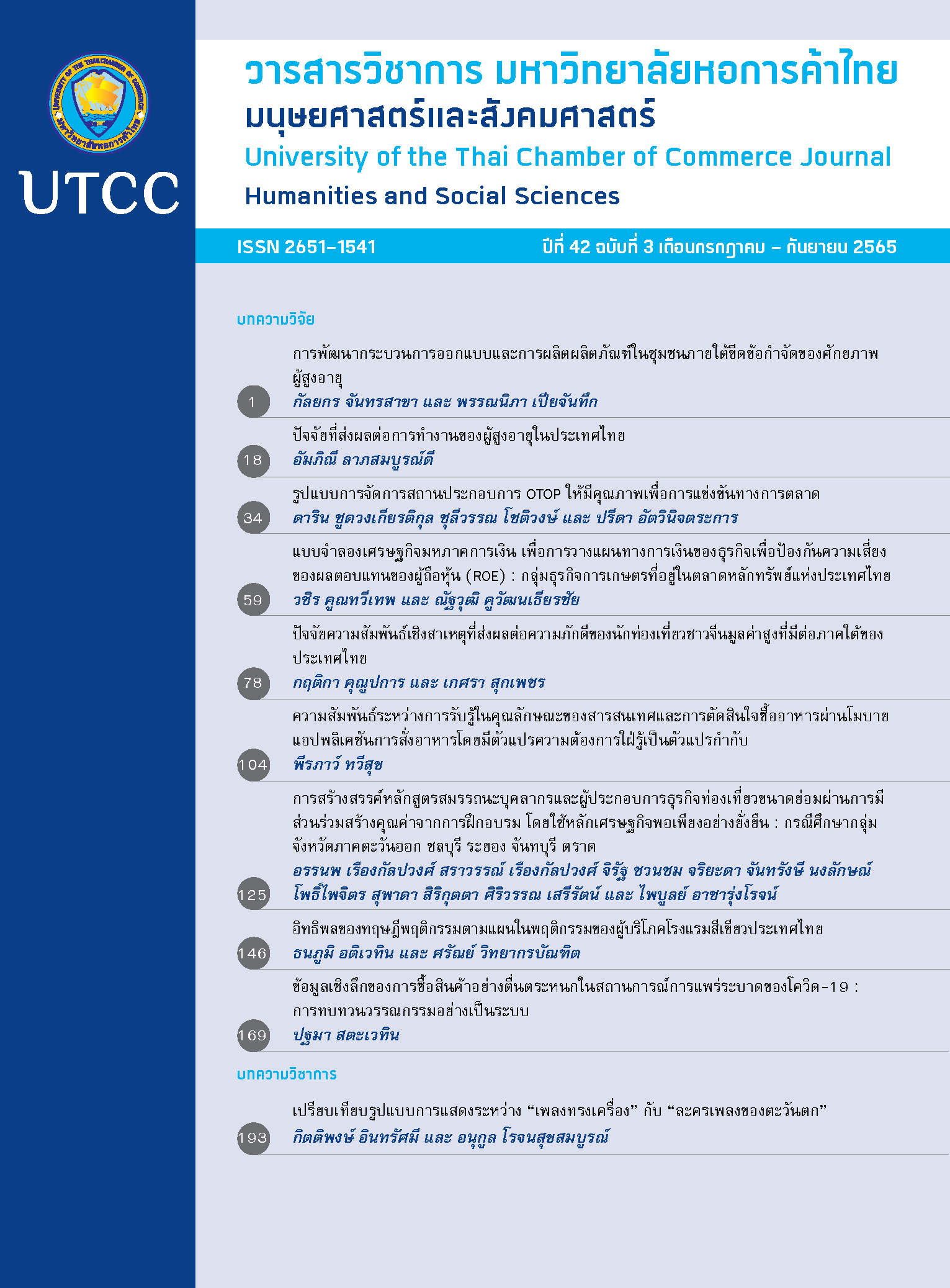
ความสัมพันธ์ระหว่างการรับรู้ในคุณลักษณะของสารสนเทศและการตัดสินใจซื้ออาหารผ่านโมบายแอปพลิเคชันการสั่งอาหารโดยมีตัวแปรความต้องการใฝ่รู้เป็นตัวแปรกำกับ
Article Sidebar
Main Article Content
บทคัดย่อ
การวิจัยนี้มีวัตถุประสงค์เพื่อศึกษาอำนาจทำนายคุณลักษณะของสารสนเทศทั้งปัจจัยเส้นทางหลัก(ข้อความแนะนำและสถิติของผู้ชมวิดีโอ/รูปภาพ), ปัจจัยเส้นทางริม (สถิติผู้ที่กดชื่นชอบและความง่ายต่อการจ่ายเงิน) กับการตัดสินใจซื้ออาหารผ่านโมบายแอปพลิเคชันการสั่งอาหารโดยมีตัวแปรความต้องการใฝ่รู้(การแสดงออกด้านอารมณ์และด้านเหตุผล) เป็นตัวแปรกำกับ ตัวอย่างคือ ผู้ซื้ออาหารผ่านโมบายแอปพลิเคชันในกรุงเทพมหานครจำนวน 405 คน ใช้แบบสอบถามในการเก็บข้อมูล ผลการวิเคราะห์ถดถอพหุคูณเชิงชั้นพบว่าปัจจัยเส้นทางหลักและปัจจัยเส้นทางริมมีความสัมพันธ์เชิงบวกกับการตัดสินใจซื้ออาหารผ่านโมบายแอปพลิเคชันนอกจากนั้นยังพบว่า ตัวแปรความต้องการใฝ่รู้การแสดงออกด้านเหตุผลเป็นตัวแปรกำกับมีความความสัมพันธ์เชิงลบกับปัจจัยเส้นทางริมและการตัดสินใจซื้อการวิจัยในครั้งนี้มีประโยชน์ทั้งในวงวิชาการและผู้ประกอบที่ขาย
อาหารผ่านโมบายแอปพลิเคชันการสั่งอาหาร โดยสามารถนำผลที่ได้จากการศึกษาในครั้งนี้ไปพัฒนาแนวทางการกำหนดกลยุทธ์การสื่อสารการตลาดผ่านเครือข่ายสังคมออนไลน์รวมถึงรูปแบบของสื่อการนำเสนอข้อความที่เหมาะสมสอดคล้องกับกลุ่มผู้ซื้อเป้าหมายเพื่อเผยแพร่ประชาสัมพันธ์ข้อมูลข่าวสารที่มีต่อการตัดสินใจซื้ออาหาร
ผ่านโมบายแอปพลิเคชัน ได้มีประสิทธิภาพมากยิ่งขึ้น
Article Details

อนุญาตภายใต้เงื่อนไข Creative Commons Attribution-NonCommercial-NoDerivatives 4.0 International License.
ลิขสิทธิ์ของบทความ
ผลงานที่ได้รับการตีพิมพ์ถือเป็นลิขสิทธิ์ของมหาวิทยาลัยหอการค้าไทย ห้ามมิให้นำเนื้อหา ทัศนะ หรือข้อคิดเห็นใด ๆ ของผลงานไปทำซ้ำ ดัดแปลง หรือเผยแพร่ ไม่ว่าทั้งหมดหรือบางส่วนโดยไม่ได้รับอนุญาตเป็นลายลักษณ์อักษรจากมหาวิทยาลัยหอการค้าไทยก่อน
เอกสารอ้างอิง
TMB Analytic เผยในช่วง2-3 ปีE-Commerce เติบโตรวดเร็วทั้งไทยและต่างประเทศ. (2563,13 พฤษภาคม).
สำนักข่าวอีไฟแนนซ์ไทย. สืบค้น 14 มีนาคม 2564 https://www.efinancethai.com/LastestNews/LatestNewsMain.aspx?ref=A&id=N2lNUkpaZjFZc
ธุรกิจส่งอาหารคึกคัก ครึ่งปีแรกโตกระฉูด 150%. (2563, 6 สิงหาคม). เดลินิวส์. สืบค้น 16 มกราคม 2564,จาก https://www.dailynews.co.th/economic/788505
Phongsak. (2563). ทางรอดและโอกาสของอุตสาหกรรมอาหารและเครื่องดื่มไทยในวิกฤตโควิด-19.สืบค้นเมื่อ19 เมษายน 2564, จาก https://www.smartsme.co.th/content/236825
ศูนย์วิจัยกสิกรไทยเผยธุรกิจ Last-mile Delivery แม้ยังโตดีแต่เผชิญโจทย์ที่ท้าทาย. (2562, 24 กันยายน).กรุงเทพธุรกิจ. สืบค้น 21 กุมภาพันธ์ 2564, จาก https://www.bangkokbiznews.com/news/detail/848399
สำนักงานคณะกรรมการกิจการกระจายเสียงกิจการโทรทัศน์และกิจการโทรคมนาคมแห่งชาติ. (2564). โครงการสำรวจข้อมูลอินเทอร์เน็ตและศึกษามูลค่าตลาดสื่อสารประเทศไทย. สืบค้นเมื่อ 24 พฤษภาคม 2564,จาก http://webstats.nbtc.go.th/netnbtc/HOME.php
Amarinacademy. (2563). แนวโน้มธุรกิจร้านอาหารในไทย ปี2563 จะเป็นอย่างไร?. สืบค้นเมื่อ 16 มีนาคม 2564,จากhttps://www.facebook.com/Amarinacademy/photos/แนวโน้ม-ธุรกิจร้านอาหารในไทย- ปี-2563-จะเป็นอย่างไรในปีที่ผ่านมาจะเห็นได้ว่าธุรกิจ/2714681325263904/
Belch, G., & Belch, M. (2009). Advertising and promotion: An integrated marketing communications perspective. New York, NY.: McGraw-Hill/Irwin.
Brynjolfsson, E., Hu, Y. J., & Rahman, M. S. (2013). Competing in the age of omnichannel retailing. MIT Sloan Management Review, 54(4), 23-29.
Burgoon, J. K., Bonito, J. A., Ramirez, A., Jr., Dunbar, N. E., Kam, K., & Fischer, J. (2002). Testing the interactivity principle: Effects of mediation, propinquity, and verbal and nonverbal modalities in interpersonal interaction. Journal of Communication, 52(3), 657-677. doi:10.1111/j.1460-2466.2002.tb02567.x
Chang, H., Zhang, L., & Xie, G. X. (2015). Message framing in green advertising: The effect of construal level and consumer environmental concern. International Journal of Advertising, 34(1), 158-176. doi: 10.1080/02650487.2014.994731
Chen, C. F., & Tsai, M. H. (2008). Perceived value, satisfaction, and loyalty of TV travel product shopping: Involvement as a moderator. Tourism Management, 29(6), 1166-1171.
Cho, M., Bonn, M. A., & Li, J. (2019). Differences in perceptions about food delivery apps between single-person and multi-person households. International Journal of Hospitality Management, 77, 108-116. doi: 10.1016/j.ijhm.2018.06.019
Cho, Y. N., Soster, R. L., & Burton, S. (2018). Enhancing environmentally conscious consumption through standardized sustainability information. The Journal of Consumer Affairs, 52(2), 393-414.
Cronbach, L. J. (1951). Coefficient alpha and the internal structure of tests. Psychometrika, 16(3), 297-334.
Daft, R. L., & Lengel, R. H. (1986). Organizational information requirements, media richness and structural design. Management Science, 32(5), 554-571. Retrieved from http://www.jstor.org/stable/2631846
Furner, C., Zinko, R., & Zhen, Z. (2016). Electronic word-of-mouth and information overload in an experiential service industry. Journal of Service Theory and Practice, 26(6), 788-810.doi: 10.1108/JSTP-01-2015-0022
Grönroos, C, & Ravald, A. (2011). Service as business logic: Implications for value creation and marketing. Journal of Service Management, 22(1), 5-22. doi:10.1108/09564231111106893
Hair, J. F., Black, W. C., Babin, B. J., & Anderson, R. E. (2010). Multivariate data analysis (7th ed.).Upper Saddle River, N.J.: Pearson Prentice Hall.
Ho, S. Y., & Bodoff, D. (2014). The effects of web personalization on user attitude and behavior: An integration of the elaboration likelihood model and consumer search theory. MIS Quarterly, 38(2), 497-520. doi: 10.25300/MISQ/2014/38.2.08
Huertas, M. K. Z., & Coelho, T. D. (2019). The interaction effect of type of message X YouTuber’s media metrics on customers’ responses and the moderation of conformity intention. Future Internet, 11(6), 1-17. doi: 10.3390/fi11060135
Huertas, M. K. Z., & Hanna, E. K. (2020). How self-confidence moderates the effect of two-sided messages on purchase intention. Journal of Creative Communications, 15(3), 235-254. doi: 10.1177/0973258620946548
Jaeger, S. R., & MacFie, H. J. H. (2001). The effect of advertising format and means-endinformation on consumer expectations for apples. Food Quality and Preference, 12(3), 189-205. doi: 10.1016/S0950-3293(00)00044-6
Jager, A. K., & Weber, A. (2020). Can you believe it? The effects of benefit type versus construal level on advertisement credibility and purchase intention for organic food. Journal of Cleaner Production, 257(120543). doi: 10.1016/j.jclepro.2020.120543
Kotler, P., & Keller, K. L. (2016). Marketing management (15th ed.). Boston, MA: Pearson. Lennon, S. J., Sanik, M. M., & Stanforth, N. F. (2003). Motivations for television shopping: Clothing purchase frequency and personal characteristics. Clothing and Textiles Research Journal, 21(2), 63-74. doi: 10.1177/0887302X0302100202
Maity, M., Dass, M., & Malhotra, N. K. (2014). The antecedent and moderators of offline information search: A meta-analysis. Journal of retailing, 90(2), 233-254. doi: 10.1016/ j.jretai.2014.03.001
Maslowska, E., Malthouse, E. C., & Collinger, T. (2016). The customer engagement ecosystem. Journal of Marketing Management, 32(5-6),469-501.doi:10.1080/0267257X.2015.1134628 Montgomery, D. C., & Peck, E. A. (1992). Introduction to linear regression analysis (2nd ed). New York, N.Y.: John Wiley & Sons.
Muntinga, D. G., Moorman, M., & Smit, E. G. (2011). Introducing COBRAs: Exploring motivations for brand-related social media use. International Journal of advertising, 30(1), 13-46. doi:10.2501/IJA-30-1-013-046
Peetz, M. H., de Rijke, M., & Kaptein, R. (2016). Estimating reputation polarity on microblog posts. Information Processing & Management, 52(2), 193-216. doi: 10.1016/j.ipm.2015.07.003
Petty, R. E., & Cacioppo, J. T. (2012). Communication and persuasion: Central and peripheral routes to attitude change. New York, NY: Springer Science & Business Media.
Poushneh, A. (2018). Augmented reality in retail: A trade-off between user’s control of access to personal information and augmentation quality. Journal of Retailing and Consumer Services, 41, 169-176. doi: 10.1016/j.jretconser.2017.12.010
Sabherwal, R., Jeyaraj, A., & Chowa, C. (2006). Information system Success: Individual andorganizational determinants. Management Science, 52(12), 1849-1864.
Scheibehenne, B., Greifeneder, R., & Todd, P. M. (2010). Can there ever be too many options?A meta-analytic review of choice overload. Journal of Consumer Research, 37(3), 409-425.doi: 10.1086/651235
Shao, G. (2009). Understanding the appeal of user generated media: A uses and gratification perspective. Internet Research, 19(1), 7-25. doi: 10.1108/10662240910927795
Skalen, P., Gummerus, J., Koskull, V. C., & Magnusson, P. (2015). Value propositions and service innovation: A service-dominant logic study. Journal of the Academy of Marketing Science. 43(2), 137-158.
Slozko, O, & Pello, A. (2015). Problems and risks of digital technologies introduction into e-payments. Transformations in Business and Economics, 14(1), 225-235.
Sprotles, G. B., & Kendall, E. L. (1986). A methodology for profiling consumers’ decision-making styles. Journal of Consumer Affairs, 20(2), 267-279.
Tabachnick, B. G., & Fidell, L. S. (2007). Using multivariate statistics (5th ed.). Boston, MA: Allyn & Bacon/Pearson Education.
Taylor, S., & Todd, P. A. (1995). Understanding information technology usage: A test of competing models. Information systems research, 6(2), 144-176.
Townsen, C, & Kahn, B. E. (2013). The “Visual Preference Heuristic”: The influence of visual versus verbal depiction on assortment processing, perceived variety, and choice overload. Journal of Consumer Research, 40(5), 993-1015. doi: 10.1086/673521
Wang, Y., & Hazen, B. T. (2016). Consumer product knowledge and intention to purchase remanufactured products. International Journal of Production Economics, 181, 460-469.doi:10.1016/j.ijpe.2015.08.031
Weiers, R. M. (2005). Introduction to business statistics (5th ed.). DuBois, PA: Brooks Cole.
Zhou, Q., Hirst, G., & Shipton, H. (2012). Promoting creativity at work: The role of problemsolving demand. Applied psychology, 61(1), 56-80. doi: 10.1111/j.1464-0597.2011.00455.
