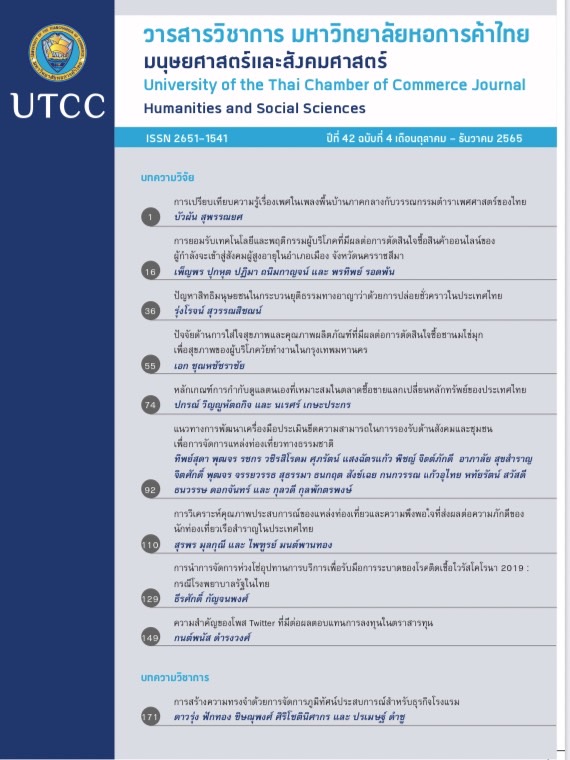
การวิเคราะห์คุณภาพประสบการณ์ของ แหล่งท่องเที่ยวและความพึงพอใจที่ส่งผลต่อ ความภักดีของนักท่องเที่ยวเรือสำราญ ในประเทศไทย
Article Sidebar
Main Article Content
บทคัดย่อ
การศึกษาครั้งนี้มีวัตถุประสงค์เพื่อวิเคราะห์คุณภาพประสบการณ์ของแหล่งท่องเที่ยวที่ส่งผลต่อ ความพึงพอใจและความภักดีของนักท่องเที่ยวเรือสำราญในประเทศไทย เก็บข้อมูลที่ท่าเรือสำราญในพื้นที่ภาคใต้ของประเทศไทยซึ่งประกอบด้วย ท่าเรือภูเก็ตและท่าเรือสมุย โดยมีกลุ่มตัวอย่างจำนวน 440 คน และใช้การสุ่มตัวอย่างแบบเฉพาะเจาะจง เครื่องมือที่ใช้ในการวิจัย คือแบบสอบถาม โดยการวิเคราะห์ข้อมูลด้วยการวิเคราะห์องค์ประกอบเชิงยืนยัน (CFA) และการวิเคราะห์สมการเชิงโครงสร้าง (SEM) ทั้งนี้การวิเคราะห์สมการเชิงโครงสร้างใช้ในการวิเคราะห์อิทธิพลระหว่างปัจจัยด้านคุณภาพปลายของแหล่งท่องเที่ยว ความพึงพอใจและความภักดี ผลการวิจัย พบว่า คุณภาพของประสบการณ์ของแหล่งท่องเที่ยวมีอิทธิพลทางบวกต่อความพึงพอใจและความภักดี ในขณะเดียวกันความพึงพอใจต่อแหล่งท่องเที่ยวมีอิทธิพลในทางบวกต่อความภักดี ดังนั้น ผู้จัดการปลายทางควรสร้างความพึงพอใจของแหล่งท่องเที่ยวให้เพิ่มมากขึ้นเพื่อสร้างความภักดีต่อแหล่งท่องเที่ยว โดยการพัฒนาแหล่งท่องเที่ยวที่หลากหลาย ปรับปรุงโครงสร้างพื้นฐานด้านการท่องเที่ยว และปรับปรุงสภาพแวดล้อมการท่องเที่ยว เช่น มาตรฐานด้านสุขอนามัยและความสะอาดของแหล่งท่องเที่ยวเพื่อเพิ่มความพึงพอใจของนักท่องเที่ยวเรือสำราญ และความภักดีต่อจุดหมายปลายทางทั้งในมิติ
ของการเดินทางมาท่องเที่ยวซ้ำในฐานะนักท่องเที่ยวทางบก รวมถึงการแนะนำเชิงบวกแก่ผู้อื่น
Article Details

อนุญาตภายใต้เงื่อนไข Creative Commons Attribution-NonCommercial-NoDerivatives 4.0 International License.
ลิขสิทธิ์ของบทความ
ผลงานที่ได้รับการตีพิมพ์ถือเป็นลิขสิทธิ์ของมหาวิทยาลัยหอการค้าไทย ห้ามมิให้นำเนื้อหา ทัศนะ หรือข้อคิดเห็นใด ๆ ของผลงานไปทำซ้ำ ดัดแปลง หรือเผยแพร่ ไม่ว่าทั้งหมดหรือบางส่วนโดยไม่ได้รับอนุญาตเป็นลายลักษณ์อักษรจากมหาวิทยาลัยหอการค้าไทยก่อน
เอกสารอ้างอิง
Anderson, J. C., & Gerbing, D. W. (1988). Structural equation modeling in practice: A review and recommended two-step approach. Psychological bulletin, 103(3), 411.
Andriotis, K., & Agiomirgianakis, G. (2010). Cruise visitors’ experience in a Mediterranean port of call. International Journal of Tourism Research, 12(4), 390-404.
Backman, S. J., & Crompton, J. L. (1991). The usefulness of selected variables for predicting activity loyalty. Leisure sciences, 13(3), 205-220.
Beerli, A., & Martin, J. D. (2004). Factors influencingdestination image. Annals of Tourism Research,31(3), 657-681.
Brida, J. G., Pulina, M., Riaño, E., & Zapata-Aguirre, S. (2012). Cruise visitors’ intention to return as land tourists and to recommend a visited destination. Anatolia, 23(3), 395-412
Chen, C.-F., & Chen, F.-S. (2010). Experience quality, perceived value, satisfaction and behavioral intentions for heritage tourists. Tourism Management, 31(1), 29-35.
Cole, S. T., & Scott, D. (2004). Examining the mediating role of experience quality in a model of tourist experiences. Journal of Travel & Tourism Marketing, 16(1), 79-90.
Crompton, J. L., & Love, L. L. (1995). The predictive validity of alternative approaches to evaluating quality of a festival. Journal of Travel Research, 34(1), 11-24.
Cruise Lines International Association. (2018a). Asia cruise trends 2018 edition. Retrieved from https://cruising.org/-/media/research-updates/research/asia-cruise-trends/asia-cruise-trends-2018.ashx
Cruise Lines International Association. (2018b, DECEMBER 13). Cruise travel trends and state of
thecruiseindustryoutlook [Press Release]. Retrievedfrom https://cruising.org/en/news-and- research/press-room/2018/december/2019-cruise-travel-trends-and-state-of-the-cruiseindustry-outlook
Cruise Lines International Association. (2020). 2020 Asia cruise deployment & capacity report. Retrieved from https://cruising.org/-/media/clia-media/research/2021/oneresource/2020-asia-cruise-deployment-and-capacity-report.ashx
Cutler, S. Q., & Carmichael, B. A. (2010). The dimensions of the tourist experience. In M Morgan, P Lugosi, & B Ritchie (Eds.), The experience of tourism and leisure: Consumer and managerial perspectives (pp. 3-26). Bristol, UK: Channel View Publications.
Feng, Y., Chen, X., & Lai, I. (2020). The effects of tourist experiential quality on perceived value and satisfaction with bed and breakfast stays in southwestern China. Journal of Hospitality and Tourism Insights, 4(1), 121-135. doi: 10.1108/jhti-02-2020-0015
Hair, J. F., Ringle, C. M., & Sarstedt, M. (2011). PLS-SEM: Indeed a silver bullet. Journal of Marketing Theory and Practice, 19(2), 139-152. doi: 10.2753/MTP1069-6679190202
Jin, N., Lee, S., & Lee, H. (2015). The effect of experience quality on perceived value, satisfaction, image and behavioral intention of water park patrons: New versus repeat visitors. International Journal of Tourism Research, 17(1), 82-95.
Kao, Y.-F., Huang, L.-S., & Wu, C.-H. (2008). Effects of theatrical elements on experiential quality and loyalty intentions for theme parks. Asia Pacific Journal of Tourism Research, 13(2),163-174.
Keller, K. L. (1993). Conceptualizing, measuring, and managing customer-based brand equity. Journal of marketing, 57(1), 1-22.
Larsen, S., Marnburg, E., & Øgaard, T. (2012). Working onboard – Job perception, organizational commitment and job satisfaction in the cruise sector. Tourism Management, 33(3), 592-597. doi: 10.1016/j.tourman.2011.06.014
Maklan, S., & Klaus, P. (2011). Customer experience: are we measuring the right things? International Journal of Market Research, 53(6), 771-772.
Meng, S.-M., Liang, G.-S., & Yang, S.-H. (2011). The relationships of cruise image, perceived value, satisfaction, and post-purchase behavioral intention on Taiwanese tourists. African Journal of Business Management, 5(1), 19-29.
Monpanthong, P. (2018). Efficiency of cruise port management: A comparison of Phuket and Singapore. Pertanika Journal of Social Sciences & Humanities, 26(4), 2787-2808.
Retrieved from http://www.pertanika.upm.edu.my/resources/files/Pertanika%20PAPERS./ JSSH%20Vol.%2026%20(4)%20Dec.%202018/38.%20JSSH-2268-2017.pdf
Morgan, M., Lugosi, P., & Ritchie, J. R. B. (2010). The tourism and leisure experience: consumer and managerial perspectives. Bristol, UK: Channel View Publications.
Petrick, J. F. (2004). First timers’ and repeaters’ perceived value. Journal of Travel Research, 43(1), 29-38
Ramseook-Munhurrun, P., Seebaluck, V. N., & Naidoo, P. (2015). Examining the structural relationships of destination image, perceived value, tourist satisfaction and loyalty: Case of Mauritius. Procedia - Social and Behavioral Sciences, 175, 252-259.
Sanz Blas, S., & Carvajal-Trujillo, E. (2014). Cruise passengers’ experiences in a Mediterranean port of call. The case study of Valencia. Ocean & Coastal Management, 102, 307-316.
Toudert, D., & Bringas-Rábago, N. L. (2016). Impact of the destination image on cruise repeater’s experience and intention at the visited port of call. Ocean & Coastal Management, 130,239-249.
Westbrook, R. A. (1980). A rating scale for measuring product/service satisfaction. Journal of marketing, 44(4), 68-72.
Wu, H.-C., Li, M.-Y., & Li, T. (2018). A study of experiential quality, experiential value, experiential satisfaction, theme park image, and revisit intention. Journal of hospitality & tourismresearch, 42(1), 26-73
Yeo, G. T., Thai, V. V., & Roh, S. Y. (2015). An analysis of port service quality and customer satisfaction: The case of Korean container ports. The Asian Journal of Shipping and Logistics, 31(4), 437-447.
Yoon, Y., & Uysal, M. (2005). An examination of the effects of motivation and satisfaction on destination loyalty: a structural model. Tomodel. Tourism Management, 26(1), 45-56
