
A Development of Computational Thinking Enhancement Curriculum Using Situation-Based Learning for Pre-service Teachers
Article Sidebar
Main Article Content
Abstract
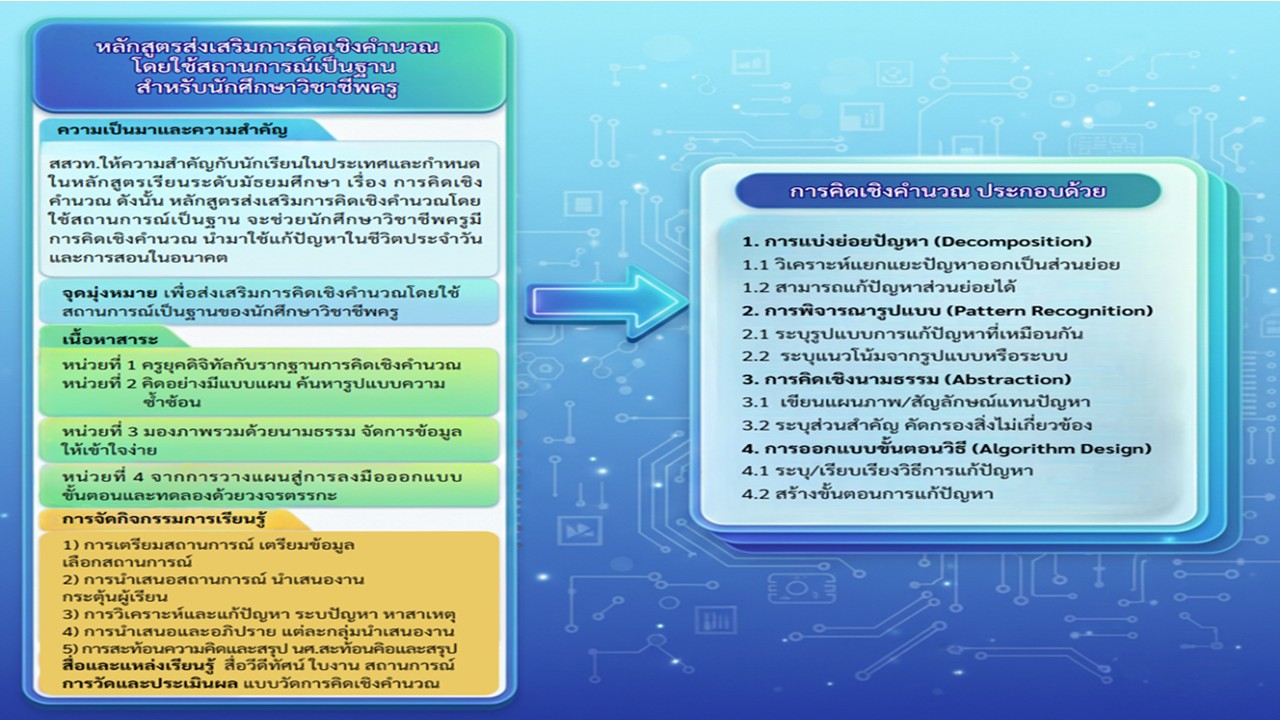
The purposes of this research were: (1) to develop and examine the quality of a computational thinking enhancement curriculum based on scenario-based learning for pre-service teachers, and (2) to study the effects of implementing the computational thinking enhancement curriculum based on scenario-based learning for pre-service teachers. This study employed a preliminary experimental research design with a one-group pretest–posttest. The sample consisted of 30 first-year students majoring in Thai Language in the Faculty of Education at Lampang Rajabhat University, during the second semester of the 2025 academic year. The participants were selected using cluster random sampling. The research instruments included the curriculum, a curriculum implementation manual, and a computational thinking assessment. Data were analyzed using descriptive statistics, including percentages, means, and standard deviations, as well as a dependent samples t-test. The research findings revealed that: The computational thinking enhancement curriculum based on scenario-based learning for pre-service teachers comprised six components: (1) background and rationale of the curriculum, (2) objectives of the curriculum, (3) curriculum structure and content consisting of four learning units: Unit 1 Digital Teachers and the Foundations of Computational Thinking; Unit 2 Systematic Thinking and Pattern Recognition through Repetition; Unit 3 Abstraction for Big-Picture Thinking and Simplified Data Management; and Unit 4 From Planning to Action: Algorithm Design and Practice with Logic Circuits; (4) learning management, (5) instructional media and learning resources, and (6) measurement and evaluation. Overall, the curriculum and its implementation manual were rated highly appropriate. Students who learned through the computational thinking enhancement curriculum based on scenario-based learning demonstrated significantly higher computational thinking skills after instruction than before instruction at the .05 level of statistical significance.
Keywords: Curriculum Development, Computational Thinking, Scenario-Based Learning
Article Details

This work is licensed under a Creative Commons Attribution-NonCommercial-NoDerivatives 4.0 International License.
References
กระทรวงศึกษาธิการ (2560). แผนการศึกษาแห่งชาติ พ.ศ. 2560–2579. กรุงเทพฯ: สำนักงาน
เลขาธิการสภาการศึกษา.
จิตสุภา กิติผดุง. (2564). การจัดการเรียนรู้โดยใช้สถานการณ์จำลองเพื่อพัฒนาทักษะการคิดและการตัดสินใจ
ของผู้เรียน. กรุงเทพฯ: สำนักพิมพ์แห่งจุฬาลงกรณ์มหาวิทยาลัย.
จิตสุภา กิติผดุง. (2564). การพัฒนาการเรียนรู้โดยใช้สถานการณ์เป็นฐาน. วารสารวิจัยทางการศึกษา, 34(1),
–115.
จุฑารัตน์ จันทร์งิ้ว, และจักรกฤษณ์ จันทะคุณ. (2567). การพัฒนากิจกรรมการเรียนรู้โดยใช้เกมเป็นฐาน
ร่วมกับ Micro: bit เพื่อส่งเสริมทักษะการคิดเชิงคำนวณ สำหรับนักเรียนชั้นมัธยมศึกษาปีที่ 1 โรงเรียนป่าไม้อุทิศ 4. วารสารบัณฑิตวิจัย, 15(1), 39–52
ทิศนา แขมณี. (2561). ศาสตร์การสอน: องค์ความรู้เพื่อการจัดกระบวนการเรียนรู้ที่มีประสิทธิภาพ (พิมพ์ครั้ง
ที่ 21). กรุงเทพฯ: สำนักพิมพ์แห่งจุฬาลงกรณ์มหาวิทยาลัย.
ปกรณ์ ประจันบาน. (2552). การวัดและประเมินผลการศึกษา. กรุงเทพฯ: สำนักพิมพ์จุฬาลงกรณ์มหาวิทยาลัย.
ปราโมทย์ พรหมขันธ์, และคณะ. (2565). การพัฒนากิจกรรมการเรียนรู้เพื่อส่งเสริมการคิดเชิงคำนวณสำหรับ
นักศึกษาวิชาชีพครู. วารสารศึกษาศาสตร์, 16(2), 89–105.
พัชรพล จองเฉลิมชัย. (2567). การจัดการเรียนรู้เพื่อพัฒนาทักษะการคิดเชิงคำนวณของนักศึกษาครูใน
ศตวรรษที่ 21. วารสารครุศาสตร์, 54(1), 112–128.
วัชรพัฒน์ ศรีคำเวียง. (2561). การคิดเชิงคำนวณกับการจัดการเรียนรู้ในศตวรรษที่ 21. วารสารวิชาการ
ศึกษาศาสตร์, 12(3), 15–28.
สมเกียรติ อินทสิงห์. (2561). การพัฒนาหลักสูตรการคิดสำหรับการเรียนรู้ในศตวรรษที่ 21 ที่เน้นการเรียนรู้
เชิงรุกสำหรับนักศึกษาปริญญาตรี. วารสารครุศาสตร์, 46(2), 85–101.
สถาบันส่งเสริมการสอนวิทยาศาสตร์และเทคโนโลยี. (2560). แนวทางการจัดการเรียนรู้และการประเมินทักษะ
การคิดเชิงคำนวณ. กรุงเทพฯ: สถาบันส่งเสริมการสอนวิทยาศาสตร์และเทคโนโลยี.
สถาบันส่งเสริมการสอนวิทยาศาสตร์และเทคโนโลยี. (2561). คู่มือการจัดการเรียนรู้วิทยาการคำนวณ.
กรุงเทพฯ: สถาบันส่งเสริมการสอนวิทยาศาสตร์และเทคโนโลยี.
อรพรรณ สงวนศักดิ์. (2567). การพัฒนาหลักสูตรฝึกอบรมเพื่อเสริมสร้างทักษะการคิดเชิงคำนวณสำหรับ
นักศึกษาวิชาชีพครู. วารสารศึกษาศาสตร์, 18(2), 112–128.
อัญชัน เพ็งสุข. (2564). ผลของการจัดการเรียนรู้โดยใช้สถานการณ์จำลองที่มีต่อทักษะการคิดวิเคราะห์ของ
นักศึกษาครู. วารสารครุศาสตร์, 49(3), 97–113.
วรากร ศิริสิทธิ์. (2563). การจัดการเรียนรู้โดยใช้สถานการณ์เป็นฐานเพื่อพัฒนาทักษะการแก้ปัญหาของ
นักศึกษาระดับอุดมศึกษา. วารสารการศึกษา, 15(1), 55–70.
Cammarano, R. F., & Fowler, D. (1997). Using simulation-based learning environments to
enhance learner responsibility. Educational Technology Research and Development, 45(3), 23–35.
Grgurina, N., & Boulanger, F. (2022). Supporting computational thinking through scenario-
based learning environments. Journal of Educational Computing Research, 60(5), 1234–1256.
Jeng, Y. L., Wu, T. T., Huang, Y. M., Tan, Q., & Yang, S. J. H. (2023). Computational thinking in
teacher education: A systematic review. Computers & Education, 195, 104684.
Kong, S. C., Lai, M., & Sun, D. (2020). Teacher development in computational thinking: Design
and learning outcomes of programming concepts, practices, and pedagogy. Computers & Education, 151, 103872. https://doi.org/10.1016/j.compedu.2020.103872
Lave, J., & Wenger, E. (1991). Situated learning: Legitimate peripheral participation. Cambridge
University Press.
McKenna, J. (2017). Teaching computational thinking: Strategies and challenges. Journal of
Computing in Education, 4(1), 45–60.
Taba, H. (1962). Curriculum development: Theory and practice. Harcourt, Brace & World.
Wing, J. M. (2006). Computational thinking. Communications of the ACM, 49(3), 33–35.
Zitouniatis, E., Kourakli, M., & Retalis, S. (2023). Teaching computational thinking using
scenario-based learning tools. Education and Information Technologies, 28, 987–1006.
