
'Empty Legend': Local Community and Force in Identity Formation
Article Sidebar
Keywords:
-
Main Article Content
Abstract
Local legends are a narrative vehicle, often used by writers from the South as part of the plot dynamic or resituated to rouse readers. 'Tam Nan Kluang' or 'Empty Legend' by Paitoon Thanya is a short story written in the late 1980's when local rhetoric, particularly that which promotes local values and wisdom was supported by the Thai government, NGO workers, academics and local writers and poets as a new paradigm in developing Thai local communities.
Empty Legend', though locally originated , has undergone some changes as the communities have undergone conflicts, innovations, adaptations , compromises and rejection. These changes are reflected through the features of the local legends verbally passed down from generations to generations.
The story reveals the discourse of power which flows from a centralized source and the power structure which allows no room for local identities. The centralized power, through local representatives, determines and controls the policy and interests of a local community ; such as, relationships among community members and transformation of local cultures into merchandise through culture promotion programmes.
Empty Legend', though locally originated , has undergone some changes as the communities have undergone conflicts, innovations, adaptations , compromises and rejection. These changes are reflected through the features of the local legends verbally passed down from generations to generations.
The story reveals the discourse of power which flows from a centralized source and the power structure which allows no room for local identities. The centralized power, through local representatives, determines and controls the policy and interests of a local community ; such as, relationships among community members and transformation of local cultures into merchandise through culture promotion programmes.
Article Details
How to Cite
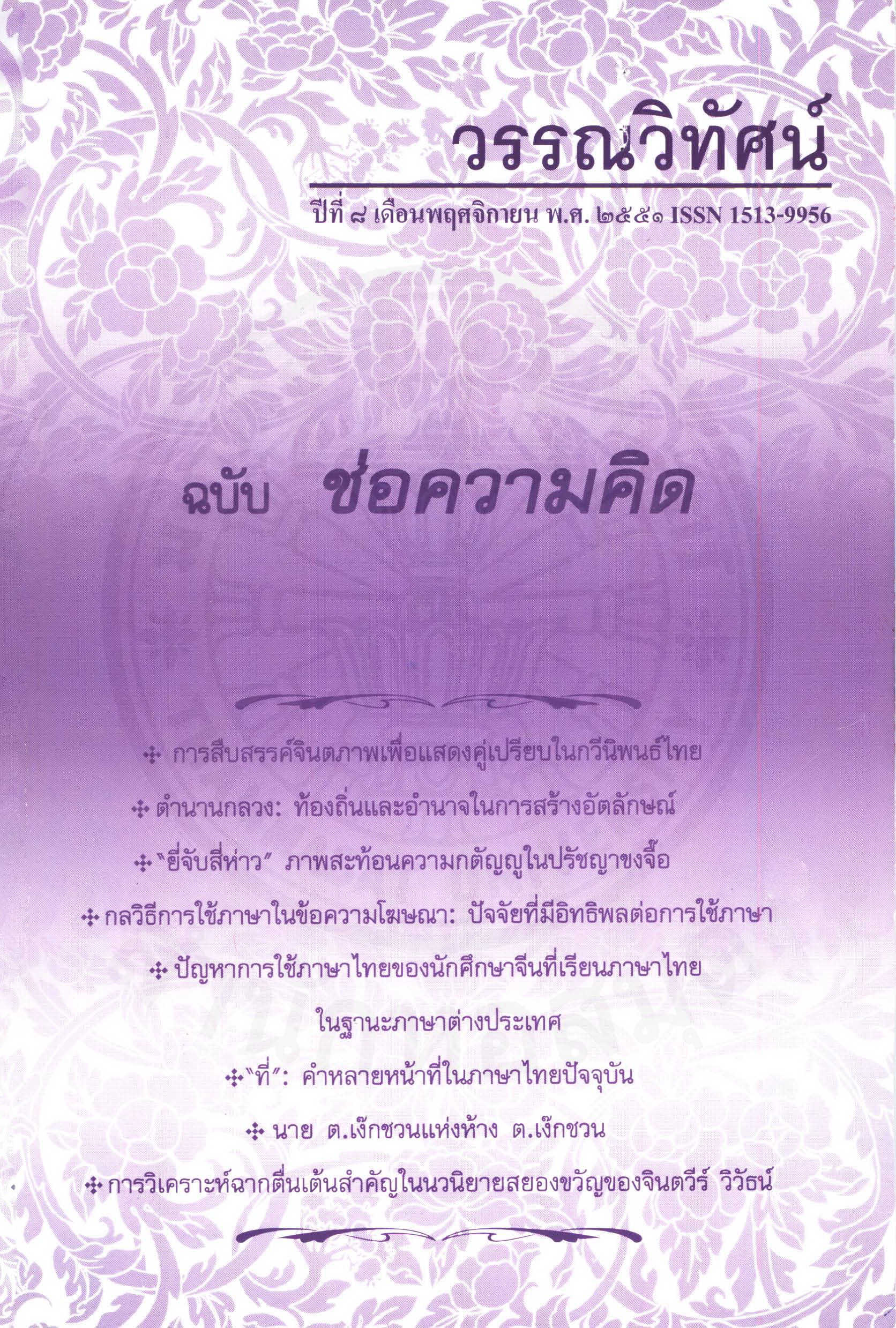
Paruchakul, W. (2016). ’Empty Legend’: Local Community and Force in Identity Formation. VANNAVIDAS, 8, 41–57. https://doi.org/10.14456/vannavidas.2008.2
Issue
Section
Articles
