
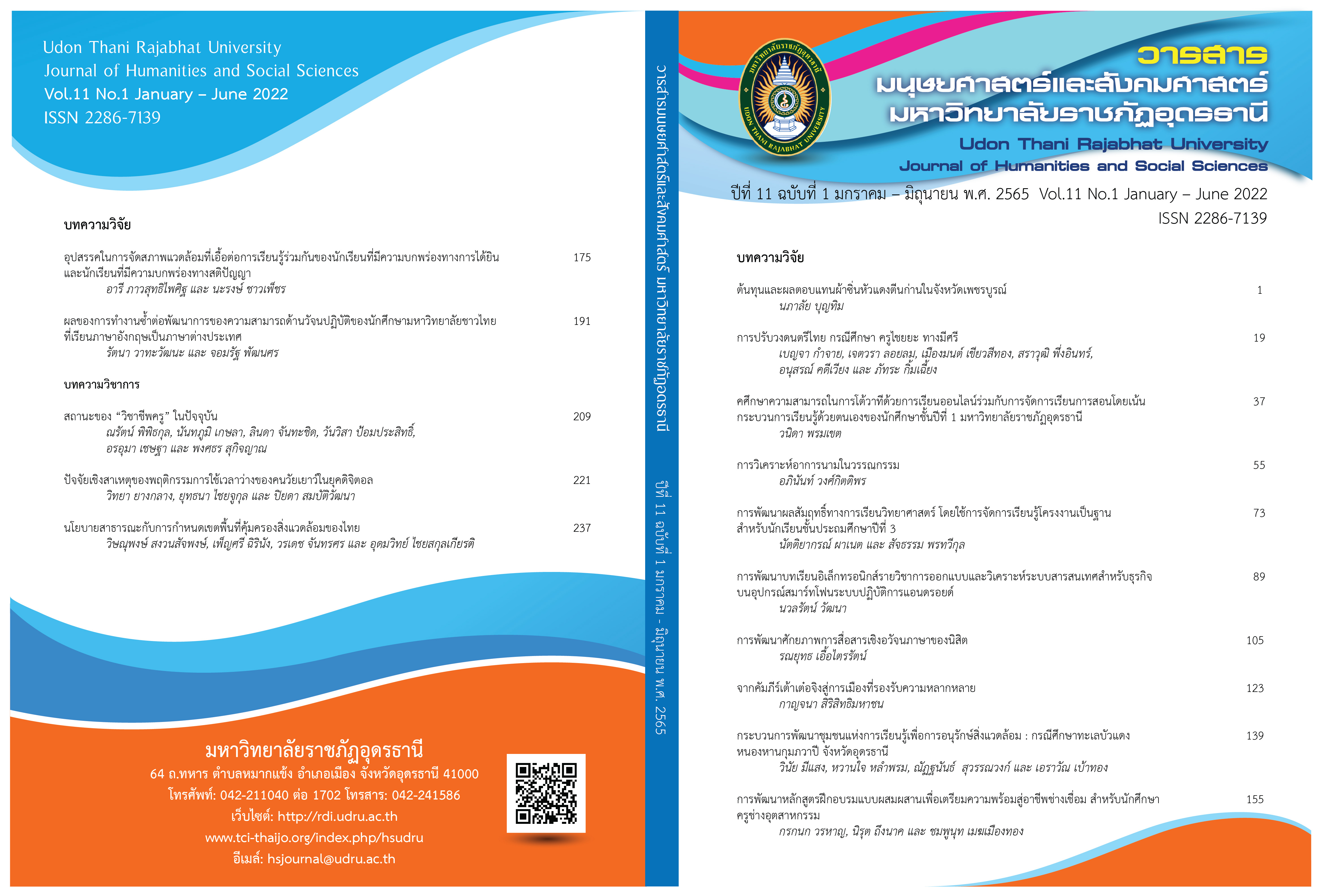
การวิเคราะห์อาการนามในวรรณกรรม
Article Sidebar
Main Article Content
บทคัดย่อ
การศึกษานี้ศึกษาเกี่ยวกับการใช้อาการนาม เช่น When I began chopping again, my axe slipped and cut off my right leg ในวรรณกรรมอังกฤษ โดยศึกษาเกี่ยวกับวิทยาหน่วยคำ โครงสร้างไวยากรณ์ ระบบอรรถศาสตร์และวจนปฎิบัติศาสตร์ งานวิจัยที่ก่อนหน้านี้ให้ความสำคัญกับการใช้อาการนามในหนังสือพิมพ์ และคลังขอมูลนานาชาติ ดังนั้นการศึกษาโครงสร้างอาการนามนี้จึงให้ความสำคัญกับตัวบทที่แตกต่างออกไป ข้อมูลการศึกษาเก็บรวบรวมมาจากวรรณกรรมที่ได้รับความนิยม คือ The Wonderful Wizard of Oz (2019) และ The Secret Garden (2021) การศึกษานี้ใช้แนวคิดภาษาศาสตร์ปริชาน คลังข้อมูลภาษาจำนวนทั้งสิ้น 200,000 คำประกอบไปด้วย 35 ตัวอย่าง การวิเคราะห์ข้อมูลโครงสร้างอาการนามทำตามแบบของ Wongkittiporn and Chitrakara (2018) ผลการศึกษาแสดงให้เห็นว่าจำนวนความถี่ของโครงสร้างอาการนามในงานวิจัยนี้เป็นผลมาจากวิธีการสร้างคำ การใช้โครงสร้างอาการนามแบ่งได้เป็นสี่ประเภทคือ ประธาน ส่วนเติมเต็มคำกริยา ส่วนเติมเต็มคำบุพบท และส่วยประกอบเพิ่มเติม ด้านอรรถศาสตร์แสดงให้เห็นว่าโครงสร้างอาการนามใช้เพื่อบ่งชี้ว่าสองเหตุการณ์เกิดขึ้นในเวลาเดียวกัน หลักการเรื่องการกำหนดและกิจกรรมเชิงกายวิภาค ในเชิงวจนปฎิบัติศาสตร์นั้น โครงสร้างอาการนามจะใช้เพื่อหลีกเลี่ยงคำซึ่งมีเสียงเดียวกันซึ่งปรากฏขึ้นซ้ำๆในบริเวณใกล้ๆกัน
Article Details
เอกสารอ้างอิง
Baum, L. F. (2019). The wonderful wizard of Oz. United Kingdom: Palazzo.
Brinton, L. J., & Traugott, E. C. (2005). Lexicalization and language change. Cambridge: Cambridge University Press.
Burnett, F. H. (2021). The secret garden. China: Thomas Nelson.
Crossley, S. A., Louwerse, M. M., McCarthy, P. M., & McNamara, D. S. (2007). A linguistic analysis of simplified and authentic texts. The Modern Language Journal, 91(1), 15-30.
Dirven, R., & Verspoor, M. (2004). Cognitive Exploration of Language and Linguistics. Amsterdam/Philadelphia: John Benjamin Publishing.
Duffley, P. J. (2000). Gerund versus infinitive as complement of transitive verbs in English: The problems of ‘tense’ and ‘control’. Journal of English Linguistics, 28(3), 221-248.
Duffley, P. J., & Arseneau, M. (2012). Tense and control interpretations in gerund participle and to- infinitive complement constructions with verbs of risk. Canadian Journal of Linguistics, 57(1), 31-50.
Emonds, J. E. (2014). Gerunds vs. infinitives in English: Not meaning but form. G. J. Bell, K. Nemcokova & B. Wojcik. In Form Theory to Practice 2013 (pp. 13-38). Zlin: Tomas Bata University Press.
Giparaite, J. & Ritčik, J. (2017). A corpus-based analysis of that-deletion in complement clauses after the verbs of saying in English and Lithuanian. Man and the World/ Foreign Language, 19(3), 48-66.
Hakin, K., Widodo, S., & Nugraheni, I. I. (2021). The analysis of gerunds in the Adventure of Sherlock Holmes. English Department Journal, 8(1), 32-38.
Heylignen, F., & Dawelel, J. (1999). Formality of language: definition, measurement and behavioral determinant. Internal Report, Center "Leo Apostel", Free University of Brussels.
Hundt, M. (2009). “Colonial lag, colonial innovation or simple language change”. In Gunter Rohdenburg & Julia Schluer (eds.) One language two grammar?: Differences between British and American. Cambridge: Cambridge University Press.
Klepousniotou, E., Debra, T., & Carolina. R. (2008). Making sense of word senses: The comprehension of polysemy depends on sense overlap. Journal of Experimental Psychology: Learning, Memory, and Cognition, 34(6), 1534-1543.
Langacker, R. R. (1994). The limit of continuity: Discreteness in Cognitive Semantics”. In C. Fuchs and B. Victorri (eds.) Continuity in Linguistic Semantics (pp. 9-20). Amsterdam/ Philadelphia: John Benjamins.
Mostafa, S. (2019). Developing the EFL advanced learners’ narrative writing skills through a unite plan strategy. CDELT Occasional Papers in the Development of English Education, 68(1), 323-356.
Muliani, S., Norahmi, M., & Asi, N. (2019). The analysis of difficulties in writing narrative text. LET: Linguistics, Literature and English Teaching Journal, 9(2), 244-264.
Radden, G., & Dirven. R. (2007). Cognitive English Grammar. Amsterdam/ Philadelphia: John Benjamin Publishing.
Radford, A. (2009). Introduction to Sentence Structure. Cambridge: Cambridge University Press.
Ross, D. (2013). Dialectal variation and diachronic development of try Complementation. Studies in Linguistic Sciences: Illinois Working Papers 2013, 108-147.
Swan, M. (2016). Practical English usage. Oxford: Oxford University Press.
Wang, D. (2014). Verbs taking “to+v” or “v+ing” as their complements: A cognitive grammar account. International Journal of Linguistics, 6(5), 143-153.
Wongkittiporn, A., & Chitrakara, N. (2018). Control Constructions in British and American English. Bulletin of the Transilvania University of Brasov, Series IV, Philology and Cultural Studies, 11(60), 19-48.
Wurmbrand, S. (2014). Tense and aspect in English infinitives. Linguistic Inquiry, 45(3), 403-447.
Yilmax, A. (2018). Form-meaning-use framework in grammar teaching: Research on Noun clauses in writing skills. Journal of Language and Linguistic Studies, 14(3), 37-55.
Yule, G. (2006). The study of language. Cambridge: Cambridge University Press.
