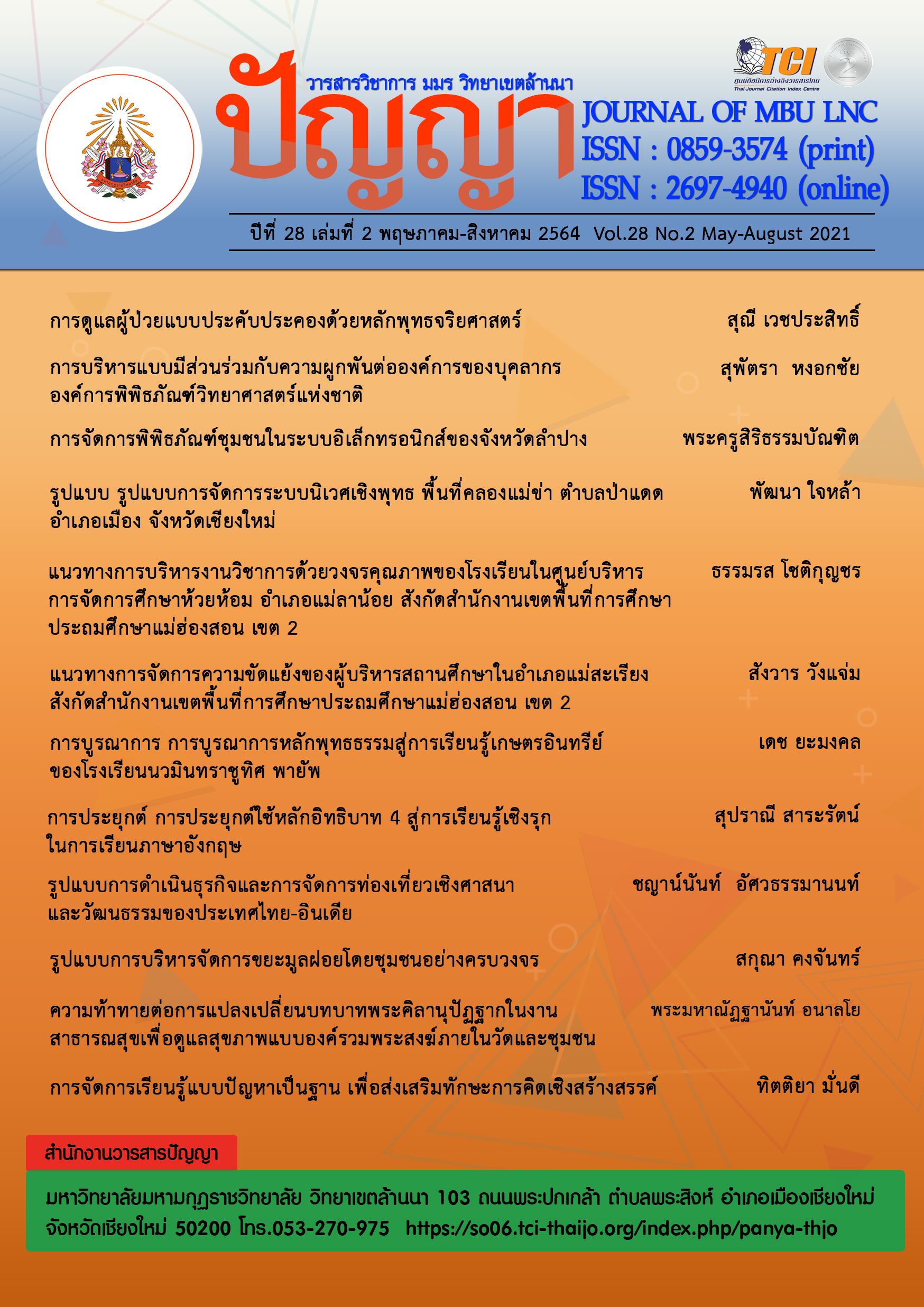
PARTICIPATIVE MANAGEMENT RELATING THE ORGANIZATIONAL COMMITMENT OF PERSONNEL OF THE NATIONAL SCIENCE MUSEUM
Keywords:
Participative management, Organizational commitment, National Science MuseumAbstract
The objectives of this research were 1) to study the opinion level of participative management factors of personnel of the National Science Museum 2) to study the opinion level of organizational commitment of personnel of the National Science Museum 3) to study the correlation between participative management factors and organizational commitment of the personnel of the National Science Museum Organization, and 4) to recommend guidelines for developing participative management factors relating the organizational commitment of personnel of the National Science Museum.
This study was a survey research. The population was 311 personnel of the National Science Museum. The sample size was determined by using Taro Yamane formula and obtained 175 samples by stratified random and simple random sampling method. The research instrument was a questionnaire. The statistics used for data analysis were frequency, percentage, mean, standard deviation and Pearson's correlation.
The results of this study revealed that 1) an overview of opinion level of participative management of the National Science Museum Organization was at high level 2) an overview of opinion level of organizational commitment of personnel of the National Science Museum was at high level. found that the personnel had good feelings about the organization this is expressed in the form of organizational attachment, both affective commitment, continuance commitment and social normative commitment 3) the participative management factors and organizational commitment of the personnel correlated positively at moderate level at statistically significant at 0.01 level, and 4) recommendation guidelines for developing participative management factors relating the organizational commitment of personnel of the National Science Museum were that there should focus and support in terms of work motivation in response to factors influencing the organizational commitment and more work efficiency.
References
ชูชาติ พ่วงสมจิตร์. (2555). ประมวลสาระชุดวิชาประสบการณ์วิชาชีพประกาศนียบัตรบัณฑิตทางบริหารการศึกษา (พิมพ์ครั้งที่ 5). นนทบุรี: มหาวิทยาลัยสุโขทัยธรรมาธิราช.
ไตรรัตน์ โภคพลากรณ์. (2554). การจัดการนวัตกรรมและการเปลี่ยนแปลง. นนทบุรี: หาวิทยาลัยสุโขทัยธรรมาธิราช.
ธนพร ธรรมโชติ. (2555). ปัจจัยด้านการบริหารแบบมีส่วนร่วมที่มีผลต่อความผูกพันต่อองค์กรของบุคลากรมหาวิทยาลัยพะเยา. พะเยา: บริหารธุรกิจมหาบัณฑิต มหาวิทยาลัยพะเยา.
ประชุม บำรุงจิตร์. (2551). ความสัมพันธ์ระหว่างการมีส่วนร่วมในการบริหารงานวิชาการกับความผูกพันต่อโรงเรียนของครู สังกัดสำนักงานเขตพื้นที่การศึกษานครนายก. (วิทยานิพนธ์ปิญญามหาบัณฑิต, : มหาวิทยาลัยราชภัฏพระนครศรีอยุธยา).
มะลิวัลย์ เหมืองทอง. (2551). ความผูกพันต่อองค์กรของบุคลากรองค์การบริหารส่วนตำบลหนองหาร ตำบลหนองหาร อำเภอสันทราย จังหวัดเชียงใหม่. เชียงใหม่: มหาวิทยาลัยแม่โจ้.
Bryman, A. (1986). Leadership and Organization. London: Rout edge & Keg an Paul.
Likert, R. (1961). New Patterns of Management. New York: McGraw-Hill.
Meyer, J. P. & Allen, N. J. (1990). The measurement and antecedents of affective, continuance and nonnative commitment to the organization. Journal of Business and Management Sciences, 4(2), 26-33.
Sashkin, M. (1982). A Manager’s Guide to Participative Management. New York: American Management Associations.
Swansburg, R. C. (1996). Management and Leadership for Nurse Management (2nd ed.). Burlington, MA: Jones & Bartlett Learning.
Yamane, T. (1973). Introductory Analysis (3rd ed.). Tokyo: Harper International Education.