
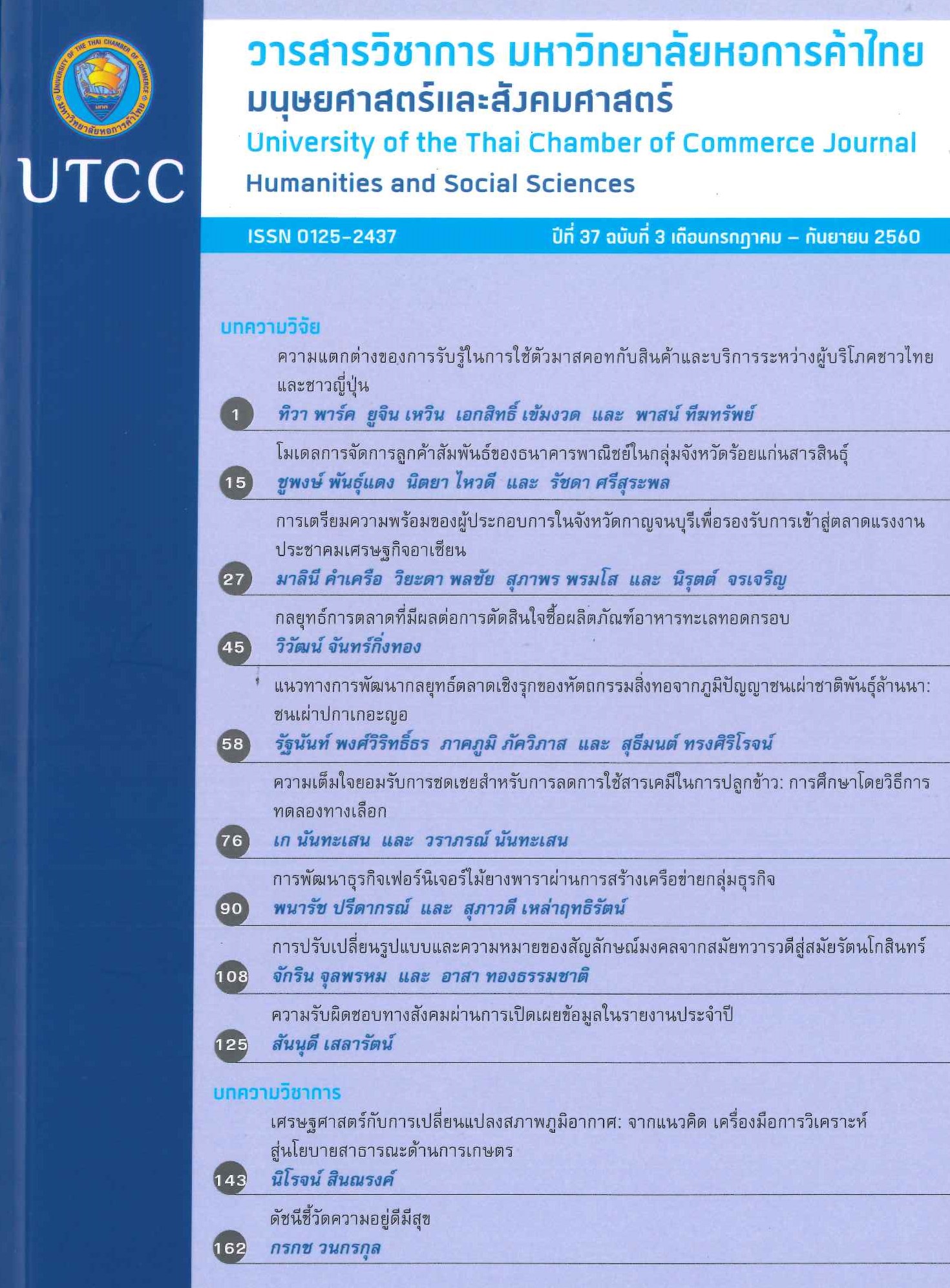
เศรษฐศาสตร์กับการเปลี่ยนแปลงสภาพภูมิอากาศ: จากแนวคิด เครื่องมือการวิเคราะห์สู่นโยบายสาธารณะด้านการเกษตร
Article Sidebar
Main Article Content
บทคัดย่อ
การเปลี่ยนแปลงสภาพภูมิอากาศ เป็นประเด็นสำคัญด้านการพัฒนาเศรษฐกิจสังคมที่กำลังได้รับความสนใจในระดับโลก โดยเฉพาะอย่่างยิ่งการวางแผนและพัฒนาเศรษฐกิจการเกษตรที่สมดุลยั่งยืนทั้งด้านเศรษฐกิจ สังคม และสิ่งแวดล้อม การศึกษานี้มีวัตถุประสงค์เพื่อทบทวนกรอบความคิดเกี่ยวกับการเปลี่ยนแปลงสภาพภูมิอากาศ การประยุกต์เครื่องมือทางเศรษฐมิติสำหรับการวิเคราะห์ผลกระทบการเปลี่ยนแปลงสภาพภูมิอากาศต่อการผลิตทางการเกษตรและกรอบนโยบายสาธารณะด้านการเกษตร ทั้งนี้ เศรษฐมิติประยุกต์นับเป็นเครื่องมือหนึ่งทางเศรษฐศาสตร์ที่สามารถประเมินผลกระทบของการเปลี่ยนแปลงสภาพภูมิอากาศต่อการผลิตทางเกษตร เพื่อใช้เป็นข้อมูลเชิงประจักษํประกอบการวางนโยบายการเกษตร โดยกรอบนโยบายต้องครอบคลุมการสร้างความตระหนักรู้ถึงความสำคัญของสภาพอากาศกับการผลิตทางการเกษตร การลดการปล่อยก๊าซเรือนกระจก และการปรับตัวเพื่อลดผลกระทบจากการเปลี่ยนแปลงสภาพภูมิอากาศในอนาคต ซึ่งต้องอาศัยความร่วมมือจากทุกภาคส่วนของสังคม ตั้งแต่ระดับชาติจนถึงระดับท้องถิ่น เพื่อให้การปรับตัวได้รับการพิจารณาให้เป็นองค์ประกอบที่สำคัญของยุทธศาสตร์การพัฒนาการเกษตรอย่างยั่งยืนภายใต้บริบทการเปลี่ยนแปลงสภาพภูมิอากาศ
Article Details
ลิขสิทธิ์ของบทความ
ผลงานที่ได้รับการตีพิมพ์ถือเป็นลิขสิทธิ์ของมหาวิทยาลัยหอการค้าไทย ห้ามมิให้นำเนื้อหา ทัศนะ หรือข้อคิดเห็นใด ๆ ของผลงานไปทำซ้ำ ดัดแปลง หรือเผยแพร่ ไม่ว่าทั้งหมดหรือบางส่วนโดยไม่ได้รับอนุญาตเป็นลายลักษณ์อักษรจากมหาวิทยาลัยหอการค้าไทยก่อน
เอกสารอ้างอิง
Antle, J.M. (2010). Asymmetry, partial moments, and production risk. American Journal of Agricultural Economics, 92(5), 1294-1309.
Asian Development Bank.(2009).Economics of climate change in Southeast Asia:A regional review. Manila, Philippines: Author.
Buddhaboon, C., Kongton, S., & Jintrawet, A.(2005). Climate scenario verification and impact on rain- fed rice production: The study of future climate changes impact on water resource and rain-fed agriculture production. In proceedings of the APN CAPable CB-01 synthesis workshop (pp.51-78). Bangkok, Thailand: Southeast Asia START Regional Center.
Cabas, J., Weersink, A., & Olale, E.(2010). Crop yield response to economic, site and climatic variables. Climatic Change,101(3-4), 559-616.
Chareinkitjarukorn, P.(2013). Green productivity and sustainability reporting guidelines.University of the Thai Chamber of Commerce Journal, 33(1), 189-214.(in Thai).
Chen, C.C., McCarl, B.A., & Schimmelpfennig, D.E.(2004). Yield variability as influenced by climate: A statistical investigation.Climatic Change, 66(1-2), 239-261.
Chithaisong, A.(2010). Thailand climate change information: Vol. 2. Bangkok,Thailand:Thailand Research Fund. (in Thai).
Demeke, A.B., Keil, A., & Zeller, M.(2011).Using panel data to estimate the effect of rainfall shocks on smallholders food security and vulnerability in rural Ethiopia. Climatic Change, 108(1-2), 185-206.
Di Falco, S.,& Chavas, J.P. (2009). crop biodiversity, risk exposure, and food security in the highlands of Ethiopia. American Journal of Agricultural Economics, 91(3), 599-611.
Intergovernmental Panel on Climate change 2007: Synthesis report. Geneva, Switzerland: Author.
Intergovernmental Panel on Climate change 2014: Synthesis report. Geneva, Switzerland: Author.
Isik, M.,& Devadoss, S.(2006). An analysis of the impact of climate change on crop yields and yield variability. Applied Economics, 38(7), 835-844.
Isvilanoda,S., Pranitwattakul, S., & Kumwong, C. (2009). Economic impact assessment of climate change on rice production in Thailand. Bangkok, Thailand: Thailand Research Fund. (in Thai).
Jones, A.D. (2011). An analysis of stochastic maize production functions (Unpublished master's thesis). University of Arkansas.
Judge, G.G., Griffiths, W.E., Hill, R.C.,LÜtkepohl, H., & Lee, T.-C.(1985). The theory and practice of econometrics. (2nd ed.). New York, NY:Wiley.
Just, R.E., & Pope, R.D. (1979). Production function estimation and related risk considerations. American Journal of Agricultural Economics, 61(2), 276-284.
Keeranan, T. (1981). Applied regression analysis for empirical research. Retrieved May 25,2016, from http://www.econ.chula.ac.th/public/publication/dp/1981/dp2407.pdf( in Thai)
Kerdreuang, A. (2015). Cost-effectiveness analysis for public policy evaluation. University of the Thai Chamber of Commerce Journal, 35(2), 174- 184. (in Thai).
Kongthon, S., Sornrawat, W., & Rattanasriwong, S. (2004). Impacts of global warming on rice, sugarcane, cassava, and maize production in Northeast Thailand: A study of Khonkan Province. Retrieved June10, 2016, from http://www.seaclimatechange.org/Content/Document/Paper_T/SEA%20START%20RC_Doc_001T_2004.pdf (in Thai).
Lasco, R.D., Habito, C.M.D., Delfino, R.J.P., Pulhin, F.B., & Concepcion, R.N. (2011). Climate change adaptation for smallholder farmers in Southeast Asia. Manila, Philippines: World Agroforestry Centre.
Matthews, R.B., Kropff, M.J., Horie, T., & Bachelet, D. 1997. Simulating the Impact of climate change on rice production in Asia and evaluation option for adaptation. Agricultural Systems, 54 (3), 399-425.
McCarl, B.A., Villavicencio, X., & Wu, X. 2008. Climate change and future analysis: Is stationarity dying? American Journal of Agricultural Economics, 90(5),1241-1247.
Office of Natural Resources and Environmental Policy and Planning. (2010). National master plan on climate change 2010-2019. Bangkok, Thailand: Author.(in Thai).
Pannangpetch,K., Sarawat, V., Boonpradub, S.,S., ...Damrikhemtrakul, W.(2009). Impacts of global warming on rice, sugarcane,Thailand. Bangkok, Thailand: Thailand Research Fund. (in Thai).
Saha, A., Havenner, A., & Talpaz, H. (1997). Stochastic production estimation: Small sample properties of MLE Versus FGLS. Applied Economics 29: 459-469.
Selvaraju, R., Gommes, R., & Bernadi, M. (2011). Climate science in support of sustainable agriculture and food security. Climate Research, 47(1-2), 95-110.
Shankar, B., Bennett, R., & Morse, S. (2007). Output risk aspects of geneticaly modified crop technology in South Africa. Economics of Innovation and New Technology, 16(4), 277-291.
