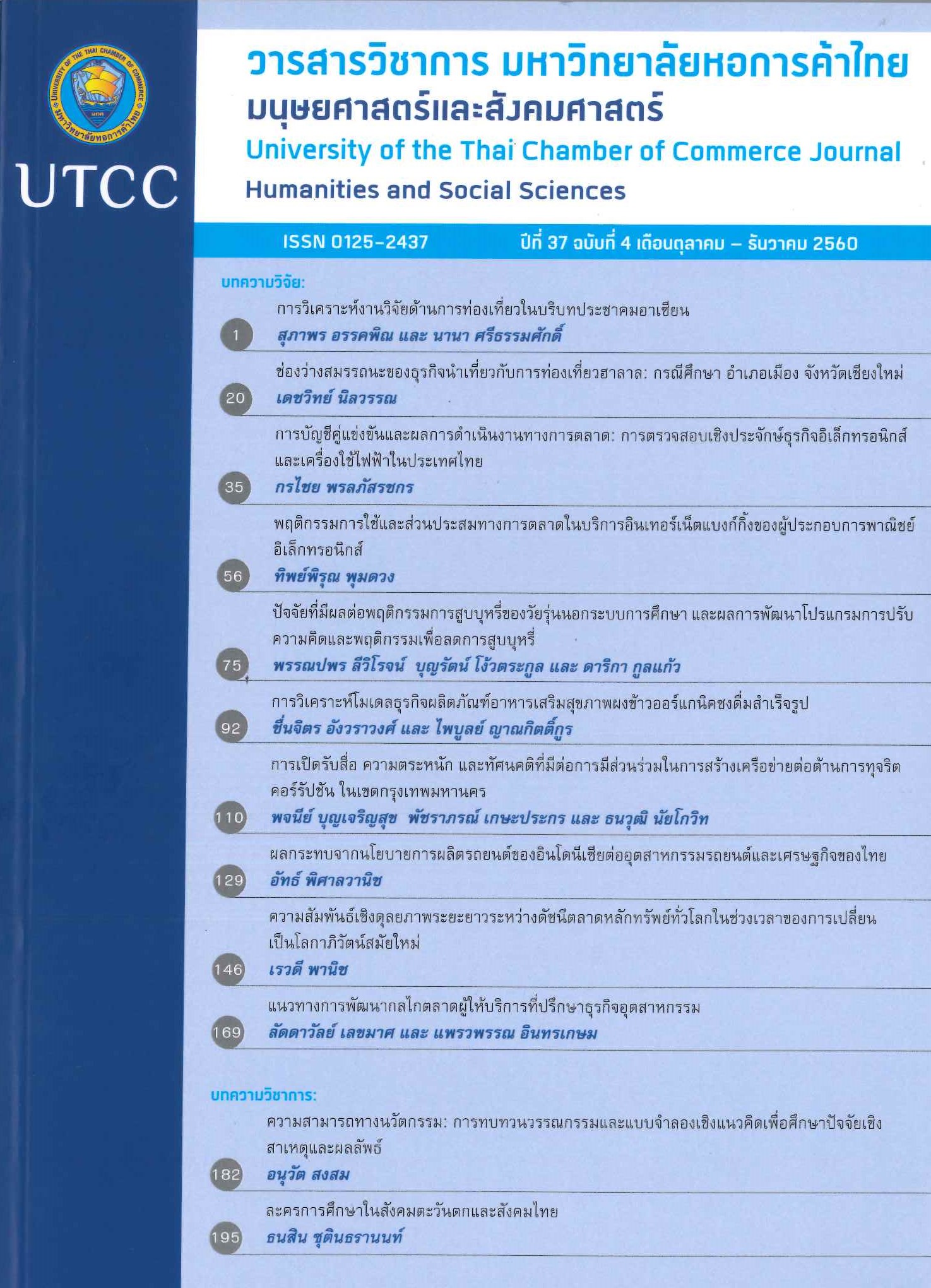
การวิเคราะห์โมเดลธุรกิจผลิตภัณฑ์อาหารเสริมสุขภาพผงข้าวออร์แกนิคชงดื่มสำเร็จรูป
Article Sidebar
Main Article Content
บทคัดย่อ
บทความนี้มีวัตถุประสงค์เพื่อศึกษาและวิเคราะห์โมเดลธุรกิจผลิตภัณฑ์ผงข้าวออร์แกนิคชงดื่มสำเร็จรูปโดยศึกษาและพัฒนาแนวคิดด้านผลิตภัณฑ์ของอาหารเสริมสุขภาพที่ผลิตจากปลายข้าวและผลพลอยได้ของข้าวหอมมะลิอินทรีย์ ในการพัฒนาโมเดลธุรกิจผู้วิจัยประยุกต์ใช้กรอบแนวคิดของโมเดลธุรกิจคานวาส(Business Model Canvas) โดยออกแบบวิจัยเป็นแบบผสมผสานวิจัยเชิงคุณภาพและเชิงปริมาณจากนั้นจึงนำมาวิเคราะห์โมเดลธุรกิจสำหรับผลิตภัณฑ์ใหม่ทั้ง 9 ด้าน คือ 1. กำหนดกลุ่มเป้าหมาย (Customer Segments) 2. คุณค่าของสินค้า( value proposition) 3.ช่องทางในการสื่อสารและจัดจำหน่าย (Channels) 4. ทรัพยากรที่จำเป็นและสำคัญ (Key Resources) 5. กิจกรรมหลักที่สำคัญ (Key Activities) 6. การสร้างหุ้นส่วนทางธุรกิจ(Key Partnerships) 7. การสร้างความสัมพันธ์ของลูกค้า(Customer Relationships) 8.รายได้ของผลิตภัณฑ์ (revenue streams) และ 9. โครงสร้างด้านต้นทุน (cost structure) ผลสรุปจากการศึกษาพบว่าผลิตภัณฑ์ ผงข้าวออร์นิคชงดื่มสำเร็จรูปเป็นผลิตภัณฑ์ที่มีความน่าสนใจในการพัฒนาไปสู่การผลิตเพื่อทดลองตลาด เนื่องจากจุดเด่นของผลิตภัณฑ์ มาจากวัตถุดิบในการผลิต คือ ปลายข้าวและผลพลอยได้ของข้าวอินทรีย์ เป็นวัตถุดิบที่ปลอดสารพิษเป็นมิตรต่อสิ่งแวดล้อม ทำให้ได้ผลิตภัณฑ์ที่ดีต่อสุขภาพของผู้บริโภค และสามารถเพิ่มรายได้ให้แก่เกษตรกรผู้ผลิตข้าวอินทรีย์จากการขายวัตถุดิบในการผลิตให้ได้ราคาสูงขึ้นจากการนำไปแปรรูป
Article Details
ลิขสิทธิ์ของบทความ
ผลงานที่ได้รับการตีพิมพ์ถือเป็นลิขสิทธิ์ของมหาวิทยาลัยหอการค้าไทย ห้ามมิให้นำเนื้อหา ทัศนะ หรือข้อคิดเห็นใด ๆ ของผลงานไปทำซ้ำ ดัดแปลง หรือเผยแพร่ ไม่ว่าทั้งหมดหรือบางส่วนโดยไม่ได้รับอนุญาตเป็นลายลักษณ์อักษรจากมหาวิทยาลัยหอการค้าไทยก่อน
เอกสารอ้างอิง
Retrieved from https://www.hec.unil.ch/ aosterwa/PhD/Osterwalder_PhD_BM_Ontology.pdf
Ampuero, O., & Vila, N. (2006). Consumer perceptions of product packaging. Journal of Consumer Marketing, 23, 100-112.
Armstrong, G., & Kotler, P. (2007). Marketing: An introduction (8th ed.). Upper Saddle River, NJ: Pearson Education.
Azila Mohd Noor, N., Yap, S.-F., Liew, K.-H., & Rajah, E. (2014). Consumer attitudes toward dietary supplements consumption: Implications for pharmaceutical marketing. International Journal of Pharmaceutical and Healthcare Marketing, 8, 6-26.
Azzurra, A., & Paola, P. (2009). Consumers’ behaviours and attitudes toward healthy food products: The case of organic and functional foods. In The AAE seminar resilient European food industry and food chain in a challenging world (pp. 3-6). Chania, Greece: n.p.
Bank of Thailand. (2014). Thai agricultural products reported 2013-2014. Retrieved January 15, 2016, from https://bot.or.th (in Thai).
Charles, M. F., & Suzy, W. (1996). The ways chief executive officers lead. Harvard Business Review. Retrieved from https://hbr.org/1996/05/the-ways-chiefexecutive-officers-lead
David, J. T. (2010). Business models, business strategy and innovation. Long Range Planning, 43, 172-194.
Department of Provincial Administration, Office of the Federal Register. (2015). The number of people throughout the kingdom:Separate Bangkok and other provinces. Retrieved December 18, 2015, from https://ratchakitcha.soc.go.th/DATA/PDF/2558/E/049/11.PDF (in Thai).
Eamlaorpakdee, P. (2012). The value chain development of rice products. University of the Thai Chamber of Commerce Journal, 32(2), 120-128. (in Thai).
Ewa, H. (2012). Health and wellness the trillion dollar industry in 2017: Key research highlights. Retrieved January 12, 2016, from https://blog.euromonitor.com/2012/11/ health-and-wellness-the-trillion-dollarindustry-in-2017-key-research-highlights.html
George, D. (2016). 37 creative employee reward ideas (2016 update). Retrieved January 22, 2016, from https://blog.bonus.ly/15- creative-employee-reward-ideas/
Green Net Cooprative. (2014). The organic Thailand 2013-2014. Retrieved January 10, 2016, from https://www.greennet.or.th/article/411 (in Thai).
Heidi, M. B., Peter, A. K., & Ian, E. (2015). Business models outside the core lessons learned from success and failure. Research -Technology Management, 58(2), 20-29.
Jaroenwanit, P., Tongsokhowong, A., & Brahmasakha Na Sakolnakor, P. (2011). Product development and market testing for commercialization of OTOP in the northern region of Northeastern Thailand: Case study of non food and medicine products. Khonkaen, Thailand: Khonkaen University. (in Thai).
John, A. C., & Roger, A. K. (2009). Competitor analysis. Retrieved June 5, 2016, from https://pages.stern.nyu.edu/~jczepiel/Publications/CompetitorAnalysis.pdf
John, B. (2008). Core concepts of marketing. Retrieved January 18, 2016, from https://www.saylor.org/site/wp-content/uploads/2012/11/Core-Concepts-of-Marketing.pdf
Jonides, J. (2000). Notices and announcements. Psychobiology, 28 (4), 593-594.
Kapsak, W. R., Rahavi, E. B., Childs, N. M., & White, C. (2011). Functional foods: Consumer attitudes, perceptions, and behaviors in a growing market. Journal of the American Dietetic Association, 111,804-810.
Katenil, N. (2014). The behavior and attitude of consumers to health-food products in Thailand. Retrieved December 12, 2015, from https://fic.nfi.or.th/broadcast/TMK-Jan2014-FICOIE.pdf (in Thai).
Kotler, P. (2014). Kotler on marketing: How to create, win, and dominate markets. New York, NY: Free Press.
Kotler, P., & Keller, K. L. (2009). Marketing management. Retrieved from https://socioline.ru/files/5/283/kotler_keller_-_marketing_management_14th_edition.pdf
Lamphao, C. (2013). The study of attitude, perception and behavior on Korean trends (Unpublished master’s thesis). National Institute of Development Administration, Bangkok, Thailand. (in Thai).
Land Development Department. (2015). Database farmers use renewable organic chemicals. Retrieved January 2, 2016, from https://www.o-agriculture.ldd.go.th/ ldd/memBioNotReadyGroup.aspx (in Thai).
Lee, H.-J., & Yun, Z.-S. (2015). Consumers’ perceptions of organic food attributes and cognitive and affective attitudes as determinants of their purchase intentions
toward organic food. Food Quality and Preference, 39, 259-267.
Leelamanit, W. (2014). Using vitamins and supplements in the elderly. Retrieved December 25, 2015, from https://www.pharmacy.mahidol.ac.th/knowledge/files/0253.pdf (in Thai).
Office of the National Economic and Social Development Board. (2016). Economic and social statistics: The number of elderly in Thailand (1990-2040). Retrieved March 18, 2016, from https://social.nesdb.go.th/SocialStat/StatReport_Final.aspx?reportid (in Thai).
Reinhard, M., & Volker, S. (2015). Strategic product value management: How companies can improve innovation, reduce costs and mitigate risk. Retrieved January 12, 2016, from https://www.strategyand.pwc.com/reports/strategicproduct-value-management
Singhirannusorn, C., & Arloonmaung, A. (2013). Dietary supplement product consumption behavior of secondary school students under Supervision Region 2 of Ministry of Public Health. FDA Journal, 20(1),38-47. (in Thai).
Tongwassanasong, N. (2016). Buying decision process of non-alcoholic beverage in modern trade store of consumers in the Nonthaburi province. University of the Thai Chamber of Commerce Journal, 36(2), 99-106. (in Thai).
United Nations. (2015). World population prospects: The 2015 revision. Retrieved March 14, 2016, from https://esa.un.org/unpd/wpp/publications/.../WPP2015_DataBooklet.pdf
Willer, H., & Lernoud, J. (2014). Organic argriculture worldwide: Current statistics. Retrieved January 12, 2016, from https://www.fibl.org/fileadmin/.../de/.../2014/willer2014-global-data.pdf
World Health Organization. (2014). World health statistics. Retrieved January 12, 2016, from https://apps.who.int/iris/bitstream/10665/..112738/1/9789240692671_eng.pdf
Zhenya, L., Martin R., George S., & Martin, S. D. (2009). Business model innovation. Retrieved January 2, 2016, from https://www.bcg.com/documents/file36456.pdf
