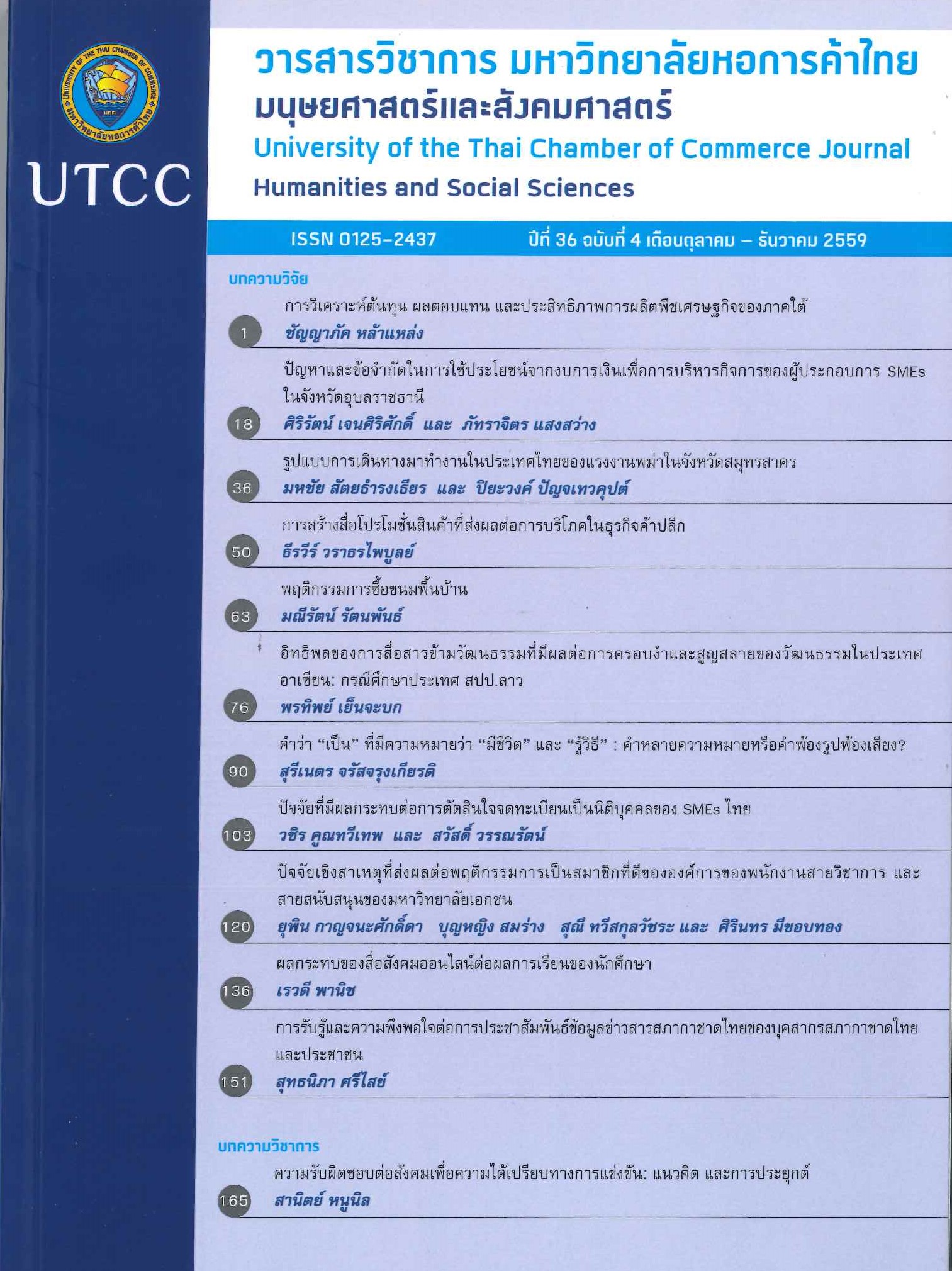
ความรับผิดชอบต่อสังคมเพื่อความได้เปรียบทางการแข่งขัน: แนวคิด และการประยุกต์
Article Sidebar
Main Article Content
บทคัดย่อ
เนื่องจากการแข่งขันทางธุรกิจที่รุนแรงในปัจจุบัน การเปลี่ยนแปลงพฤติกรรมของผู้บริโภค รวมทั้งการตระหนักถึงปัญหาด้านสังคมและสิ่งแวดล้อมมากขึ้นของผู้มีส่วนได้ส่วนเสียกลุ่มต่าง ๆ ส่งผลให้องค์กรธุรกิจต้องแสวงหากลยุทธ์ใหม่ ๆ เพื่อการสร้างความได้เปรียบทางการแข่งขัน ความรับผิดชอบต่อสังคมถือเป็นอีกกลยุทธ์หนึ่งที่ถูกนำมาใช้ในการสร้างความได้เปรียบทางการแข่งขันให้กับองค์กร เนื่องจากการดำเนินงานด้านความรับผิดชอบต่อสังคมจะสร้างให้เกิดความสัมพันธ์ที่ดีระหว่างองค์กรกับผู้มีส่วนได้ส่วนเสียกลุ่มต่างๆ อันจะส่งผลกระทบเชิงบวกต่อองค์กร อาทิ ความพึงพอใจของลูกค้า ความผูกพันต่อองค์กรของพนักงาน ความสัมพันธ์ที่ดีกับชุมชน รวมทั้งช่วยประหยัดต้นทุนการดำเนินงานขององค์กรในระยะยาว และสร้างให้เกิดการพัฒนาที่ยั่งยืน
Article Details
ลิขสิทธิ์ของบทความ
ผลงานที่ได้รับการตีพิมพ์ถือเป็นลิขสิทธิ์ของมหาวิทยาลัยหอการค้าไทย ห้ามมิให้นำเนื้อหา ทัศนะ หรือข้อคิดเห็นใด ๆ ของผลงานไปทำซ้ำ ดัดแปลง หรือเผยแพร่ ไม่ว่าทั้งหมดหรือบางส่วนโดยไม่ได้รับอนุญาตเป็นลายลักษณ์อักษรจากมหาวิทยาลัยหอการค้าไทยก่อน
เอกสารอ้างอิง
Computer Firms, 1945-2000.” European Management Journal 22,5: 517-531.
Baker, M. 2015. Corporate Social Responsibilities - What does it mean? [Online].Available: http://www.mallenbaker.net/csr/definition.php
Barney, J. B. 1991. “Firm Resource and Sustained Competitive Advantage.” Journal of Management 17,1: 99-120.
Baron, D. P. 2001. “Private politics, Corporate Social Responsibility and Integrated Strategy.” Journal of Economics and Management Strategy 10,1: 7-45.
Bhattacharyya, S. S. 2010. “Exploring the Concept of Strategic Corporate Social Responsibility for an Integrated Perspective.” European Business Review 22,1: 82-102.
Carroll, A. B. 1979. “A Three-Dimensional Conceptual Model of Corporate Performance.” Academy of Management Review 4,4: 497-505.
Carroll, A. B. 1991. “The Pyramid of Corporate Social Responsibility: Toward the Moral Management of Organizational Stakeholders.” Business Horizon 34,4: 39-48.
Dahlsrud, A. 2006. “How Corporate Social Responsibility is Defined: An Analysis of 37 Definitions.” Corporate Social Responsibility and Environment Management 15,1: 1-13.
Danthamrongkul, W. 2003. Management. Bangkok: Thirdwave Education. (in Thai).
วิทยา ด่านธำรงกูล. 2546. การบริหาร. กรุงเทพมหานคร: เธิร์ดเวฟ เอ็ดดูเคชั่น.
Du, S., Bhattacharya, C. B., and Sen, S. 2007. “Reaping Relational Rewards from Corporate Social Responsibility: the Role of Competitive Positioning.” International Journal of
Research in Marketing 24,3: 224-241.
European Commission. 2015. What is CSR? [Online]. Available: http://ec.europa.eu/social/main.jsp?catId=331
Frey, M., et al. 2014. “Corporate Social Responsibility and Competitiveness within SEMs of the Fashion Industry: Evidence from Italy and France.” Sustainability 32,6: 872-893.
Friedman, M. 1970. “The Social Responsibility of Business to Increase its Profits.” The New York Time Magazine 13: 32-33.
Garaihy, E. H. W., Mobarak, M. K. A., and Albahussain, A. S. 2014. “Measuring the Impact of Corporate Social Responsibility Practices on Competitive Advantage: A Mediation Role of Reputation and Customer Satisfaction.” International of Journal of Business and Management 9,5: 109-124.
Iszatt-White, M., and Sauanders, C. 2014. Leadership. Oxford: Oxford Press.
Jones, T. M. 1995. “Instrumental Stakeholder Theory: A Synthesis of Ethics.” The Academy of Management Review 20,2: 404-437.
Karagozoglu, N., and Lindell, M. 2000. “Environmental Management: Testing the Win-Win Model.” Journal of Environmental Planning and Management 43,6: 817-829.
Khunthongjan, S. 2008. “The Relationship between Corporate Governance Characteristics and Competitive Potentialities of Small and Medium-sized Enterprises in the Northeast of Thailand.” Journal of Ubolratchathani University 10,2: 112-127. (in Thai).
สุภาวดี ขุนทองจันทร์. 2551. “ความสัมพันธ์ระหว่างคุณลักษณะบรรษัทภิบาลกับศักยภาพในการแข่งขันของวิสาหกิจขนาดกลางและขนาดย่อมในเขตภาคตะวันออกเฉียงเหนือ.” วารสารวิชาการมหาวิทยาลัยอุบลราชธานี 10,2: 112-127.
Marín, L., Rubio, A., and Maya, D. R. S. 2012. “Competitiveness as a Strategic Outcome of Corporate Social Responsibility.” Corporate Social Responsibility and Environmental
Management 19, 364-376.
McWilliams, A., and Siegel, D. 2011. “Creating and Capturing Value: Strategic Corporate Social Responsibility, Resource Based Theory and Sustainable Competitive Advantage.” Journal of Management 37,5: 1480-1495.
Mostovicz, I., Kakabadse, N., and Kakabadse, A. 2009. “CSR: The Role of Leadership in Driving Ethical Outcomes.” Corporate Governance 9,4: 448-460.
Network NGO-Business Partnership. 2009. Research Paper: CSR Development in Thailand. Bangkok: The Network NGO-Business Partnership. (in Thai).
เครือข่ายความร่วมมือระหว่างภาคธุรกิจและภาคประชาสังคมเพื่อการพัฒนาที่ยั่งยืน. 2552. รายงาน วิจัยเรื่องการพัฒนา CSR ในประเทศไทย. กรุงเทพมหานคร: เครือข่ายความร่วมมือระหว่างภาคธุรกิจและภาคประชาสังคมเพื่อการพัฒนาที่ยั่งยืน.
Porter, M. E. 1985. Competitive Advantage: Creative and Sustaining Superior Performance. New York: The Free Press.
Porter, M. E., and Kramer, M. R. 2006. “Strategy and society: The Link between Competitive Advantage and Corporate Social Responsibility.” Harvard Business Review 84, 78-92.
Russell, N. S., and Millar, H. H. 2104. “Exploring the Relationships among Sustainable Manufacturing Practice, Business Performance and Competitive Advantage: Perspectives from a Developing Economy.” Journal of Management and Sustainability 4,3: 37-53.
Securities and Exchange Commission. 2015. Corporate Social Responsibility (CSR) [Online]. Available: http://www.sec.or.th/TH/RaisingFunds/EquityDebt/Pages/link-Laws_Regulations/CSR.aspx (in Thai).
สำนักงานคณะกรรมการกำกับหลักทรัพย์และตลาดหลักทรัพย์. 2558. ความรับผิดชอบต่อสังคม (CSR) [ออนไลน์]. เข้าถึงจาก: http://www.sec.or.th/TH/RaisingFunds/EquityDebt/Pages/link-Laws_Regulations/CSR.aspx
Stock Exchange of Thailand. Social Responsibility Center. 2013. Corporate Social Responsibility for Sustainable Development. Bangkok: Social Responsibility Center, Stock Exchange of Thailand. (in Thai).
ตลาดหลักทรัพย์แห่งประเทศไทย. สถาบันธุรกิจเพื่อสังคม. 2556. ความรับผิดชอบต่อสังคมเพื่อการพัฒนาที่ยั่งยืน. กรุงเทพมหานคร: สถาบันธุรกิจเพื่อสังคม ตลาดหลักทรัพย์แห่งประเทศไทย.
Tiyou, S. 2003. Strategic Management. Bangkok: Thammasat University. (in Thai).
เสนาะ ติเยาว์. 2546. การบริหารเชิงกลยุทธ์. กรุงเทพมหานคร: มหาวิทยาลัยธรรมศาสตร์.
Tollin, K., and Jones, R. 2007. “Marketing Logics for Competitive Advantage. European Journal of Marketing 43,3/4: 523-550.
Vilanova, M., Lozano, J. M., and Arenas, D. 2009. “Exploring the Nature of the Relationship Between CSR and Competitiveness.” Journal of Business Ethics 87,1: 57-69.
Virakul, B. 2015. “Global Challenges, Sustainable Development, and their Implications for Organizational Performance.” European Business Review 27,4: 430-446.
Waddock, S. 2004. “Parallel Universes: Companies, Academic, and Citizenship: Towards Corporate Accountability.” Business and Society Review 110,2: 191-212.
Wiriyapipat, N. 2009. “Trend of CSR: Gearing towards ISO 26000.” University of the Thai Chamber of Commerce Journal 29,3: 193-205. (in Thai).
นิภา วิริยะพิพัฒน์. 2552. “ก้าวทันกระแส CSR: ความพร้อมสู่มาตรฐาน ISO 26000.” วารสารวิชาการมหาวิทยาลัยหอการค้าไทย 29,3: 193-205.
World Business Council for Sustainable Development. 2015 . Corporate Social Responsibility (CSR) [Online]. Available: http://www.wbcsd.org/work-program/business-role/previous-work/corporate-social-responsibility.aspx
