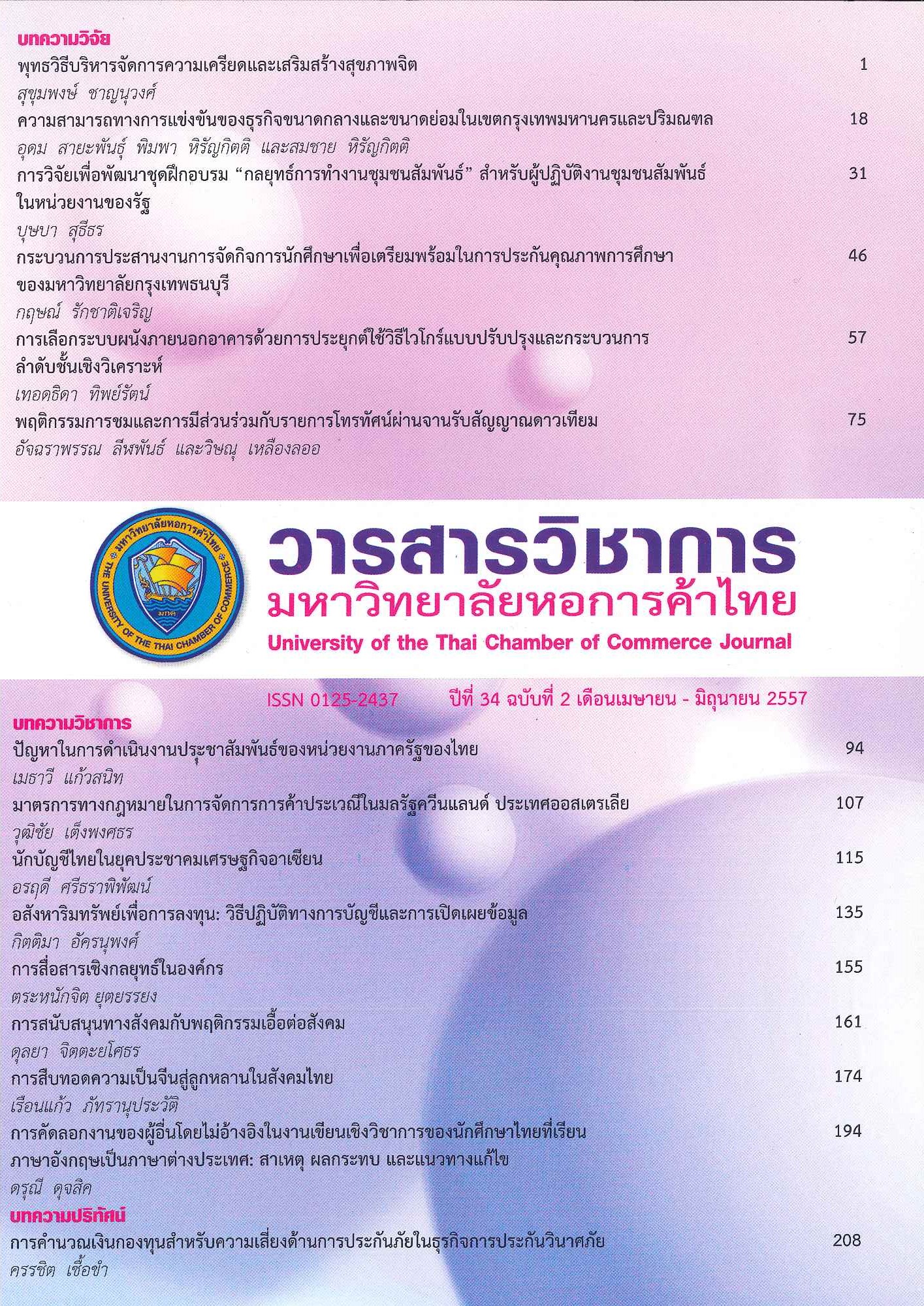
การคัดลอกงานของผู้อื่นโดยไม่อ้างอิงในงานเขียนเชิงวิชาการของนักศึกษาไทยที่เรียน ภาษาอังกฤษเป็นภาษาต่างประเทศ: สาเหตุ ผลกระทบ และแนวทางแก้ไข
Article Sidebar
Main Article Content
บทคัดย่อ
อินเทอร์เน็ตมีประโยชน์ต่อการเรียนและการสอนแต่ก็สร้างปัญหาที่เกี่ยวข้องกับการคัดลอกงานของผู้อื่นโดยไม่อ้างอิงให้ถูกต้อง ปัญหานี้ส่วนหนึ่งเกิดจากความสะดวกรวดเร็วในการเข้าถึงข้อมูลทางเวิลด์ไวด์เว็บ รวมทั้งปัจจัยที่เกี่ยวข้องกับนักศึกษาและสถาบันการศึกษา บทความนี้มีจุดมุ่งหมาย ที่จะนำเสนอปัญหาที่เกิดจากการโจรกรรมเชิงวิชาการ วิเคราะห์สาเหตุและผลกระทบของการกระทำผิดดังกล่าว พร้อมทั้งเสนอแนวทางการแก้ปัญหาให้กับผู้บริหารสถาบันการศึกษาและอาจารย์ผู้สอน
Article Details

อนุญาตภายใต้เงื่อนไข Creative Commons Attribution-NonCommercial-NoDerivatives 4.0 International License.
ลิขสิทธิ์ของบทความ
ผลงานที่ได้รับการตีพิมพ์ถือเป็นลิขสิทธิ์ของมหาวิทยาลัยหอการค้าไทย ห้ามมิให้นำเนื้อหา ทัศนะ หรือข้อคิดเห็นใด ๆ ของผลงานไปทำซ้ำ ดัดแปลง หรือเผยแพร่ ไม่ว่าทั้งหมดหรือบางส่วนโดยไม่ได้รับอนุญาตเป็นลายลักษณ์อักษรจากมหาวิทยาลัยหอการค้าไทยก่อน
เอกสารอ้างอิง
Auer, N. J., and Krupar, E. M. 2001. “Mouse Click Plagiarism: The Role of Technology in Plagiarism and the Librarian’s Role in Combating it.” Library Trends 49, 3: 415-432.
Badge, J., and Scott, J. 2009. Dealing with Plagiarism in the Digital Age [On-line]. Available: http://evidencenet.pbworks.com/ Dealing-with-plagiarism-in-the-digital-age
Bamford, J., and Sergiou, K. 2005. “International Students and Plagiarism: An Analysis of the Reasons for Plagiarism among International Foundation Students.” Investigations in University Teaching and Learning 2, 2: 17-22.
Batane, T. 2010. “Turning to Turnitin to Fight Plagiarism among University Students.” Educational Technology & Society [On-line]. Available: ifets.info/others/download_pdf.php?j_id=47&a_id=1036
Boonpattanaporn, Pornpan. 2008. “A Comparative Study of English Essay Writing Strategies and Difficulties as Perceived by English Major Students: A Case Study of Students in the School of Humanities, the University of the Thai Chamber of Commerce.” University of the Thai Chamber of Commerce Journal 28, 2: 75-90. (in Thai)
พรพรรณ บุญพัฒนาภรณ์. 2551. “การศึกษาเปรียบเทียบกลวิธีและอุปสรรคในการเขียนเรียงความภาษาอังกฤษตามการรับรู้ของนักศึกษาวิชาเอกภาษาอังกฤษ: กรณีศึกษาคณะมนุษยศาสตร์ มหาวิทยาลัยหอการค้าไทย.” วารสารวิชาการ มหาวิทยาลัยหอการค้าไทย 28, 2: 75-90.
Born, A. D. 2003. “Teaching Tip: How to Reduce Plagiarism.” Journal of Information Systems Education 14, 3: 223-224.
Cheah, S., and Bretag, T. 2008. “Making Technology Work for Academic Integrity in Malaysia.” Paper presented at the 3rd International Plagiarism Conference. [On-line]. Available: http://www.plagiarismconference.org/pages/conference-2008/conference-proceedings.php.
Dujsik, D. 2002. “Limiting Plagiarism in EFL Writing Classrooms.” Thai TESOL Bulletin 15, 2: 19-26.
Grabe, W., and Kaplan, R. B. 1996. Theory and Practice of Writing. London: Longman.
The Josephson Institute Center for Youth Ethics. 2010. The Ethics of American Youth.[Online]. Available: http://charactercounts.org/programs/reportcard/2010/installment02_
report-card_honesty-integrity.html
Kearney, R. 1988. The Wake of Imagination. Minneapolis, MN: University of Minnesota Press.
Kuldeep, N. 2012, October 4. “Plagiarism in Education and What We Can Do about it.” The Nation [On-line]. Available: http://www.nationmultimedia.com/opinion/Plagiarism-in-education-and-what-we-can-do-about-i-30191629.html
Lamubol, S. 18 August 2012. “Plagiarism Controversy Raises Questions over Academic Integrity.” University World News. [On-line]. Available: http://www.universityworldnews.com/article.php?story=20120818084937660
Ma, H. J., Wan, G., and Lu, E. Y. 2008. “Digital Cheating and Plagiarism in Schools.” Theory into Practice 47: 197-203.
McCabe, D. L. 2005. “Cheating among College and University Students: A North American Perspective.” [On-line]. Available:
http://www.ojs.unisa.edu.au/index.php/IJEI/article/viewFile/14/9%E2%80%9D
McCabe, D. L., and Pavela, G. 2004. “Ten (Updated) Principles of Academic Integrity: How Faculty can Foster Student Honesty.” Change 36, 3: 10-15.
O’ Hara, M., Carter, C. and Manassee, G. 2007. Getting It Write: A Multi-Disciplinary Approach to Student Academic Support: A JISCPAS Case Study. [On-line]. Available:
http://www.jiscpas.ac.uk/documents/ohara_casestudy.pdf
Park, C. 2003. “In Other (People’s) Words: Plagiarism by University Students—Literature and Lessons.” Assessment & Evaluation in Higher Education 28, 5: 471-488.
Pracht, C. 2003. “Cyber-Plagiarism in the ESL/EFL Classroom.” TESOL Matters 13, 2: 1.
Prensky, M. 2001. Digital Natives, Digital Immigrants. [On-line]. Available: http://www.albertomattiacci.it/docs/did/Digital_Natives_Digital_Immigrants.pdf
Renard, L. December, 1999. “Cut and Paste 101: Plagiarism and the Net.” Educational Leadership 38-42.
Shei, C. 2005. “Plagiarism, Chinese Learners and Western Convention.” Taiwan Journal of TESOL [Online]. Available:
http://citeseerx.ist.psu.edu/viewdoc/download?doi=10.1.1.98.7086&rep=rep1&type=pdf
Smithee, M., Greenblatt, S. L., and Eland, A. 2004. U.S. Classroom Culture. Washington, DC: NAFSA: Association of International Educators.
Stevenson, S. December 11, 2001. Adventures in Cheating: A Guide to Buying Term Papers Online. [Online]. Available: http://www.slate.com/articles/life/shopping/2001/12/adventures_in_cheating.html
Thep-Ackrapong, T. 2005. “Teaching English in Thailand: An Uphill Battle.” Manutsat Paritat: Journal of Humanities 27, 1: 51-62.(in Thai).
ทิพา เทพอัครพงศ์. 2548. “Teaching English in Thailand: An Uphill Battle.” มนุษยศาสตร์ปริทรรศน์ 27, 1: 51-62.
Todd, R. W. 2012, May 17. Associate Professor of Applied Linguistics at King Mongkut’s University of Technology Thonburi in Bangkok, Thailand. Interview.
Turnitin. 2012. White Paper: The Plagiarism Spectrum. [Online]. Available: http://pages.turnitin.com/rs/iparadigms/images/Turnitin_WhitePaper_PlagiarismSpectrum.pdf
The University of South Florida. 2011-2012. Student Handbook.Vespada, D. 2012, May 15. Assistant Professor of Thai Language and Literature at University of the Thai Chamber of Commerce in Bangkok, Thailand. Interview.
