
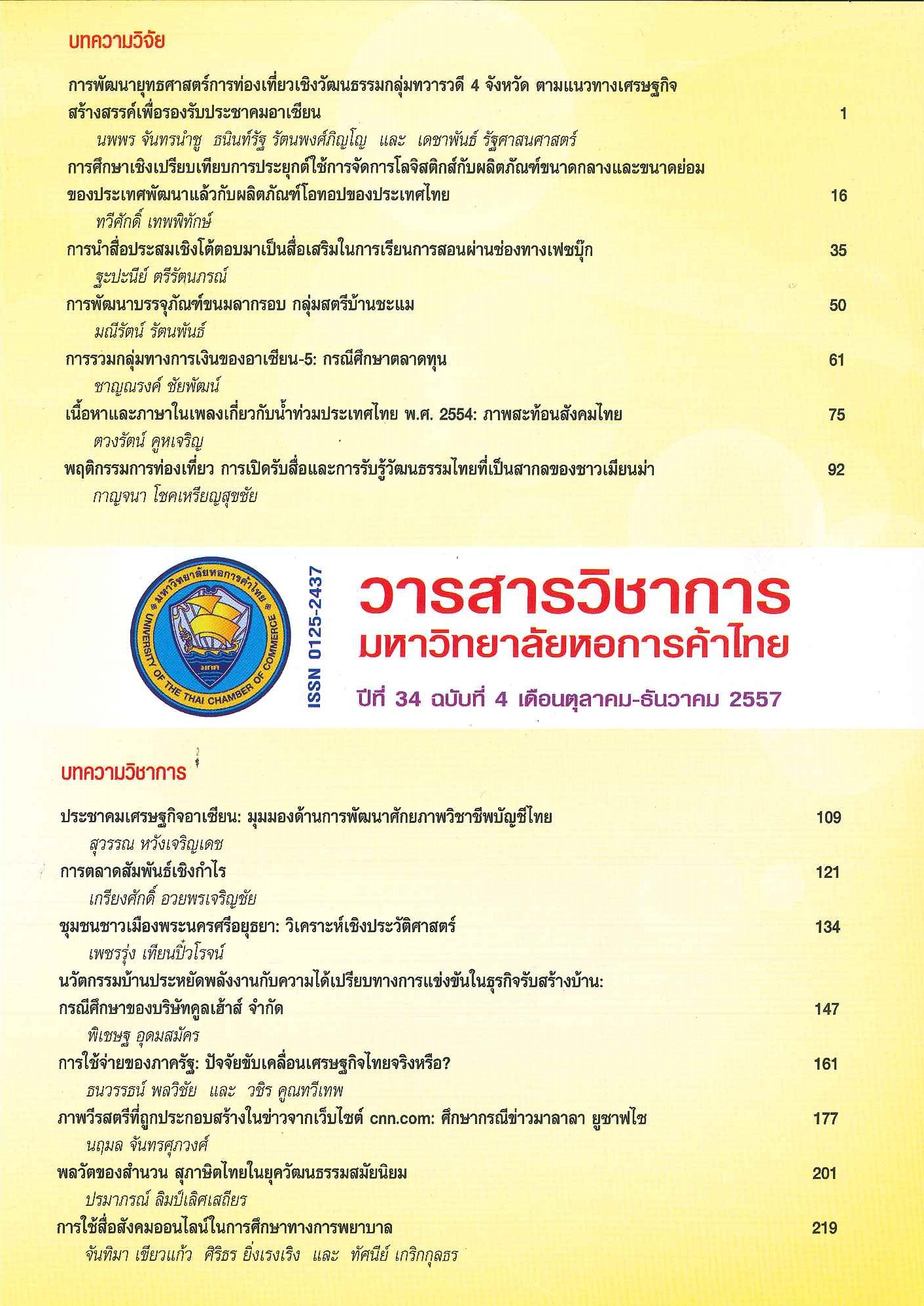
การรวมกลุ่มทางการเงินของอาเซียน-5: กรณีศึกษาตลาดทุน
Article Sidebar
Main Article Content
บทคัดย่อ
การรวมกลุ่มทางเศรษฐกิจเป็นแนวโน้มที่กำลังเกิดขึ้นทั่วโลก โดยในปี พ.ศ.2558 จะมีการรวมกลุ่มกันอย่างเป็นทางของประชาคมอาเซียน จัดเป็นการรวมกลุ่มทางเศรษฐกิจในระดับที่ 3 คือ ตลาดร่วม ประเทศสมาชิกอาเซียนสามารถเคลื่อนย้ายปัจจัยการผลิต สินค้า บริการ และแรงงาน ได้อย่างเสรีภายในกลุ่ม ต่อจากนั้นอาเซียนควรพัฒนาการรวมกลุ่มในระดับที่สูงขึ้น เป็นการรวมกลุ่มทางการเงิน เพื่อเป็นกลไกสำคัญในการเชื่อมโยงธุรกรรมระหว่างประเทศในอาเซียน และสนับสนุนให้การรวมกลุ่มในภาคเศรษฐกิจจริงประสบความสำเร็จมากยิ่งขึ้น ตามทฤษฎีอาณาเขตเงินตราที่เหมาะสม กล่าวไว้ว่า ประเทศที่มีการรวมกลุ่มกันเพื่อใช้เงินตราสกุลร่วมกันจะต้องมีความเชื่อมโยงสอดคล้องกันของตัวแปรทางเศรษฐกิจ บทความนี้จึงต้องการตรวจสอบถึงความเชื่อมโยงเกี่ยวเนื่องกันของตัวแปรในภาคการเงินของอาเซียน-5 โดยใช้ข้อมูลดัชนีตลาดหุ้นของอาเซียน ตั้งแต่เดือนมกราคม ปี 2546 ถึง เดือนมิถุนายน ปี 2556 และใช้สถิติความสัมพันธ์ดุลยภาพระยะยาวในการวิเคราะห์ ผลการศึกษาพบว่า ดัชนีตลาดหุ้นของอาเซียน-5 มีความสัมพันธ์ดุลยภาพระยะยาว จำนวน 8 คู่ จากทั้งหมด 10 คู่ ได้แก่ประเทศ มาเลเซีย-อินโดนีเซีย ฟิลิปปินส์-อินโดนีเซีย ฟิลิปปินส์-มาเลเซีย สิงคโปร์-อินโดนีเซีย สิงคโปร์-มาเลเซีย สิงคโปร์-ฟิลิปปินส์ ไทย-มาเลเซีย และ ไทย-ฟิลิปปินส์ เมื่อวิเคราะห์การปรับตัวในระยะสั้น พบว่า เมื่อมีการเบี่ยงเบนออกจากดุลยภาพแล้ว ดัชนีตลาดหุ้นของอาเซียน-5 ทั้ง 8 คู่ จะปรับตัวเข้าสู่ดุลยภาพในระยะยาว นอกจากนี้ยังมีความสัมพันธ์ในทิศทางเดียวกัน ส่วนดัชนีตลาดหุ้นของประเทศไทย-อินโดนีเซีย และ ไทย-สิงคโปร์ พบว่าไม่มีความสัมพันธ์ดุลยภาพระยะยาว การศึกษานี้ชี้ให้เห็นว่าตัวแปรในตลาดทุนของอาเซียน-5 ส่วนใหญ่มีความเชื่อมโยงสอดคล้องกันซึ่งเป็นส่วนหนึ่งที่จะสนับสนุนการรวมกลุ่มทางการเงินของอาเซียน-5
Article Details

อนุญาตภายใต้เงื่อนไข Creative Commons Attribution-NonCommercial-NoDerivatives 4.0 International License.
ลิขสิทธิ์ของบทความ
ผลงานที่ได้รับการตีพิมพ์ถือเป็นลิขสิทธิ์ของมหาวิทยาลัยหอการค้าไทย ห้ามมิให้นำเนื้อหา ทัศนะ หรือข้อคิดเห็นใด ๆ ของผลงานไปทำซ้ำ ดัดแปลง หรือเผยแพร่ ไม่ว่าทั้งหมดหรือบางส่วนโดยไม่ได้รับอนุญาตเป็นลายลักษณ์อักษรจากมหาวิทยาลัยหอการค้าไทยก่อน
เอกสารอ้างอิง
ASEAN. 2008. ASEAN Economic Community Blueprint. Jakarta: ASEAN Secretariat.
Benbouziane, M., and Benamar, A. 2010. “Could GCC Countries Achieve an Optimal Currency Area?” Middle East Development Journal 2, 2: 203-227.
Bloomberg. 2014. Asia-Pacific Stock Indexes [Online]. Available: https://https://www.bloomberg.com/markets/stocks/world-indexes/asia-pacific
Chaiphat, C. 2013. “A Comparison of Synchronicity of Macroeconomic Variables: ASEAN – Japan.” University of the Thai Chamber of Commerce Journal 33, 3: 16-31. (in Thai).
ชาญณรงค์ ชัยพัฒน์. 2556. “เปรียบเทียบความสอดคล้องของตัวแปรเศรษฐกิจมหภาค: อาเซียน-ญี่ปุ่น.” วารสารวิชาการ มหาวิทยาลัยหอการค้าไทย 33, 3: 16-31.
Chen, C. W. S., et al. 2009. “The Impact of Structural Breaks on the Integration of the ASEAN-5 Stock Markets.” Mathematics and Computers in Simulation 79: 2654-2664.
Chuku, A. C. 2012. The Proposed ECO: Should West Africa Proceed With A Common Currency? Oxford: The Centre for the Study of African Economies.
Dickey, D. A., and Fuller, W. A. 1981. “Likelihood Ratio Tests for Autoregressive Time Series with a Unit Root.” Econometrica 49,4: 1057-1072.
Engle, R. F. and Granger, C. W. J. 1987. “Cointegration and Error Correction: Representation, Estimation, and Testing.” Econometrica 55, 2: 251-276.
Gupta, R., and Guidi, F. 2012. “Cointegration Relationship and Time Varying Co-Movements Among Indian and Asian Developed Stock Markets.” International Review of Financial Analysis 21: 10-22.
Horvath, J. 2003. Optimum Currency Area Theory: A Selective Review. Helsinki: Bank of Finland, Institute for Economies in Transition.
Jean Louis, R., Brown, R., and Balli, F. 2011. “On the Feasibility of Monetary Union: Does it Make Sense to Look for Shocks Symmetry Across Countries when none of the Countries Constitutes an Optimum Currency Area?” Economic Modelling 28, 6: 2701-2718.
Kenen, P. B. 1969. The Theory of Optimum Currency Areas. Chicago, IL: University of Chicago Press.
Lim, L. 2009. “Convergence and Interdependence between ASEAN-5 Stock Markets.” Mathematics and Computers in Simulation 79: 2957-2966.
Magnifico, G. 1973. European Monetary Unification. New York: Wiley and Sons.
McKinnon, R. I. 1963. “Optimum Currency Areas.” American Economic Review 53, 4: 717-725.
Mundell, R. A. 1961. “A Theory of Optimum Currency Areas.” American Economic Review 51, 4: 657-665.
Pisanwannich, A. 2012. “The Effect of the Asian Economic Community (AEC) on Thai Rice Exports.” University of the Thai Chamber of Commerce Journal 32, 3: 33-57. (in Thai).
อัทธ์ พิศาลวานิช. 2555. “ผลกระทบของประชาคมเศรษฐกิจอาเซียนต่อเศรษฐกิจข้าวไทย” วารสารวิชาการ มหาวิทยาลัยหอการค้าไทย 32, 3: 33-57.
Thao, T. P., and Daly, K. 2012. “The Impacts of the Global Financial Crisis on Southeast Asian Equity Markets Integration.” International Journal of Trade, Economics and Finance 3, 4: 299-304.
Yu, I. W., Fung, K. P., and Tam, C. S. 2010. "Assessing Financial Market Integration in Asia Equity Markets.” Journal of Banking and Finance 34: 2874-2885
