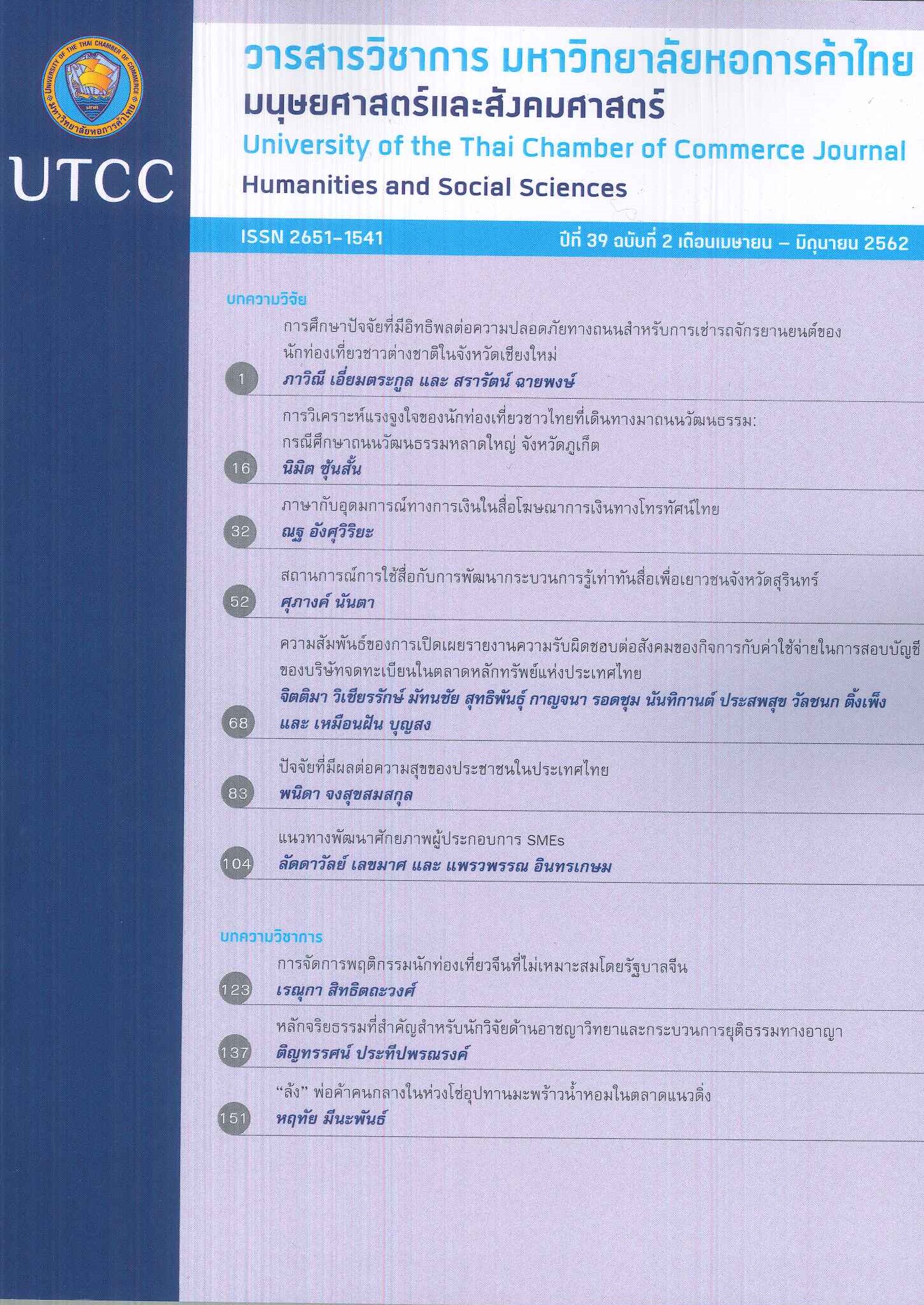
ความสัมพันธ์ของการเปิดเผยรายงานความรับผิดชอบต่อสังคมของกิจการกับค่าใช้จ่ายในการสอบบัญชีของบริษัทจดทะเบียนในตลาดหลักทรัพย์แห่งประเทศไทย
Article Sidebar
Main Article Content
บทคัดย่อ
งานวิจัยนี้ศึกษาขอบเขตและปริมาณการเปิดเผยรายงานความรับผิดชอบต่อสังคมของกิจการ รวมทั้งค่าสอบบัญชีของบริษัทจดทะเบียนในตลาดหลักทรัพย์แห่งประเทศไทย และทดสอบความสัมพันธ์ของการเปิดเผยรายงานความรับผิดชอบต่อสังคมของกิจการกับค่าใช้จ่ายการสอบบัญชี ของบริษัทจดทะเบียนในตลาดหลักทรัพย์แห่งประเทศไทย 100 บริษัท การศึกษาใช้การวิเคราะห์เนื้อหาในการนับการเปิดเผยรายงานความรับผิดชอบต่อสังคมของกิจการในรายงานประจำปีของกลุ่มตัวอย่างระหว่างปี พ.ศ. 2557 ถึง พ.ศ. 2559 และใช้การวิเคราะห์เชิงพรรณนา และการวิเคราะห์ถดถอยพหุ ผลการศึกษาพบการเปิดเผยรายงานความรับผิดชอบต่อสังคมโดยเฉลี่ย เท่ากับ 10.83 คะแนน โดยการเปิดเผยรายงานด้านแรงงานและงานที่มีคุณภาพมีการรายงานสูงสุด การรายงานด้านสิ่งแวดล้อม การรายงานด้านสังคม การรายงานด้านความรับผิดชอบต่อผลิตภัณฑ์ และการรายงานด้านสิทธิมนุษยชนตามลำดับ ส่วนค่าใช้จ่ายในการสอบบัญชีของกิจการพบว่าสูงขึ้นทุกปี นอกจากนี้ผลการศึกษาพบการเปิดเผยรายงานความรับผิดชอบต่อสังคม และขนาดของกิจการมีความสัมพันธ์เชิงบวกอย่างเป็นนัยสำคัญกับค่าใช้จ่ายในการสอบบัญชี
Article Details
ลิขสิทธิ์ของบทความ
ผลงานที่ได้รับการตีพิมพ์ถือเป็นลิขสิทธิ์ของมหาวิทยาลัยหอการค้าไทย ห้ามมิให้นำเนื้อหา ทัศนะ หรือข้อคิดเห็นใด ๆ ของผลงานไปทำซ้ำ ดัดแปลง หรือเผยแพร่ ไม่ว่าทั้งหมดหรือบางส่วนโดยไม่ได้รับอนุญาตเป็นลายลักษณ์อักษรจากมหาวิทยาลัยหอการค้าไทยก่อน
เอกสารอ้างอิง
มัทนชัย สุทธิพันธุ์, และนฤมล สิทธิเดช. (2559). การรายงานความรับผิดชอบต่อสังคมและผลการดำเนินงานของบริษัทที่จดทะเบียนในตลาดหลักทรัพย์แห่งประเทศไทย. วารสารมหาวิทยาลัยสงขลานครินทร์ ฉบับสังคมศาสตร์และมนุษยศาสตร์, 22(1), 1-23.
วิภา จงรักษ์สัตย์. (2559). การเปิดเผยข้อมูลความรับผิดชอบต่อสังคมของกิจการในประเทศไทย.วารสารศรีนครินทรวิโรฒวิจัยและพัฒนา (สาขามนุยศาสตร์และสังคมศาสตร์), 8(15), 128-144.
สถาบันไทยพัฒน์. (2561). ในมาตรฐาน ISO 26000 กล่าวถึงเรื่องใดบ้าง. สืบค้นเมื่อ 19 กันยายน 2561, จาก https://www.thaicsr.com/2012/10/iso-26000_4840.html
สิรีนาฏ นาคเลิศ, และมัทนชัย สุทธิพันธุ์. (2559). อิทธิพลของการกำกับดูแลกิจการต่อการเปิดเผยข้อมูลสิ่งแวดล้อมของบริษัทที่จดทะเบียนในตลาดหลักทรัพย์แห่งประเทศไทย. จุฬาลงกรณ์ธุรกิจปริทัศน์, 38(149), 1-37
Amin, M. N. (2011). Audit risk model as a corporate social responsibility implementation of certified public accounting firms (evidence from Indonesia). Social Responsibility Journal, 7(3), 509-522.
Anna, S., & Vasiliki, T. (2017). The link between CSR and audit fees: Are audit fees associated with CSR? (Unpublished master’s thesis). International Hellenic University, Thessaloniki, Greece
Ball, R., Jayaraman, S., & Shivakumar, L. (2012). Audited financial reporting and voluntary disclosures as complements: A test of the confirmation hypothesis. Journal of Accounting and Economics, 53(1-2), 136-166.
Beattie, V., & Smith, S. J. (2012). Evaluating disclosure theory using the views of UK finance directors in the intellectual capital context. Accounting and Business Research, 42(5), 471-494.
Chen, L., Srinidhi, B., Tsang, A., & Yu, W. (2012). Corporate social responsibility, audit fees, and audit opinions: Working paper. Fairfax, VA: George Mason University.
Chen, L., Srinidhi, B., Tsang, A., & Yu, W. (2016). Audited financial reporting and voluntary disclosure of corporate social responsibility (CSR) reports. Journal of Management Accounting Research, 28(2), 53-76.
Demartini, C., & Trucco, S. (2016). Does intellectual capital disclosure matter for audit risk? Evidence from the UK and Italy. Sustainability Journal, 8, 1-19.
Frias-Aceituno, J. V., Rodríguez-Ariza, L., & Garcia-Sánchez, I. M. (2014). Explanatory factors of integrated sustainability and financial reporting. Business Strategy and the Environment, 23(1), 56–72.
García, C. B., García, J., López Martín, M. M., & Salmerón, R. (2015). Collinearity: Revisiting the variance inflation factor in ridge regression. Journal of Applied Statistics, 42(3), 648–661.
Gul, F., Chen, C., & Tsui, J. (2003). Discretionary accounting accruals, managers’ incentives, and audit fees. Contemporary Accounting Research, 20(3), 441-464.
Hogan, C. E., & Wilkins, M. S. (2008). Evidence on the audit risk model: Do auditors increase audit fees in the presence of internal control deficiencies? Contemporary Accounting Research, 25(1), 219-242.
Karim, A. K. M. W., & Moizer, P. (1996). Determinants of audit fees in Bangladesh. The International Journal of Accounting, 31(4), 497–509.
Klassen, R. D., & McLaughlin, C. P. (1996). The impact of environmental management on firm performance. Management Science, 42(8), 1199–1214.
Krishnan, G., & Visvanathan, G. (2009). Do auditors price audit committee’s expertise? The case of accounting versus non-accounting financial experts. Journal of Accounting, Auditing & Finance, 24(1), 115-144.
Milne, M. J., & Hackston, D. (1996). Some determinants of social and environmental disclosures in New Zealand companies. Accounting, Auditing & Accountability Journal, 9(1), 77–108.
Mindak, M., & Heltzer, W. (2011). Corporate environmental responsibility and audit risk. Managerial Auditing Journal, 26(8), 697-733.
Organisation for Economic Co-operation and Development. (2011). 2011 Update of the OECD guidelines for multinational enterprises. Retrieved September 19, 2018, from https://www.oecd.org/corporate/mne/oecdguidelinesformultinationalenterprises.htm
Pallant, J. (2010). SPSS survival manual: A step by step guide to data analysis using SPSS (4th ed.). Berkshire, England: McGraw-Hill Education.
Saeidi, S. P., Sofian, S., Saeidi, P., Saeidi, S. P., & Saaeidi, S. A. (2015). How does corporate social responsibility contribute to firm financial performance? The mediating role of competitive advantage, reputation, and customer satisfaction. Journal of Business Research, 68(2), 341–350.
Shah, A., & Khan, S. (2007). Determinants of capital structure: Evidence from Pakistani panel data. International Review of Business Research Paper, 3(4), 265–282.
Suttipun, M. (2014). Corporate characteristics, CSR reporting, and firm financial performance: An evidence of Thailand. Corporate Ownership and Control, 12(1), 844-855.
Suttipun, M., & Nuttaphon, C. (2014). Corporate social responsibility reporting on websites in Thailand. Kasetsart Journal of Social Science, 35(3), 536-549.
Suttipun, M., & Stanton, P. (2012). A study of environmental disclosures by Thai listed companies on websites. International Journal on Global Science and Technology Forum Business Review, 1(3), 105-110.
Stock Exchange of Thailand. (2017). Company listed in the Stock Exchange of Thailand. Retrieved September 30, 2017, from https://www.set.or.th
Uadiale, O. M., & Fagbemi, T. O. (2012). Corporate social responsibility and financial performance in developing economies: The Nigerian experience. Journal of Economics and Sustainable Development, 3(4), 44–54.
