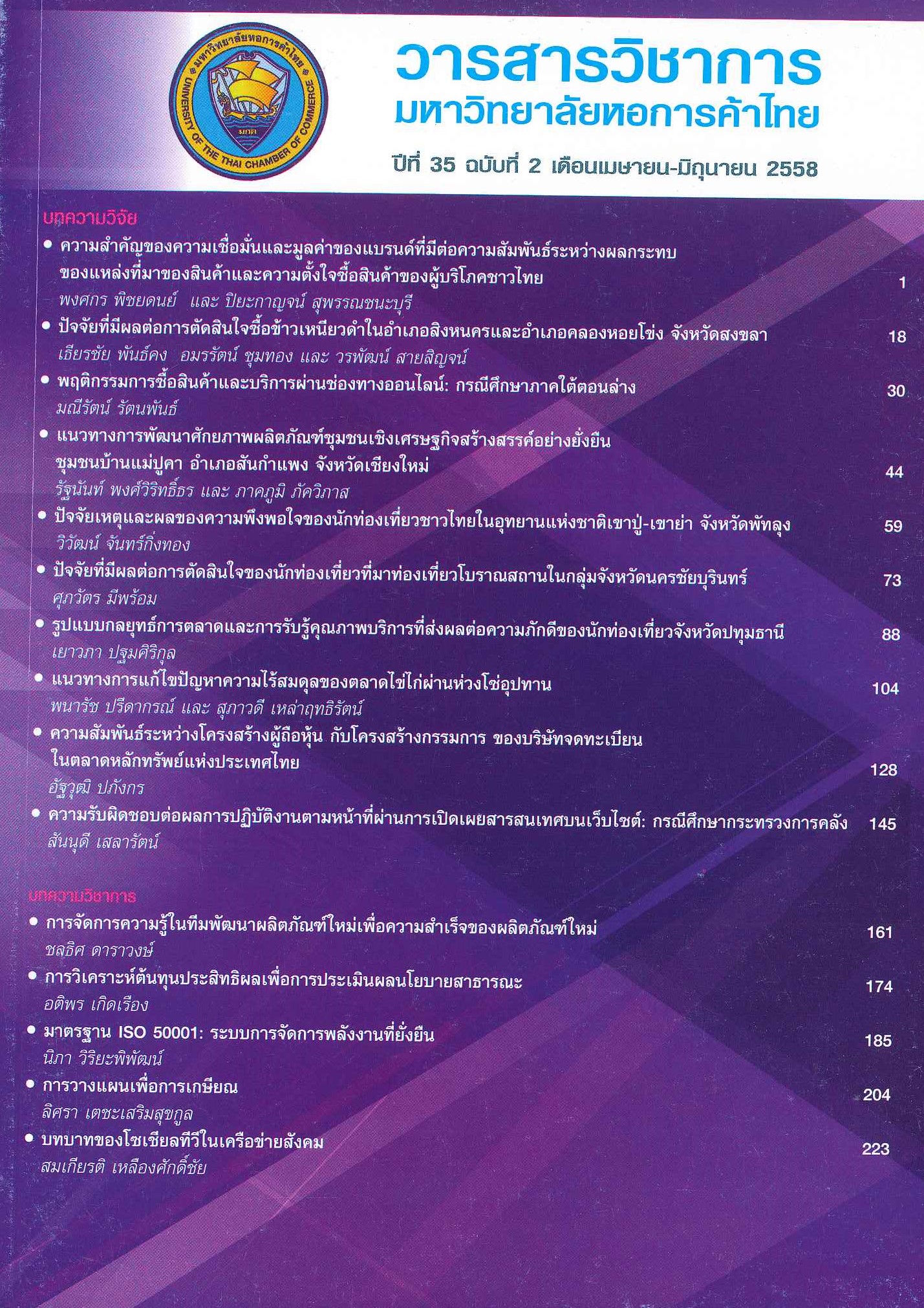
ความรับผิดชอบต่อผลการปฏิบัติงานตามหน้าที่ผ่านการเปิดเผยสารสนเทศบนเว็บไซต์: กรณีศึกษากระทรวงการคลัง
Article Sidebar
Main Article Content
บทคัดย่อ
บทความวิจัยนี้ศึกษากลไกความรับผิดชอบต่อผลการปฏิบัติงานตามหน้าที่ผ่านการเปิดเผยสารสนเทศบนเว็บไซต์ ของกระทรวงการคลัง ซึ่งตัวอย่าง คือ หน่วยงานระดับกรม จำนวน 9 แห่ง งานวิจัยนี้ ผลการวิจัย พบว่า สารสนเทศที่เปิดเผยมีปัญหาเกี่ยวกับเรื่องความน่าเชื่อถือ การพร้อมใช้งานของข้อมูลและความทันเวลา ซึ่งการเพิ่มระดับความรับผิดชอบต่อการปฏิบัติงานตามหน้าที่ จำเป็นต้่องมีการปรับปรุงแนวคิดและระบบการตรวจสอบสารสนเทศ โดยเฉพาะสิ่งกระตุ้น ทัศนคติ และแรงจูงใจของผู้ให้สารสนเทศและผู้ใช้สารสนเทศ ซึ่งผลกระทบกับความสัมพันธ์ของความรับผิดชอบต่อผลการปฎิบัติงานตามหน้าที่โดยตรง
Article Details

อนุญาตภายใต้เงื่อนไข Creative Commons Attribution-NonCommercial-NoDerivatives 4.0 International License.
ลิขสิทธิ์ของบทความ
ผลงานที่ได้รับการตีพิมพ์ถือเป็นลิขสิทธิ์ของมหาวิทยาลัยหอการค้าไทย ห้ามมิให้นำเนื้อหา ทัศนะ หรือข้อคิดเห็นใด ๆ ของผลงานไปทำซ้ำ ดัดแปลง หรือเผยแพร่ ไม่ว่าทั้งหมดหรือบางส่วนโดยไม่ได้รับอนุญาตเป็นลายลักษณ์อักษรจากมหาวิทยาลัยหอการค้าไทยก่อน
เอกสารอ้างอิง
Axworthy, T. 2005. The Accountability Ladder: Five Steps Toward Democracy [Online]. Available: https://www.wfda.net/UserFiles/ File/speeches/Axworthy.pdf
Ball, I. 2005. Achieving Greater Accountability in Government through Improved Public Sector Financial Reporting [Online]. Available: www.ifac.org/MediaCenter/? q=node/view/111
Barata, K., et al. 1999. Report to the World Bank infoDev Programme-From Accounting to Accountability: Managing Accounting Records as a Strategic Resource [Online]. Available: www.irmt. org/download/DOCUME-1/DEVELO-1/ RESEAR-1/ESCOR2.PDF
Behn, R. 2001. Rethinking Democratic Accountability. Washington, D.C.: Brookings Institution Press.
Bertók, J., et al. 2002. "Making It Happen: Developing Policy Guidelines for Accountability and Transparency.” in Bertók, J. (ed). Public Sector Transparency and Accountability: Making It Happen, pp. 37-50. Paris: OECD.
Birkinshaw, P. 2006. "Transparency as a Human Right." in Hood, C. and Heald, D. (eds). Transparency: the Key to Better Governance, pp. 47-57. Oxford; New York: Oxford University Press.
Bolívar, M., Pérez, C. and Hernández, A. 2006. “Cultural Contexts and Governmental Digital Reporting.” International Review of Administrative Sciences 72, 2: 269-290.
Bovens, M. 2005. "Public Accountability." in Ferlie, E., Lynn, L. and Pollitt, C. (eds). The Oxford Handbook of Public Management, pp. 182-208. Oxford: Oxford University Press.
Brinkerhoff, D. 2001. Taking Account of Accountability: A conceptual Overview and Strategic Options [Online]. Available: www.usaid.gov
Coy, D. and Dixon, K. 2004 "The Public Accountability Index: Crafting a Parametric Disclosure Index for Annual Reports.” The British Accounting review 36, 1: 79-106.
Coy, D., Fischer, M. and Gordon, T. 2001. "Public Accountability: A New Paradigm for College and University Annual Reports.” Critical Perspectives on Accounting 12, 1: 1-31.
Davis, J., Schoorman, F. and Donaldson, L.1997. "Towards a Stewardship Theory of Management.” Academy of Management Review 22, 1: 20-47.
Debreceny, R. and Gray, G. 1999. "Financial Reporting on the Internet and the External Audit.” European Accounting Review 8, 2: 335-350.
Dicke, L. and Ott, J. 2002. "A Test: Can Stewardship Theory Serve as a Second Conceptual Foundation for Accountability Methods in Contracted Human Services?” International Journal of Public Administration 25, 4: 463-487.
Dubnick, M. 2006. Orders of Accountability [Online]. Available: https://pubpages.unh. edu/dubnick/cv/cv.pdf.
Fischer, S. 1998. The Asian Crisis: A View from the IMF [Online]. Available: www.imf.org
Gray, S. J. 1988. 'Towards a Theory of Cultural Influence on the Development of Accounting Systems Internationally.” Abacus 21, 1: 1-15.
Hofstede, G. 1991. Cultures and Organizations: Software of the Mind. London: McGraw-Hill.
ljiri, Y. 1983. "On the Accountability-Based Conceptual Framework of Accounting." Journal of Accounting and Public Policy 2, 2: 75-81.
Marston, C., and Polei, A. 2004. "Corporate Reporting on the Internet by German Companies.” International Journal of Accounting Information Systems 5, 3: 285-311.
McMahon, L. 1995 "Corporate Accountability in Australia: Managing the Information Environment for Corporate Accountability.” Journal of Business Ethics 14, 8: 673-681.
McTigue, M., Roemer, T. and Ellig, J. 2005. 6th Annual Perfornance Report Scorecard: Which Federal Agencies Best Inforn the Public? [Online]. Available: www. mercatus.org/governmentaccountability/ category.php/15.html
Mulgan, R. 2000. “Accountability: An Ever-Expanding Concept?” Public Administration 78, 3: 555-573.
Mulgan, R. 2002. Accountability Issues in the New Model of Governance [Online]. Available: https://dspac.anu.edu.au/bitstream/1885/41731/3/mulgan.pdf
Pablos, J.L., et al. 2002. "The Annual Report as a Tool for Financial Disclosure in Local Governments.” International Journal of Management 19, 4: 651-663.
Phongpaichit, P. and Baker, C. 1995. Thailand: Economy and Politics. Oxford: Oxford University Press.
Power, M. 1991. "Auditing and Environmental Expertise: Between Protest and Professionalization." Accounting Auditing and Accountability Journal 4, 3: 30-42.
Prat, A. 2006. "The More Closely we are Watched, the Better we Behave?” in Hood, C. and Heald, D. (eds). Transparency: the Key to Better Governance, pp. 91-103. Oxford; New York: Oxford University Press.
Premchand, A. 1999. "Public Financial Accountability.” Asian Review of Public Administration 11, 2: 45-70.
Selaratana, S. 2009. "Accountability in the Thai Public Sector." Doctoral Dissertation, Department of Accounting and Finance, Faculty of Law, Business and Socialnces, University of Glasgow.
Sinclair, A. 1995. "The Chameleon of Accountability: Forms and Discourses.” Accounting, Organizations and Society 20, 2-3: 219-237.
Soontornpipit, P. 2002. Is a Culture of Accountability Developing in Thailand? [Online]. Available: www.ombudsman.go.th
Stewart, J. 1984. "The Role of Information in Public Accountability." in Hopwood, A. and Tomkins, C. (eds). Issues in Public Sector Accounting, pp. 13-34. Oxford: Deddington Philip Allan.
Suwanraks, R. 1999. "Summary of Discussion and Recommendations: The 1998 TDRI Year-end Conference: From Crisis to Sustainable Development.” TDRI Quarterly Review 14, 1: 10-20.
UN. 2004. Concept Paper 2: Transparency and Accountability in Public Financial Administration [Online]. Available: https://unpan1.un.org/intradoc/groups/public/ documents/UN/UNPAN007716.pdf
Vandergeest, P. 1993. "Constructing Thailand: Regulation, Everyday Resistance, and Citizenship.” Journal for the Comparative Study of Society and History 35, 1: 133-158.
Velayutham, S. and Perera, M. 2004. "TheInfluence of Emotions and Culture on Accountability and Governance.” Corporate Governance: International Journal of Business in Society 4, 1: 52-64.
World Bank. 1992. Governance and Development. Washington D.C.: World Bank.
Xiao, Z., Jones, M. and Lymer, A. 2002. “Immediate Trends in Internet Reporting.” The European Accounting Review 11, 2: 245-275.
