
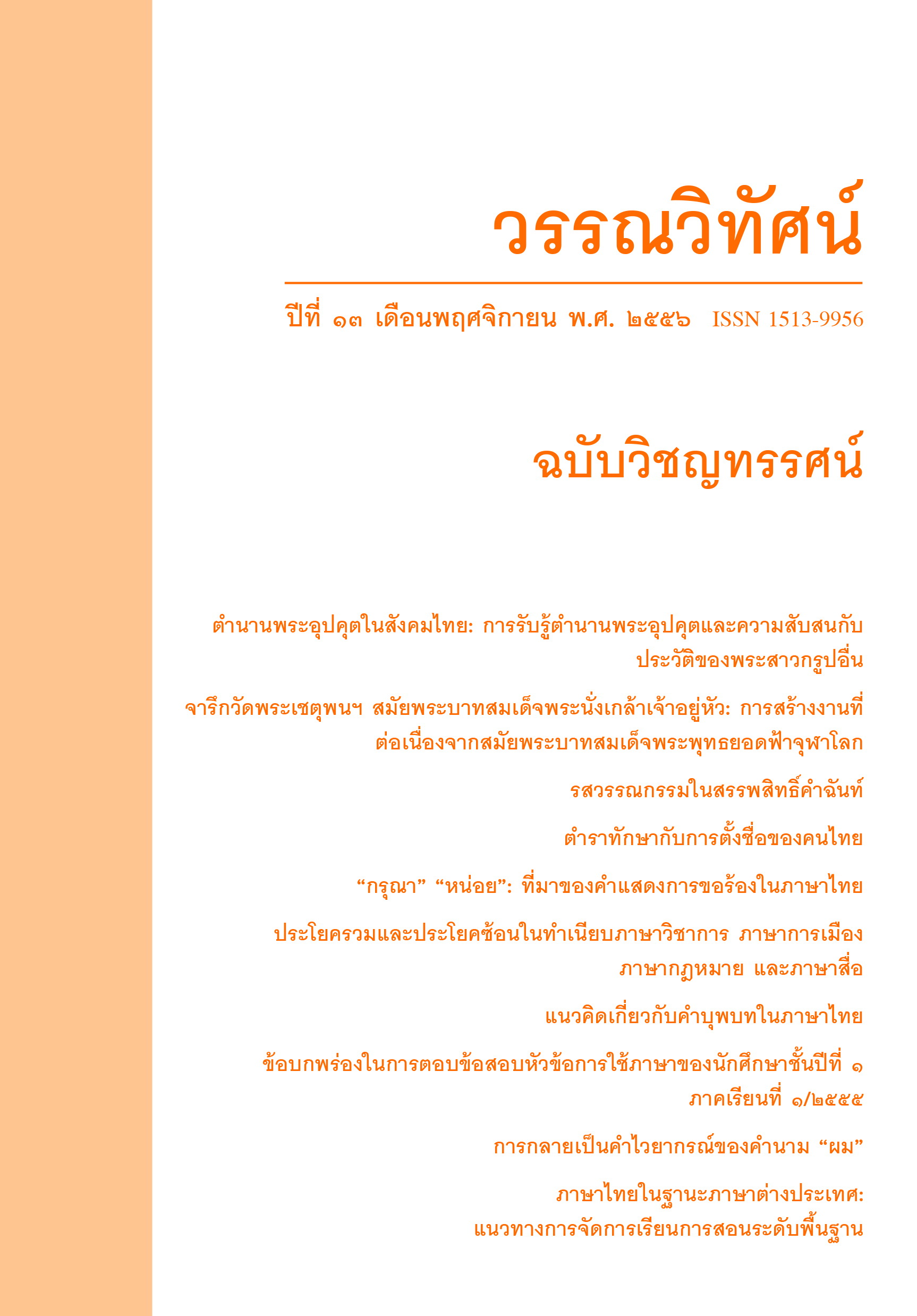
The Verb /kàrúnaa/ and the Quantitative Adverb /nćy/:The Original Sources of Requestive Markers in Thai
Article Sidebar
Main Article Content
Abstract
This article is a study of the grammatical development of the requestive markers /kàrúnaa/ ‘be kind’ and /n ćy/ ‘a little’ in Thai. The objectives of the study are (1) to search for the criteria to distinguish the requestive markers /kàrúnaa/ and /n ćy/ from verb counterparts and the quantitative adverb counterparts respectively and (2) to identify the factors and the processes that change the verb /kàrúnaa/ and the quantitative adverbs /n ćy/ into requestive markers. The grammaticalization approach is adopted in this study. The data used is from the Thai National Corpus.
Based on data of modern Thai, the criteria for the classification are (1) syntactically, the requestive marker /kàrúnaa/ does not occur with the subject in the sentence but the verb counterpart does and (2) semantically, the requestive marker/n ćy/ must occur in the context of a request only but the quantitative adverb counterpart does not. The factors involved are (1) syntactic: verbs in Thai appear in serial verb constructions, i.e. the verb /kàrúnaa/ normally appears in front of other verbs in serial verb constructions and (2) semantic: inherent semantic features in connection with kindness and small quantity encourage grammatical change. The processes involved are (1) decategorialization (2) semantic bleaching (3) persistence and (4) metaphorical extension.
Article Details
References
นววรรณ พันธุเมธา. (๒๕๕๓). ไวยากรณ์ไทย (พิมพ์ครั้งที่ ๕). กรุงเทพมหานคร: สำนักพิมพ์แห่งจุฬาลงกรณ์มหาวิทยาลัย.
ภาควิชาภาษาศาสตร์ คณะอักษรศาสตร์ จุฬาลงกรณ์มหาวิทยาลัย. (๒๕๔๑-๒๕๕๐). TNC: Thai National Corpus ในพระราชูปถัมภ์สมเด็จพระเทพรัตนราชสุดาฯ สยามบรมราชกุมารี. สืบค้นเมื่อวันที่ ๑๕-๒๕ มกราคม ๒๕๕๕, จาก http://ling.arts.chula.ac.th/tnc2/
ราชบัณฑิตยสถาน. (๒๕๔๖). พจนานุกรมฉบับราชบัณฑิตยสถาน พ.ศ. ๒๕๔๒. กรุงเทพมหานคร: นานมีบุ๊คส์ พับลิเคชั่น.
วิจินตน์ ภาณุพงศ์. (๒๕๓๘). โครงสร้างภาษาไทย: ระบบไวยากรณ์ (พิมพ์ครั้งที่ ๑๓). กรุงเทพมหานคร: โรงพิมพ์มหาวิทยาลัยรามคำแหง.
สุจริตลักษณ์ ดีผดุง. (๒๕๔๘). ขอ . . . หน่อย, ขอ . . . ด้วย, ช่วย . . . ที. ใน รวมบทความวิชาการภาษาและวัฒนธรรมเพื่อพัฒนาชนบท. กรุงเทพมหานคร: โรงพิมพ์บริษัทสหธรรมิก.
อุปกิตศิลปสาร, พระยา. (๒๕๔๖). หลักภาษาไทย (พิมพ์ครั้งที่ ๑๒). กรุงเทพมหานคร: ไทยวัฒนา- พานิช.
Bybee J., Perkins R., and Pagliuca W. (1994).The evolution of grammar: tense,aspect, and modality in the languages of the world. Chicago: University of Chicago Press.
Hopper, P.J. (1991). On some principles of grammaticalization, In E.C. Traugott and B. Heine (eds.), Approach to grammaticalization, (Vol.1). Amsterdam: JohnBenjamins. pp.17-35.
Hopper, P.J., and Traugott, E.C. (2003). Grammaticalization. Cambridge: Cambridge University Press.
Lehmann, C. (1985). Grammaticalization: Synchronic variation and diachronic change. In Lingua E stile, 20, pp.303-318.
Peterson, Elizabeth. (2008). Pressure to please: the case of English and politeness in Finland. In Vergaro, C. (Eds.), Dynamics of language contact in the twentyfirst century. 2.1 ed. Perugia, Italy: Guerra Edizioni, pp.161-177.
