
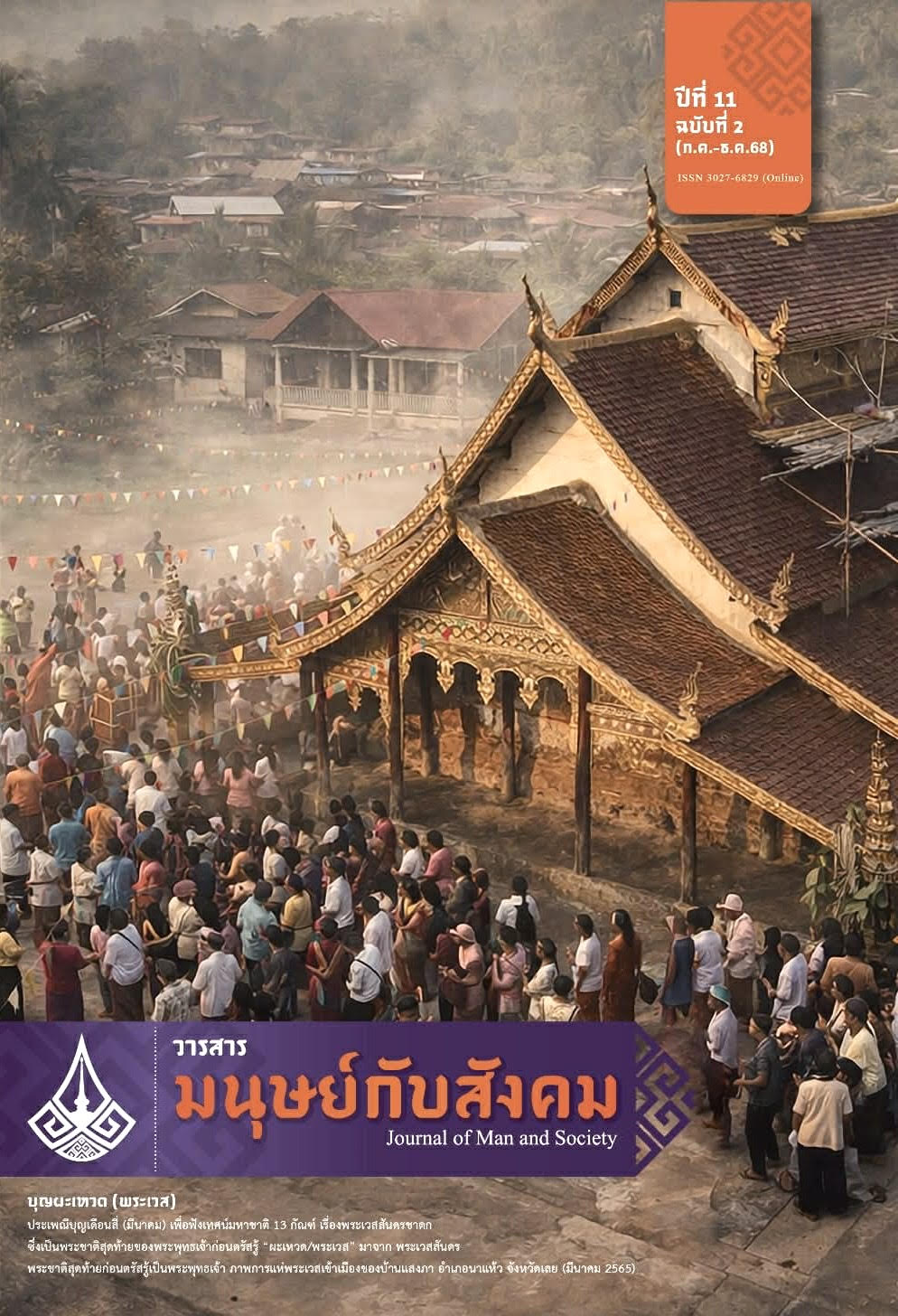
Amid the currents of change in the digital era, where information flows rapidly, the Journal of Man and Society, Volume 11, Issue 2 (July–December 2025), continues to serve as an intellectual space for exploring and understanding emerging social phenomena across multiple dimensions, including folklore and belief systems, local wisdom, and the construction of meaning through language and literature. In this issue, we are honored to feature contributions from authors whose research articles and scholarly works keenly illuminate the intersection between traditional roots and adaptation within contemporary contexts. The issue opens with an exploration of the dynamics of folklore in contemporary settings. These include the transmission and reinterpretation of belief through popular media in the article “Folklore in the Novel Garin: Mysterious Occult Case,” as well as the creative use of local cultural capital in social activities, exemplified by “Folklore in the Beauty Pageant of Miss Duangdee Sri Sawankhalok.” Together, these studies demonstrate that traditional beliefs have not faded away; rather, they have been transformed to sustain their presence in modern society. Similarly, the study “The Linguistic Strategies and Construction of Fortune Discourse in Rueng Lao Chao Neeand Rueng Lao Saturday–Sunday Online” reveals the reproduction of beliefs in fate and luck through influential mass media platforms.
In the dimension of local wisdom and community-driven development, this issue presents research that foregrounds the relationship between humans and resources at both spiritual and material levels. This is explored through articles such as “Local Vegetables in IsanPalm-Leaf Medical Manuscripts” and “Khao Dok Rai: Food Wisdom and Relationship with Social Institutions in SakomSubdistrict, Chana District, Songkhla Province,” both of which reaffirm the enduring value of local knowledge that has long sustained life and society. This focus resonates with the article “The Role of Community Organization Councils in Building Grassroots Economic Development Networks: A Case Study of Noen Kho Sub-District, Klaeng District, Rayong,” which illustrates concrete mechanisms of community self-management.
In addition, the academic articles section brings together works that offer in-depth analyses of representation, power, and space through textual interpretation. These include the study “A study of the representation of the ruling class in the early Rattanakosin period through the character “Wong Asandaewa”in the Inao literature,” as well as an interpretive reading of “Sense of Place and the Construction of the Meaning of Place in Hom Phaen-din Lao by ‘Luk Don Kaden’.” Together, these studies provide clearer insight into the interaction between human experience, historical subtexts, and spiritual spaces.
The Editorial Board also recommends an influential book that can help scholars and writers communicate their ideas more powerfully: Made to Stick: Why Some Ideas Survive and Others Die by Chip and Dan Heath. The book raises critical questions about how ideas can stand out and become memorable, offering principles that make ideas “stick” in people’s minds. The insights from this work are particularly valuable tools for the academic world.
Finally, the Editorial Board sincerely hopes that the eight articles and selected ideas featured in this issue will serve as an academic compass, guiding readers toward a deeper understanding of human beings and society across multiple dimensions. We extend our heartfelt thanks to all contributing authors for sharing their valuable work, as well as to the reviewers whose expertise has helped refine and strengthen the content.
Pakpoom Hannapha
Editor
Published: 20-11-2025
