The Relationship between English Reading Comprehension and Mathematical Literacy among English Program Students at Thanyaburi School in Pathumthani Province
Abstract
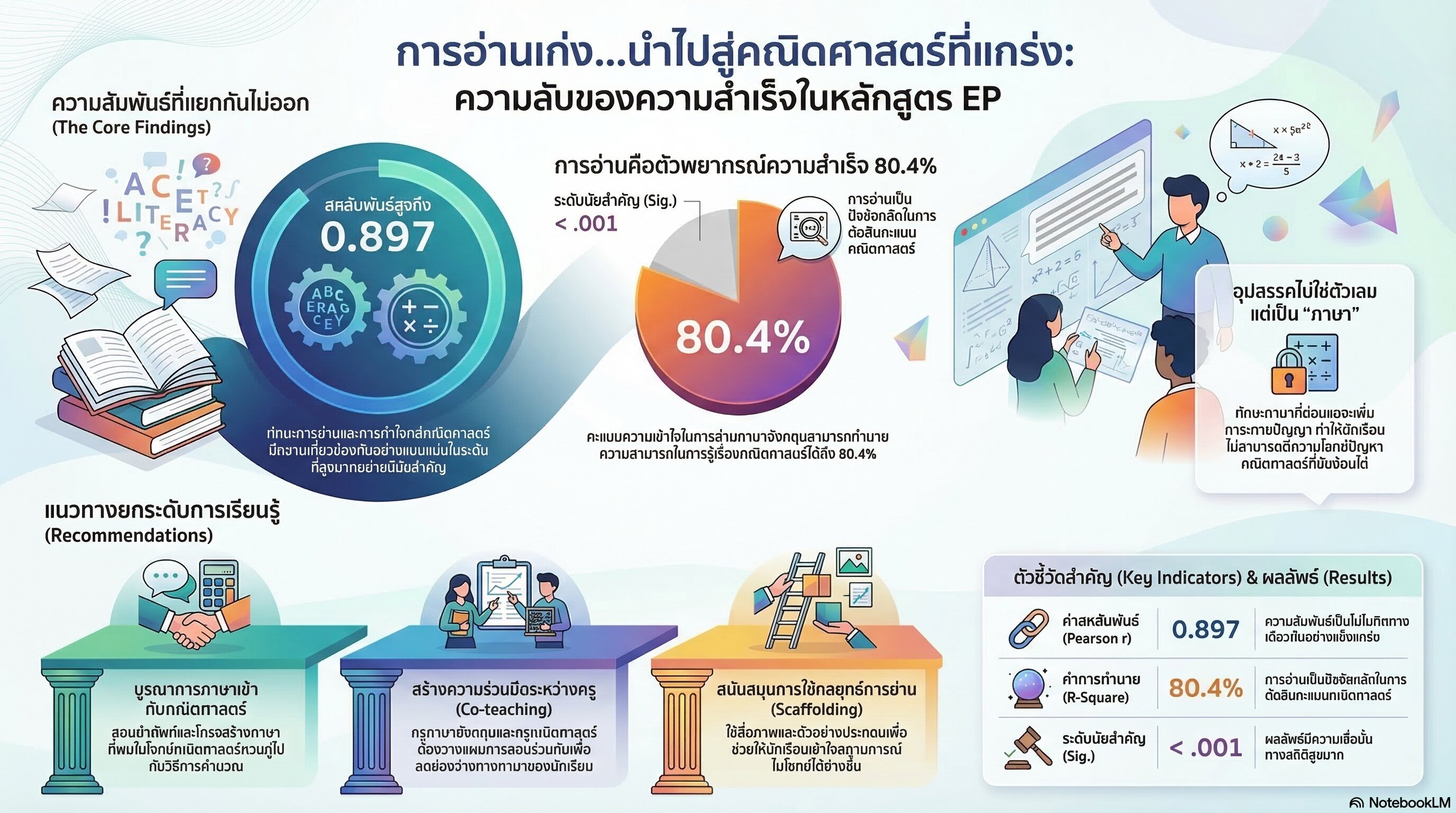
This study investigated the levels of English reading comprehension and mathematical literacy, and the relationship between these competencies, among 56 students who were enrolled in the English Program at Thanyaburi School, Pathumthani Province, during the 2025 academic year. English reading was assessed using the TOEFL Junior Reading section, while mathematical literacy was measured with a researcher-developed test aligned with the PISA framework. The mathematical literacy test demonstrated strong content and construct validity (IOC = 0.60–1.00; CFA factor loadings = 0.31–1.04) and high reliability (Cronbach’s α = 0.763–0.842; EPA = 0.868–0.920). Results indicated moderate-to-high English reading proficiency (M = 233.30, SD = 30.97) and a wide range of mathematical literacy scores (M = 18.32, SD = 5.72). Pearson correlation revealed a very strong positive and statistically significant relationship (r = 0.897, p < .001), and regression analysis showed that English reading comprehension significantly predicted mathematical literacy, explaining 80.4% of the variance (R² = 0.804). These findings underscore the critical role of reading skills in facilitating mathematical reasoning, problem-solving, and real-life application in English-medium instruction. The results suggest integrating targeted reading strategies, vocabulary support, and teacher collaboration between language and mathematics educators to enhance students’ academic outcomes.
References
Al-Amri, H., & Awaji, B. (2023). English language proficiency as a predictor of Saudi undergraduates’ mathematics scores. Journal of Educational and Social Research, 13(5), 99. https://doi.org/10.36941/jesr-2023-0158
Balci, M., & Lynch, R. (2022). The relationship of English language usage skills, English reading proficiency and English self-efficacy with mathematics academic achievement of grades 3-4 and grades 5-6 students at Pan-Asia International School, Bangkok, Thailand. Scholar: Human Sciences, 14(2), 42. http://www.assumptionjournal.au.edu/index.php/Scholar/article/view/5319
Bernabini, L., Bonifacci, P., & de Jong, P. F. (2021). The relationship between reading skills and mathematical cognition: A cross-linguistic study. Frontiers in Psychology, 12, Article 577488. https://doi.org/10.3389/fpsyg.2021.577488
Canale, M., & Swain, M. (1980). Theoretical bases of communicative approaches to second language teaching and testing. Applied Linguistics, 1(1), 1–47.
Chan, K. L., & Chiu, L. F. (2023). Language proficiency and its impact on academic achievement in bilingual mathematics classrooms. Education Studies, 51(1), 19–35.
Cinkara, E., Bagceci, B., & Kutlar, L. (2014). The relationship between English and math success and some variables at freshman level. Journal of Education and Practice, 5(3), 6–10.
Cummins, J. (1979). Cognitive/academic language proficiency, linguistic interdependence, the optimum age question, and some other matters. Working Papers on Bilingualism, 19, 121–129.
du Plooy, B., Stander, L., & Scheckle, E. (2025). The link between English language proficiency and academic performance among NC(V) first-year engineering students at a South African TVET college. Southern African Linguistics and Applied Language Studies, 1–12. https://doi.org/10.2989/16073614.2024.2367435
Erdoğan, M., & Aycan, M. (2021). The impact of English proficiency on mathematics achievement in bilingual education settings. Educational Research International, 15(3), 112–120.
Galang, R. T., Arrozal, J. Y., Regala, A., & Manlutac, A. C. (2023). Reading comprehension level and academic performance of college students in their mathematics course. International Journal of Multidisciplinary: Applied Business and Education Research, 4(10), 3516–3520. https://doi.org/10.11594/ijmaber.04.10.07
Giofrè, D., Donolato, E., & Mammarella, I. C. (2018). The differential role of verbal and visuospatial working memory in mathematics and reading. Trends in Neuroscience and Education, 12, 15–23. https://doi.org/10.1016/j.tine.2018.02.001
González-Martín, A. M., Berd-Gómez, R., Saura-Montesinos, V., Biel-Maeso, M., & Abrahamse, E. (2024). On the relationship between bilingualism and mathematical performance: A systematic review. Education Sciences, 14(11), 1172. https://doi.org/10.3390/educsci14111172
Karacaoğlu, Ö. C., & Kasap, Y. (2023). The effect of reading comprehension skills on mathematics and science achievement according to PISA data. International Journal of Educational Research Review, 8(3), 623–637. https://doi.org/10.24331/ijere.134880
Piaget, J. (1973). To understand is to invent: The future of education. Grossman Publishers.
Rambely, A. S., Ahmad, R., Majid, N., & Jaaman, S. H. (2013). The relationship of English proficiency and mathematics achievement. In Proceedings of the International Conference on Teaching and Learning in Higher Education. University Kebangsaan Malaysia.
Steinhauer, C., Becker, M., & Neumann, M. (2022). Bidirectional relations between reading and mathematics across secondary school: A longitudinal analysis using NEPS data. Journal for Educational Research Online, 14(1), 85–111. https://doi.org/10.31244/jero.2022.01.05
Tanko, I. Z., Yushau, B., & Arhyel, I. (2022). Relationship between mathematics performance and English language proficiency among senior secondary school students in Bauchi metropolis, Nigeria. Galaxy International Interdisciplinary Research Journal, 10(5), 509–516. http://internationaljournals.co.in/index.php/giirj/article/view/1897
Vygotsky, L. (1978). Mind in society: The development of higher psychological processes. Harvard University Press.
Yamane, T. (1973). Statistics: An introductory analysis (3rd ed.). Harper & Row.
Zamanzadeh, V., et al. (2015). Design and implementation of a content validity study of a questionnaire: A practical approach. Nursing and Midwifery Studies, 4(3), 103–108.
Downloads
Published
How to Cite
License
Copyright (c) 2026 Journal of Buddhist Education and Research (JBER)

This work is licensed under a Creative Commons Attribution-NonCommercial-NoDerivatives 4.0 International License.