Social Media Usage as a Moderator between User Satisfaction and Continuance Intention: Evidence from Generation Z on the Bilibili Platform
Abstract
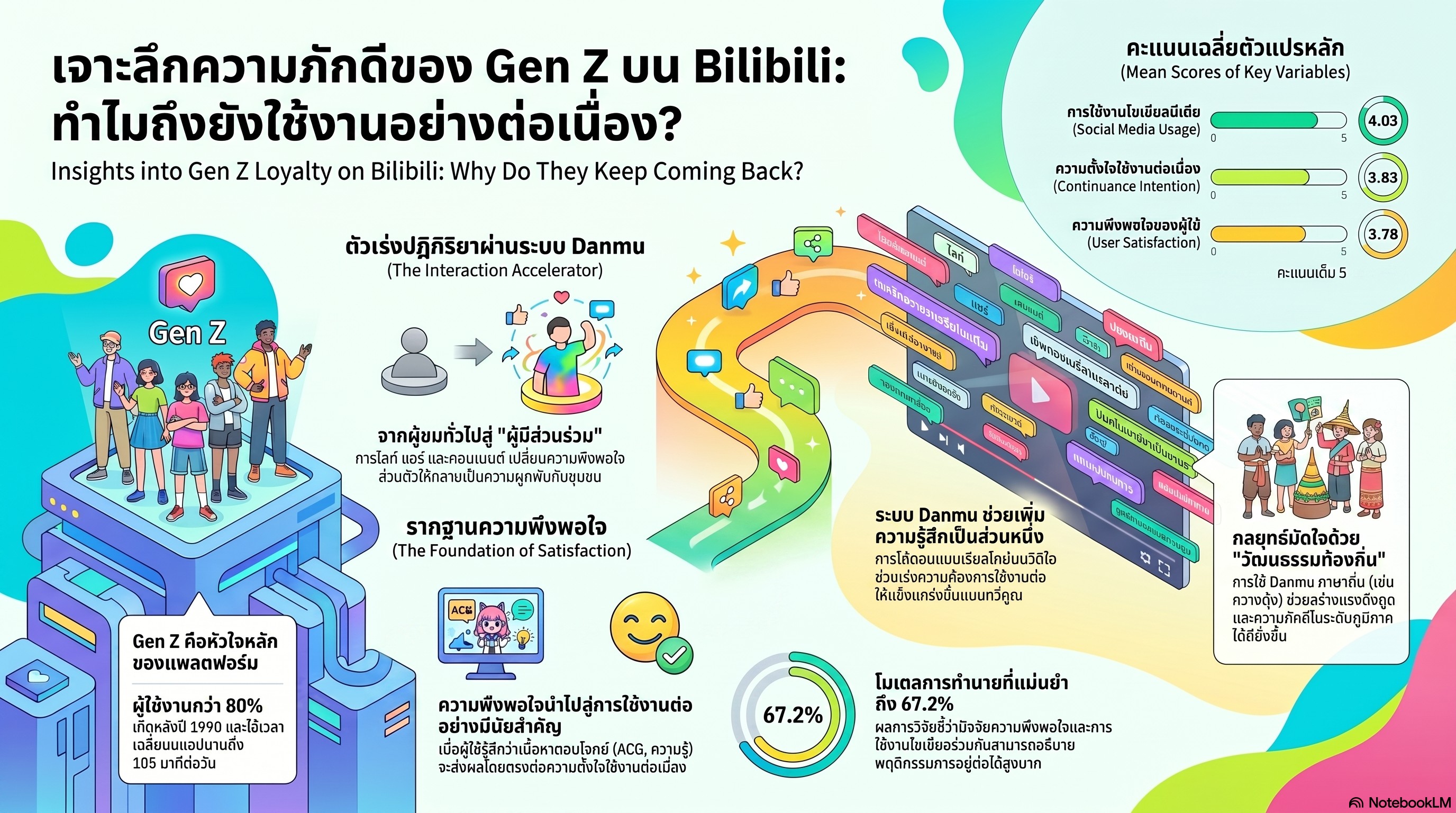
As the digital economy continues to flourish, video platforms have become central to Generation Z’s information acquisition, social connection, and entertainment experiences. Consequently, retaining users has become increasingly important. Drawing on Expectation Confirmation Theory and Community Participation Theory, this study develops a dual-core model that positions social media usage as a moderator between user satisfaction and continuance intention. Focusing on Bilibili users in Guangdong Province, the study collected 510 valid online survey responses through random sampling and employed structural equation modeling to examine the proposed hypotheses. The results indicate that user satisfaction significantly predicts continuance intention, and that social media usage strengthens this relationship (R² = 67.2%). The findings further reveal a danmu-driven “satisfaction–usage–continuance” mechanism. This research contributes to the literature on digital behavior and offers practical implications for platform management—including optimizing danmu features and incentivizing user participation—as well as guidance for enhancing Generation Z’s digital literacy.
References
Alalwan, A. A., Dwivedi, Y. K., & Rana, N. P. (2023). Factors influencing Generation Z's continued use intention of social media platforms: An integrated UTAUT2–ECT model. Journal of Retailing and Consumer Services, 70, 103147.
Alalwan, N. (2022). Actual use of social media for engagement to enhance students’ learning. Education and Information Technologies, 27(7), 9767–9789.
Ambalov, A. (2022). A meta-analysis of expectation-confirmation theory in information systems research: 20 years of progress. Information & Management, 59(3), 103599.
Baron, R. M., & Kenny, D. A. (1986). The moderator–mediator variable distinction in social psychological research: Conceptual, strategic, and statistical considerations. Journal of Personality and Social Psychology, 51(6), 1173–1182.
Bhattacherjee, A. (2001). Understanding information systems continuance: An expectation-confirmation model. MIS Quarterly, 25(3), 351–370.
Blanchard, A. L., & Markus, M. L. (2004). The experienced “sense” of a virtual community: Characteristics and processes. ACM SIGMIS Database, 35(1), 65–79.
Chen, J., Li, X., & Zhang, Y. (2023). Community participation and user continuance in online health communities: An integrated ECM and IS success model. Journal of Medical Internet Research, 25(1), e45678.
Chen, L., Chen, P., & Lin, Z. (2020). Artificial intelligence in education: A review. IEEE Access, 8, 75264–75278.
Chen, Y., Wang, L., & Liu, H. (2023). User satisfaction and continuance intention in Bilibili: The role of danmu culture among Generation Z. Computers in Human Behavior, 142, 107654.
Chen, Z. T. (2021). Poetic prosumption of animation, comic, game and novel in a post-socialist China: A case of a popular video-sharing social media Bilibili as heterotopia. Journal of Consumer Culture, 21(1), 257–277.
Cochran, W. G. (1977). Sampling techniques (3rd ed.). John Wiley & Sons.
Cohen, J., Cohen, P., West, S. G., & Aiken, L. S. (2013). Applied multiple regression/correlation analysis for the behavioral sciences (3rd ed.). Routledge.
DeLone, W. H., & McLean, E. R. (2003). The DeLone and McLean model of information systems success: A ten-year update. Journal of Management Information Systems, 19(4), 9–30.
Deng, J., Li, Y., & Zhang, X. (2021). Development overview and valuation analysis of Bilibili. In Proceedings of the 2021 3rd International Conference on Economic Management and Cultural Industry (ICEMCI 2021) (pp. 1–6). Atlantis Press.
Djafarova, E., & Bowes, T. (2021). “Instagram made me buy it”: Generation Z impulse purchases in the fashion industry. Journal of Retailing and Consumer Services, 59, 102345.
Ellison, N. B., Steinfield, C., & Lampe, C. (2007). The benefits of Facebook “friends”: Social capital and college students’ use of online social network sites. Journal of Computer-Mediated Communication, 12(4), 1143–1168.
Fornell, C., & Larcker, D. F. (1981). Evaluating structural equation models with unobservable variables and measurement error. Journal of Marketing Research, 18(1), 39–50.
Hair, J. F., Black, W. C., Babin, B. J., & Anderson, R. E. (2010). Multivariate data analysis (7th ed.). Pearson.
Hossain, M. A., & Quaddus, M. (2012). Expectation confirmation and continuance intention to use mobile banking: A moderated mediation analysis. In Proceedings of the 23rd Australasian Conference on Information Systems (pp. 1–12).
Jia, X., Pang, Y., Huang, B., & Hou, F. (2023). Understanding consumers’ continuance intention to watch streams: A value-based continuance intention model. Frontiers in Psychology, 14, 1073301.
Kaur, P., Dhir, A., Tandon, A., & Al-Emran, M. (2023). Social media engagement and continuance intention: The moderating role of community participation. Technology in Society, 72, 102189.
Kim, H.-W., Chan, H. C., & Gupta, S. (2007). Value-based adoption of mobile internet: An empirical investigation. Decision Support Systems, 43(1), 111–126.
Kim, J., Lee, S., & Park, J. (2023). Understanding continued use of digital learning platforms: An integrated ECM and IS success model approach. Computers & Education, 195, 104712.
Kline, R. B. (2016). Principles and practice of structural equation modeling (4th ed.). Guilford Press.
Koh, J., & Kim, Y.-G. (2003). Sense of virtual community: Its antecedents and consequences. International Journal of Human-Computer Studies, 59(6), 675–700.
Li, H., Graupensperger, S., Graham, J., & Luan, Z. (2023). Mobile phone short video use negatively impacts attention functions: An EEG study. Frontiers in Psychology, 14, 1206147.
Li, Y., Zhang, Q., & Wang, X. (2024). Social media engagement scale–adapted (SMES-A): Development and validation in mobile app context. Journal of Interactive Marketing, 61, 45–62.
Lin, C.-P. (2008). Clarifying the relationship between social capital and knowledge sharing in virtual communities. Online Information Review, 32(4), 490–505.
Liu, B. (2021). Cultural integration: An examination of Bilibili. Youth Journalist, 14, 82–92.
McMillan, D. W., & Chavis, D. M. (1986). Sense of community: A definition and theory. Journal of Community Psychology, 14(1), 6–23.
Nahapiet, J., & Ghoshal, S. (1998). Social capital, intellectual capital, and the organizational advantage. Academy of Management Review, 23(2), 242–266.
Ni, X., Li, Y., & Wang, Y. (2020). Development and validation of the Social Media Engagement Scale for Adolescents (SMES-A). Computers in Human Behavior, 112, 106478.
Oliver, R. L. (1980). A cognitive model of the antecedents and consequences of satisfaction decisions. Journal of Marketing Research, 17(4), 460–469.
Riyat, M., Dwivedi, Y. K., & Williams, M. D. (2025). Generation Z’s confirmation process in educational technology platforms: The role of social interaction and eWOM. Education and Information Technologies. Advance online publication.
Susanto, A., Rezaei, S., & Thurasamy, R. (2023). Longitudinal analysis of expectation confirmation in mobile banking: A dynamic perspective. International Journal of Bank Marketing, 41(2), 345–367.
Tajfel, H., & Turner, J. C. (1986). The social identity theory of intergroup behavior. In S. Worchel & W. G. Austin (Eds.), Psychology of intergroup relations (2nd ed., pp. 7–24). Nelson-Hall.
Turner, A. (2023). Generation Z: Technology and social interest. Journal of Adult Education, 52(1), 45–62.
Vaterlaus, J. M., Patten, E. V., Roche, C., & Young, K. J. (2014). Gettinghealthy: The perceived influence of social media on young adult health behaviors. Computers in Human Behavior, 45, 151–157.
Venkatesh, V., Thong, J. Y. L., & Xu, X. (2012). Consumer acceptance and use of information technology: Extending the unified theory of acceptance and use of technology. MIS Quarterly, 36(1), 157–178.
Wang, S., Chen, L., & Zhang, H. (2024). Danmu interactions and user continuance in short video platforms: A moderated mediation model. Information Systems Research, 35(1), 123–145.
Wiertz, C., & de Ruyter, K. (2007). Beyond the call of duty: World of Warcraft and the impact of co-participation on loyalty. Advances in Consumer Research, 34, 46–47.
Xu, J., & Li, M. (2022). Regional cultural resonance in Bilibili: Satisfaction, engagement, and continuance among Guangdong Gen Z users. Asia Pacific Journal of Marketing and Logistics, 35(6), 1345–1367.
Xu, J., Ismail, A. B., & Jamal, J. B. (2024). The impact of mobile short video platform characteristics on users’ continuous use behavior in China: A stimulus–organism–response perspective. Multidisciplinary Science Journal, 7(1), e2025019.
Yao, J., Zhang, Y., & Wang, R. (2025). Beyond expectation and confirmation: Unraveling the drivers of continued engagement with Chinese short video apps. Telecommunications Policy. Advance online publication.
Zarifis, A. (2023). Understanding users’ negative emotions and continuous usage intention in short video platforms. Electronic Commerce Research and Applications, 58, 101244.
Zhang, L. T., & Cassany, D. (2023). Danmu as co-creation: User-generated content and community building in Bilibili. New Media & Society, 25(8), 1987–2005.
Zhang, Q., Wang, Y., & Kamalul Ariffin, S. (2024). Keep scrolling: An investigation of short video users’ continuous watching behavior. Information & Management, 61(4), 104014.
Zhao, Y., Liu, Q., & Wang, J. (2024). Synchronous interaction in danmu culture: Enhancing belongingness and stickiness in Bilibili. Computers in Human Behavior, 150, 107987.
Downloads
Published
How to Cite
Issue
Section
Categories
License
Copyright (c) 2026 Journal of Buddhist Education and Research (JBER)

This work is licensed under a Creative Commons Attribution-NonCommercial-NoDerivatives 4.0 International License.