An Analysis of Relative Clauses found in the Dhammapada of “Treasury of Truth” Translated by Ven. Weragoda Sarada Maha Thero
Keywords:
Relative Clauses, The Dhammapada, Yamaka Vagga, Buddhist Narrative StyleAbstract
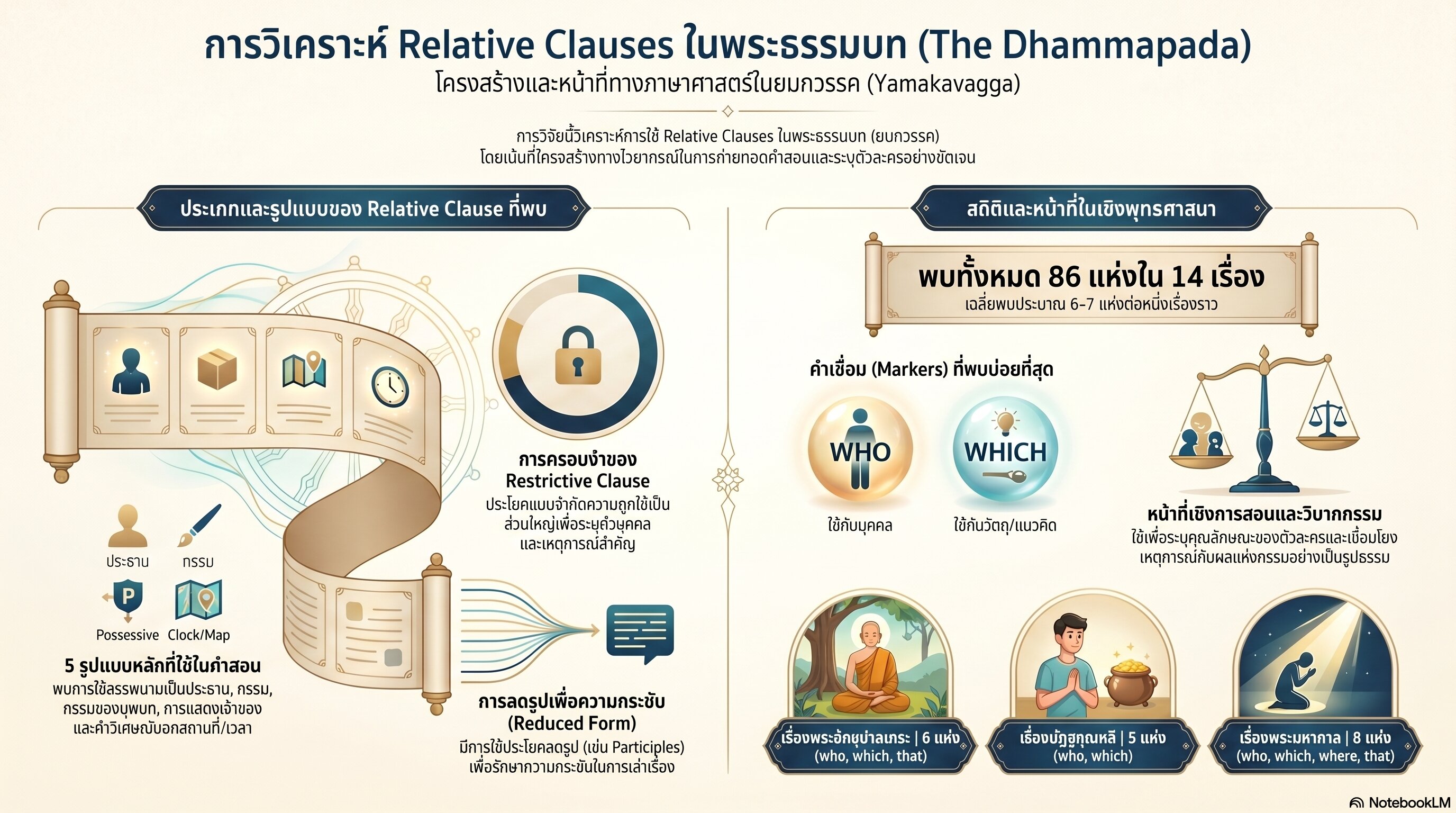
This research was two objectives: 1) to analyze the types and forms of relative clauses found in The Dhammapada by Ven. Weragoda Sarada Maha Thero 2) to determine the frequency of usage of relative clauses in The Dhammapada by Ven. Weragoda Sarada Maha Thero. The study is qualitative research in nature focusing on a documentary method through reading and studying based on the Buddhist book of Dhammapada concerning the topic of the problem taken from 14 stories in the Buddhist Sutta Pitaka of Yamaka Vagga (Twin Verses) presented from the Suttanta Pitaka. The data were collected and used to apply for analysis designed by the researcher under qualitative method from the Dhammapada of stories translated by Ven. Weragoda Sarada Maha Thero. The data analysis led to a comprehensive understanding of the method of the study based on the critical analysis of syntactic knowledge. The result of research found as follow: The textual analysis of fourteen stories revealed that relative clauses constitute a crucial stylistic and grammatical device in Buddhist narrative discourse. Five principal forms were identified: (a) relative pronoun as subject, (b) relative pronoun as object, (c) relative pronoun as object of a preposition, (d) possessive relative clause, and (e) adverbial relative clause of place or time. In addition, reduced relative clauses were also found, reflecting efforts to maintain narrative conciseness. Restrictive relative clauses dominated the text, serving to identify and specify individuals and events, whereas non-restrictive forms provided elaboration and moral emphasis. For the second objective, a total of 86 relative clauses were recorded, averaging 6–7 per story. The relative pronoun as subject was the most frequent type, while the possessive form was least frequent. The most common markers included who, which, that, where, when, and whose. The findings indicate a patterned and consistent distribution, aligning with oral narrative traditions that prioritize cohesion, clarity, and the reinforcement of doctrinal themes. In conclusion, the study demonstrates that relative clauses in the Yamaka Vagga serve a dual function. Linguistically, they enhance syntactic clarity and textual cohesion. Narratively, they embed moral and doctrinal significance into characters and events, highlighting karmic consequences and ethical teachings. The consistent use of relative clauses across all stories underscores their central role in Buddhist narrative style and their importance as a translation strategy in conveying both grammatical precision and spiritual instruction.
References
Azar, B. S. (1999). Understanding and using English grammar. Pearson Education.
Dharmawati, & Mulyadi. (2021). A study on relative clause in English, Indonesian and Arabic language: A comparative analysis. Journal of Language Teaching and Learning, Linguistics and Literature, 9(1), 109–115.
Eastwood, J. (1994). Oxford guide to English grammar. Oxford University Press.
Huddleston, R., & Pullum, G. K. (2010). A student’s introduction to English grammar. Cambridge University Press.
Juliarta, I. M. (2022). Relative clause and its translation found in The Good Earth. Focus Journal: Language Review, 1(2), 1–10.
Leenakitti, N., & Pongpairoj, N. (2019). A study of translation of relative clauses from English into Thai. PASAA, 58, 95–130.
Oshima, A., & Hogue, A. (1999). Writing academic English (3rd ed.). Pearson Longman.
Purnamasari, A. (2020). Relative clauses and their implications for students’ and teachers’ grammatical awareness. International Journal of Social Sciences, 6(1), 449–455.
Quirk, R., Greenbaum, S., Leech, G., & Svartvik, J. (1985). A comprehensive grammar of the English language. Longman.
Rattanasak, S. (2013). Acquisition of English non-restrictive relative clauses: An interlanguage study of Thai EFL students (Master’s thesis). Thammasat University.
Roberts, E. V., & Jacobs, H. E. (2003). Literature: An introduction to reading and writing. Prentice Hall.
Seaton, A., & Mew, Y. H. (2007). Basic English grammar. Saddleback Educational Publishing.
Tahamid Ar Rabbi, & Kabir, M. N. (2024). Literature review in applied linguistics: A conceptual framework (T. Karunakaran, Ed.). Kumaran Book House.
Tipparach, J., et al. (2021). A study of English relative clauses appearing in CNN business news online. Journal of Graduate School, Pitchayatat, 16(1), 43–57.
Ven. Weragoda Sarada Thero. (1993). The treasury of truth: The Dhammapada. The Corporate Body of the Buddha Educational Foundation.
Yule, G. (2006). The study of language (3rd ed.). Cambridge University Press.
Downloads
Published
How to Cite
Issue
Section
License
Copyright (c) 2026 Author(s)

This work is licensed under a Creative Commons Attribution-NonCommercial-NoDerivatives 4.0 International License.