An Analysis of Past Tenses found in the Dhammapada of “Treasury of Truth” Translated by Ven. Weragoda Sarada Maha Thero
Keywords:
Past tenses, Syntactic Analysis, Dhammapada Buddhist Stories, Yamaka Vagga, Frequency analysisAbstract
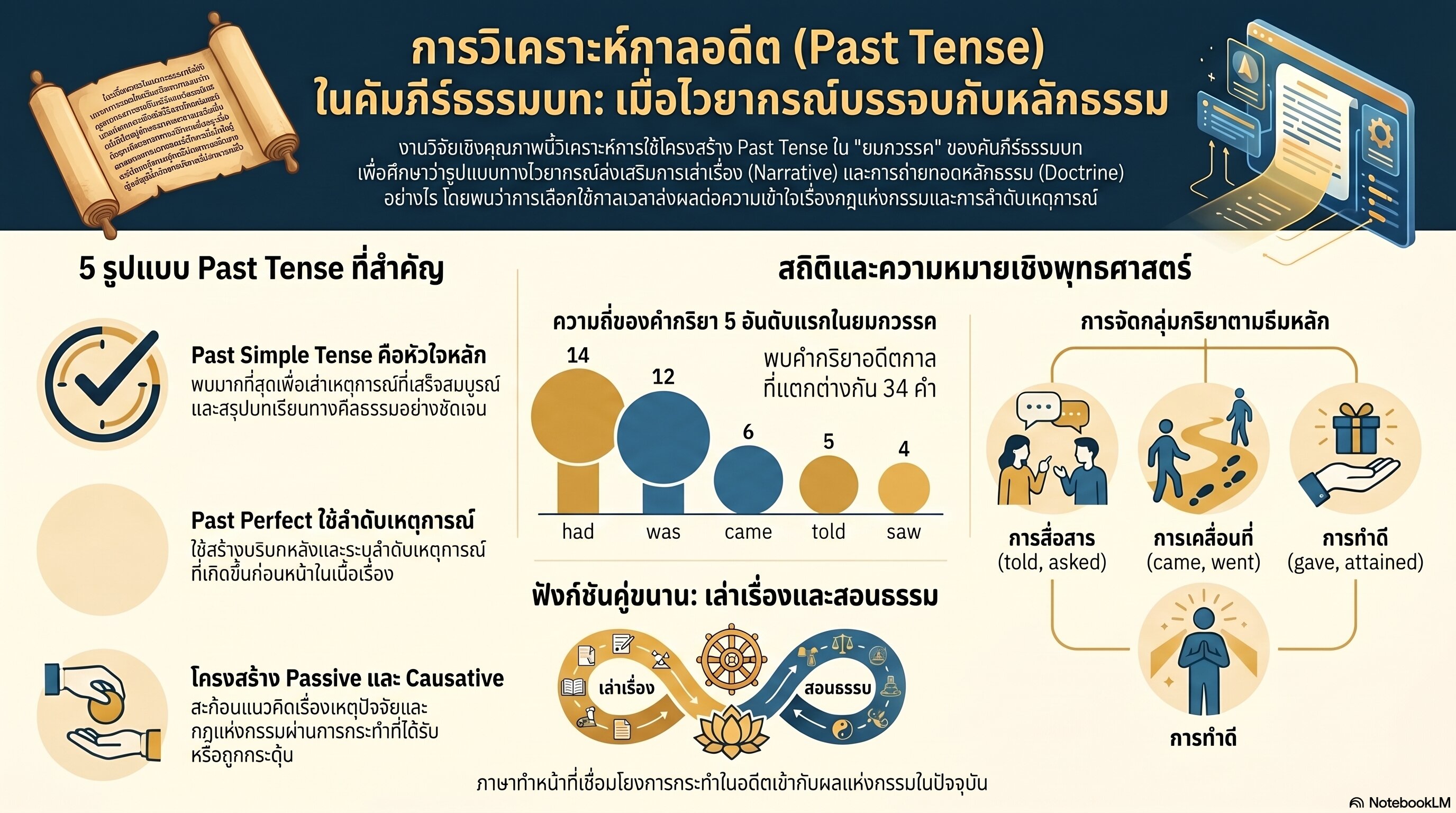
This research investigates the use of past tense constructions in The Dhammapada translated by Ven. Weragoda Sarada Maha Thero, with a focus on the Yamaka Vagga (Twin Verses) section. The research was two objectives: 1). to investigate the types and forms of past tense found in “The Dhammapada” by Ven. Weragoda Sarada Maha Thero 2). to find out the frequency of past forms that occurred in “The Dhammapada” by Ven. Weragoda Sarada Maha Thero. A syntactic and frequency analysis was conducted across fourthteen narratives within the Yamaka Vagga, which are rich in both grammatical structures and doctrinal content. The data were collected and used to apply for analysis designed by the researcher under qualitative method from the Dhammapada of stories translated by Ven. Weragoda Sarada Maha Thero. The data analysis led to a comprehensive understanding of the method of the study based on the critical analysis of syntactic knowledge. The findings reveal that five principal types of past tense constructions are employed: past simple, past perfect, past continuous, passive and causative structures, and complex/compound sentences. Among these, the past simple tense is the most frequently used, primarily to narrate completed events and to convey moral lessons in a clear, direct manner. Past perfect tense constructions are used to provide background context and establish temporal sequencing, while past continuous tense appears less frequently but contributes descriptive detail. Passive and causative forms highlight actions received or caused, reflecting Buddhist notions of causality and karma. Complex and compound sentences further enrich the narrative, aligning with oral storytelling traditions. The frequency analysis identified 34 distinct past tense verbs, with the most frequent being had, was, came, told, saw, and gave. These verbs cluster around three thematic domains: communication (e.g., told, asked), movement (e.g., came, went), and moral action (e.g., gave, attained). Such repetition strengthens cohesion across stories and underscores central Buddhist teachings of generosity, mindfulness, and karmic consequence. In conclusion, the study demonstrates that the linguistic style of the Yamaka Vagga relies predominantly on past simple verbs to ensure narrative clarity, supported by past perfect, continuous, and passive forms for temporal precision and doctrinal emphasis. The findings affirm that past tense constructions serve both narrative and doctrinal functions, effectively linking language use with the transmission of Buddhist values.
References
Azar, B. S. (1989). Fundamentals of English grammar. Prentice Hall.
Blakesley, D., & Hoogeveen, J. L. (2011). Writing: A manual for the digital age. Cengage Learning.
Bradley, S. W. (2015). English grammar is simple: Understanding English grammar. Booktango.
Brumfit, C. J., & Carter, R. A. (1986). Literature and language teaching. Oxford University Press.
Carter, R. A., & Long, M. N. (1991). Teaching literature. Longman.
Celce-Murcia, M., & Larsen-Freeman, D. (1999). The grammar book: An ESL/EFL teacher’s course (2nd ed.). Heinle & Heinle.
Crystal, D. (1994). The Cambridge encyclopedia of the English language. Cambridge University Press.
Cohen, L., Manion, L., & Morrison, K. (2002). Research methods in education. Routledge.
Creswell, J. W., & Poth, C. N. (2016). Qualitative inquiry and research design: Choosing among five approaches. SAGE Publications.
Eastwood, J. (2002). Oxford guide to English grammar. Oxford University Press.
Fraenkel, J. R., Wallen, N. E., & Hyun, H. H. (2012). How to design and evaluate research in education (7th ed.). McGraw-Hill.
Frank, M. (1972). Modern English: A practical reference guide. Prentice Hall.
Greenbaum, S., & Quirk, R. (2009). A student’s grammar of the English language. Longman.
Hariyono, R., & Wilkinson, B. L. (2008). Essential ABC English grammar. Lintas Media.
Hişmanoğlu, M. (2005). Teaching English through literature. Journal of Language and Linguistic Studies, 1(1), 53–66.
Iamsirirak, E., & Phoocharoensil, S. (2023). The recognition of English tenses by Thai EFL learners. Journal of Higher Education Theory and Practice, 23(19), 7–18.
Joshi, M. (2014). Using tenses in English: Past, present, future. Manik Joshi.
Joyce, H., & Feez, S. (2000). Writing skills: Narrative and non-fiction text types. Phoenix Education.
Klammer, T. P., Schulz, M. R., & Volpe, A. D. (2004). Analyzing English grammar (4th ed.). Pearson.
Larsen-Freeman, D., & Celce-Murcia, M. (2016). The grammar book: Form, meaning, and use for English language teachers (3rd ed.). National Geographic Learning.
Lim, S. (2016). English improvement series: Book 1. Susan Lim.
Morley, D. G. (2000). Syntax in functional grammar: An introduction to lexicogrammar in systemic linguistics. Continuum.
Narayanaswamy, & Ravindra Kumar, G. R. (1995). Morphology of zircons in massive and incipient charnokites of southern Kerala: Their bearing on the origin. Current Science, 69(11), 941–944.
Payne, E. T. (2011). Understanding English grammar: A linguistic introduction. Cambridge University Press.
Pongpairoj, N. (2017). Lexical aspect and the use of simple past tense by Thai learners of English. MANUSYA: Journal of Humanities, 20(3), 1–18.
Prapobaratanakul, C., & Pongpairoj, N. (2016). Variable production of English past tense morphology: A case study of a Thai-speaking learner of English. PASAA, 51, 70–95.
Roberts, E. V., & Jacobs, H. E. (2003). Literature: An introduction to reading and writing. Prentice Hall.
Seaton, A., & Mew, Y. H. (2007). Basic English grammar. Saddleback Educational Publishing.
Sugiarto, D., & Sumarsono, P. (2014). The implementation of think-pair-share model to improve students’ ability in reading narrative texts. International Journal of English and Education, 3(3), 206–215.
Susilawati, F. (2017). Teaching writing of narrative text through digital comic. Journal of English and Education, 5(2), 103–111.
Thomson, A. J., & Martinet, A. V. (1985). A practical English grammar. Oxford University Press.
Ven. Weragoda Sarada Thero. (1993). The treasury of truth: The Dhammapada. The Corporate Body of the Buddha Educational Foundation.
Wipawin, P. (2017). Error analysis of past simple and past continuous tenses at a secondary school (Master’s thesis). Thammasat University.
Wongsothorn, A. (2000). Language teaching methodology for Thai learners. Chulalongkorn University Press.
Yamput, S. (2011). An error analysis of the use of past simple and past continuous tenses by first-year students at Silpakorn University (Master’s thesis). Thammasat University.
Yule, G. (2006). The study of language (3rd ed.). Cambridge University Press.
Downloads
Published
How to Cite
Issue
Section
License
Copyright (c) 2026 Author(s)

This work is licensed under a Creative Commons Attribution-NonCommercial-NoDerivatives 4.0 International License.