A Review of Research on Teachers' Professional Identity
Keywords:
Teachers’ Professional Identity, Teacher Development, Professional GrowthAbstract
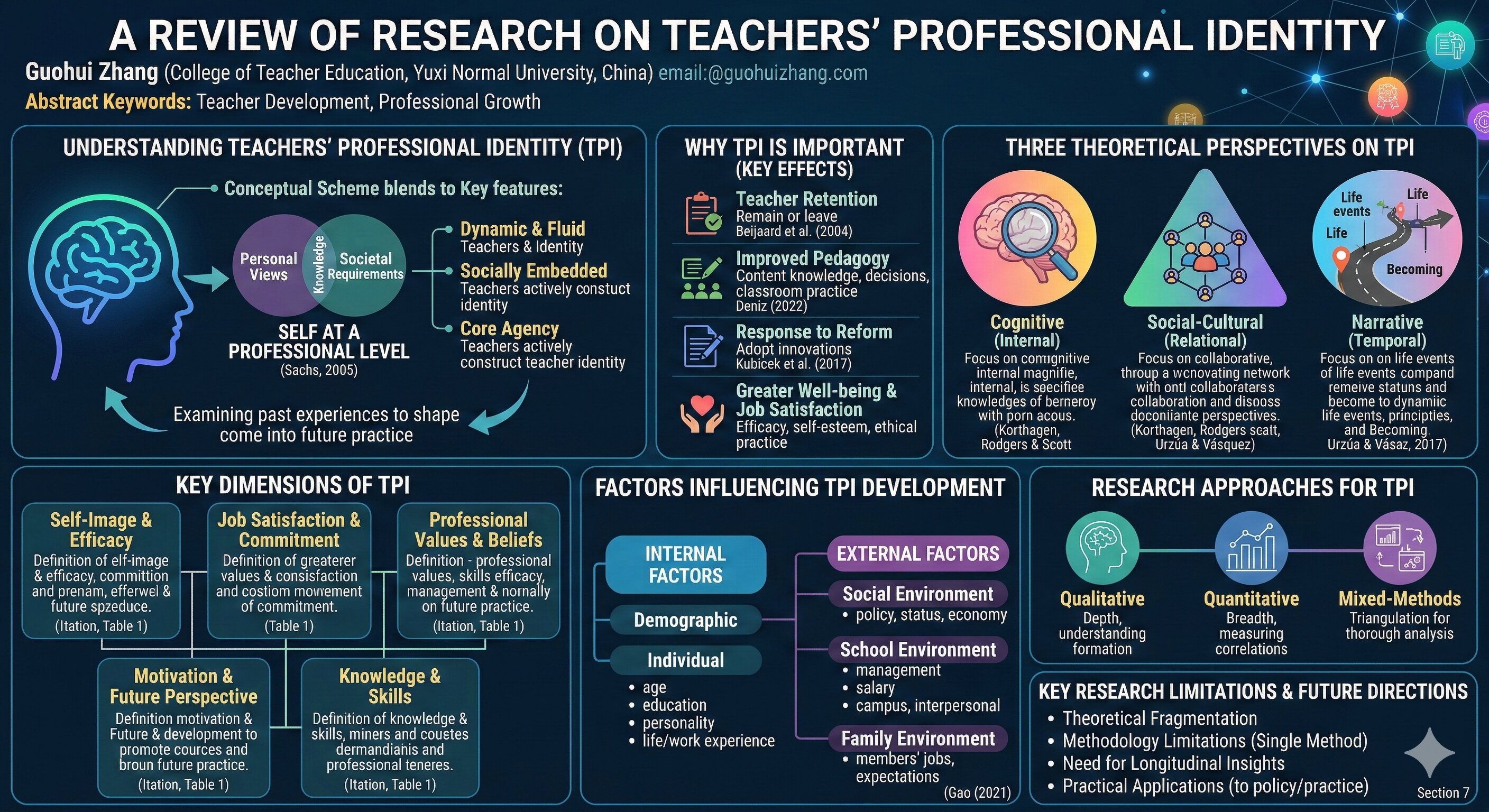
Teachers' Professional Identity (TPI) is a dynamic, multi-faceted construct affecting career destinations, pedagogy, and self-concept. The definition, theoretical underpinnings, predominant dimensions, determinant variables, and approaches to researching TPI are discussed in this thesis in a review of the extant literature. The deficits in current and allied studies are critiqued against this to promote development in associated studies.
References
Atai, M. R., & Khazaee, M. (2014). Exploring Iranian EAP Teachers' Pedagogical Content Knowledge and Their Professional Identity. Issues in Language Teaching, 3(1), 35-51.
Atal, D., & Deryakulu, D. (2019). The effects of educational changes on the professional identities of information and communication technologies teachers. Pegem Eğitim ve Öğretim Dergisi, 9(3), 877-912.
Beauchamp, C., & Thomas, L. (2009). Understanding teacher identity: An overview of issues in the literature and implications for teacher education. Cambridge Journal of Education, 39(2), 175-189.
Beijaard, D. (2000). Teachers’ prior experiences and actual perceptions of professional identity. Teachers and Teaching, 6(3), 281-294.
Beijaard, D., Meijer, P. C., & Verloop, N. (2004). Reconsidering research on teachers’ professional identity. Teaching and Teacher Education, 20(2), 107-128.
being and turnover intentions among rural school teachers: school organizational
Bukor, E. (2015). Exploring teacher identity from a holistic perspective: Reconstructing and reconnecting personal and professional selves. Teachers and Teaching, 21(3), 305–327.
Burns, D., & Bell, M. (2011). The professional identity of teacher educators: Career on the cusp? Professional Development in Education, 37(5), 701-715.
Canrinus, E. T., Helms-Lorenz, M., Beijaard, D., Buitink, J., & Hofman, A. (2012). Self-efficacy, job satisfaction, motivation and commitment: Exploring the relationships between indicators of teachers’ professional identity. European journal of psychology of education, 27, 115-132.
Celebi, E., & Eraldemir-Tuyan, S. (2022). Transformative Experiences of EFL Lecturers' Professional Identity in Online Education. European Journal of Educational Research, 11(2), 795-804.
Chang, C. P., Chiu, L. Y., & Liu, J. (2017). A study on the relationship between well
climate as a moderating variable. Creative Education, 8(4), 523-538.
Cross, R. (2020). The 'subject' of Freeman & Johnson's reconceived knowledge base of second language teacher education. Language Teaching Research, 24(1), 37-48.
Day, C. (2002). Developing teachers: The challenges of lifelong learning. Routledge.
De Fina, A., Schiffrin, D., & Bamberg, M. (Eds.). (2006). Discourse and identity. UK: Cambridge University Press.
Deniz, Ü. (2022). What should we understand from teachers' professional identity? An overview of the literature. Journal of Innovative Research in Teacher Education, 3(2), 113-127.
Dilek, E., & Atlas, B. (2022). The relationship between EFL teachers’ professional identity and professional autonomy. Asian Journal of Education and Training.
Donato, R. (2017). Foreign language teacher development: What does identity have to do with it? In G. Barkhuizen (Ed.), Reflections on language teacher identity research (pp. 24-30). New York, NY: Routledge, Taylor & Francis Group.
Eslamdoost, S., King, K. A., & Tajeddin, Z. (2020). Professional identity conflict and (re) construction among English teachers in Iran. Journal of Language, Identity & Education, 19(5), 327-341.
Esteve, J. M. (2009). Professional identity and professional autonomy. Educational Philosophy and Theory, 41(2), 106-119.
Eteläpelto, A., & Vähäsantanen, K. (2006). Developing adult learners' professional expertise. International Journal of Educational Research, 45(4-5), 383-395.
Fahd Aljuhaish, S., Othman, J., & Senom, F. (2020). Saudi EFL teachers’ identity formation in Saudi schools: a case study. Arab World English Journal, 11(3), 431-445.
Flores, M. A., & Day, C. (2006). Contexts which shape and reshape new teachers’ identities: A multi-perspective study. Teaching and teacher education, 22(2), 219-232.
Gao, S. M. (2021). A Review of Research on Teachers' Professional Identity. University, 34,131-133.
Ghafar Samar, R., Kiany, G. R., Akbari, R., & Azimi, H. (2011). Institutional identity of teachers: A determinant of teacher efficacy. TELL, 5(2), 31-59.
Halim Masnan, A., Abdullah, A. H., Mokhtarpour, M., & Nordin, N. M. (2021). Influences on the development of teacher identity. Malaysian Online Journal of Educational Management, 9(3), 65-83.
Hashemi, M. R., Karimi, M. N., & Mofidi, M. (2021). Developing and validating an EFL teacher professional identity inventory: a mixed methods study. Mextesol Journal, 45(1), n1.
Heled, E., & Davidovich, N. (2019). The Impact of Academic, Personal, and Professional Attributes on the Occupational Identity of School Counselors in Israel. International Journal of Educational Methodology, 5(4), 513-523.
Hong, J. Y. (2010). Pre-service and beginning teachers’ professional identity and its relation to dropping out of the profession. Teaching and Teacher Education, 26(8), 1530-1543.
Huang, I. C., & Varghese, M. M. (2015). Toward a composite, personalized, and institutionalized teacher identity for non-native English speakers in US secondary ESL programs. Critical Inquiry in Language Studies, 12(1), 51-76.
Ibarra, H. (1999). Provisional Selves: Experimenting with Image and Identity in Professional Adaptation. Administrative Science Quarterly, 44(4), 764-791.
İlgan, A. C., Haktanır, G., & Akbaşlı, S. (2015). Professional identity and teaching responsibilities. Educational Sciences: Theory & Practice, 15(2), 427-439.
Ivanova, A., & Skara-Mincne, G. (2016). Teachers' professional identity and its influence on instructional approaches. Teaching and Teacher Education, 58, 120- 130.
June). Leaving civil engineering: Examining the intersections of gender, disability, and professional identity. In American Society for Engineering Education Annual Conference. Retrieved from https://par.nsf.gov/servlets/purl/10172214
Kelchtermans, G. (2009). Who I am in how I teach is the message: Self-understanding, vulnerability and reflection. Teachers and Teaching: Theory and Practice, 15(2), 257–272.
Korthagen, F. A. J. (2004). In search of the essence of a good teacher: Towards a more holistic approach in teacher education. Teaching & Teacher Education: An International Journal of Research and Studies, 20(1), 77-97.
Kubicek, B., Korunka, C., & Hoonakker, P. (2017). Work and family identities and wellbeing: A longitudinal study of dual-earner couples. Journal of Vocational Behavior, 100, 169-182.
Kumpulainen, K. R., Sajaniemi, N., Suhonen, E., & Pitkäniemi, H. (2023). Occupational well-being and teamwork in Finnish early childhood education. Journal of Early Childhood Education Research, 12(2), 71-97.
Lasky, S. (2005). A sociocultural approach to understanding teacher identity, agency and professional vulnerability in a context of secondary school reform. Teaching and Teacher Education, 21(8), 899-916.
London, M. (1993). Relationships between career motivation, empowerment and support for career development. Journal of occupational and organizational psychology, 66(1), 55-69.
McCall, C., Paretti, M., McNair, L., Shew, A., Simmons, D., & Zongrone, C. (2020,
Moslemi, N., & Habibi, P. (2019). The relationship among Iranian EFL teachers’ professional identity, self-efficacy and critical thinking skills. How, 26(1), 107-128.
Nelson, M., & Brice Jr, J. (2008). Emotional and informational social support: Exploring contrasting influences on human resource management innovation. Journal of Organizational Culture, Communications and Conflict, 12(1), 71.
Olsen, B. (2008). Introducing teacher identity and this volume. Teacher Education Quarterly, 3-6.
Olsen, B., & Buchanan, R. (2017). “Everyone wants you to do everything”: Investigating the professional identity development of teacher educators. Teacher education quarterly, 44(1), 9-34.
Othman, J., & Aljuhaish, S. F. (2021). Factors Influencing Non-Native EFL Teachers' Identity Construction at a Saudi School in Kuala Lumpur, Malaysia. Arab World English Journal, 12(3), 524-537.
Pennington, M. C., & Richards, J. C. (2016). Teacher identity in language teaching: Integrating personal, contextual, and professional factors. RELC Journal, 47(1), 5-23.
Qadach, M., Schechter, C., & Da’as, R. A. (2020). Instructional leadership and teachers' intent to leave: The mediating role of collective teacher efficacy and shared vision. Educational Management Administration & Leadership, 48(4), 617-634.
Qadeer, A., Tahir, A., & Chishti, M. I. (2018). Beginning teachers’ professional self-image: reconciliation between teachers and head teachers. Journal of Educational Research, 21(1), 1027-9776.
Remley, T. P. Jr., & Herlihy, B. (2005). Ethical, legal, and professional issues in counseling (2nd ed.). Upper Saddle River, NJ: Pearson Education.
Rogers, C. R., & Scott, K. H. (2008). The development of the personal self and professional identity in learning to teach. In M. Cochran-Smith, S. Feiman-Nemser, D. J. McIntyre, & K. E. Demers (Eds.), Handbook of research on teacher education (pp. 732−746). New York: Routledge.
Sachs, J. (2005). Teacher education and the development of professional identity: Learning to be a teacher. In P. Denicolo & M. Kompf (Eds.), Connecting policy and practice: Challenges for teaching and learning in schools and universities (pp. 5–21). Oxford: Routledge.
Sercu, L. (2006). The foreign language of intercultural competence teacher: the acquisition of a new professional identity. Intercultural Education, 17(1), 55-72.
Shoulders, C. (2018). A Description of the Professional Identities of Arkansas Agriculture Teachers. Journal of Agricultural Education, 59(3), 278-290.
Simon, E. (2022). Development of Teachers' Professional Identity as a Second Career in the M. Teach Program as a Lever to Empower the Future Education System. Journal of Education and Learning, 11(2), 35-42.
Syah, M. F. J., Janudin, S. E., Mansor, M., Fuadi, D., Widiastuti, R., Romadhoni, D. N., & Hafidah, A. S. (2022). The Development of Indonesian Accounting Teacher Professional Identity Measurement: An Exploratory Factor Analysis. European Journal of Educational Research, 11(1), 33-49.
Urzúa, A., & Vásquez, C. (2008). Reflection and professional identity in teachers’ future-oriented discourse. Teaching and Teacher Education, 24, 1935-1946.
Vähäsantanen, K., & Eteläpelto, A. (2009). Teachers' professional agency in transition. Teaching and Teacher Education, 25(3), 370-377.
Veisson, M., & Kabaday, A. (2018). Exploring the Preschool Teachers’ Views on Professionalism, Quality of Education and Sustainability: International Study in Estonia and Turkey. Journal of Teacher Education for Sustainability, 20(2), 5-18.
Volkov, Y. G., & Chikarova, G. I. (2021). Digital Transformation of Russian Society as a Condition of Forming Young Teachers' Professional Identity in a Big City. World Journal on Educational Technology: Current Issues, 13(2), 288-296.
Walters, W., Robinson, D. B., & Walters, J. (2020). Mentoring as meaningful professional development: The influence of mentoring on in-service teachers' identity and practice. International Journal of Mentoring and Coaching in Education, 9(1), 21-36.
Wei, S. H. (2008). Research on Teachers' Professional Identity (Doctoral dissertation, Southwest University). Retrieved from https://chn.oversea.cnki.net/index/
Widodo, H. P., Fang, F., & Elyas, T. (2020). The construction of language teacher professional identity in the Global Englishes territory: ‘we are legitimate language teachers’. Asian Englishes, 22(3), 309-316.
Yang, J., Buck, G. A., & Nageotte, N. (2022). The Self-Study Process of a Scientist as She Delineated the Meaning of Scientific Inquiry and Developed a New Professional Identity as a Science Teacher Educator. International Journal of Research in Education and Science, 8(2), 408-429.
Yazan, B. (2019). “You Learn Best When You Feel Safe and Supported”: TESOL Interns’ Professional Identity Development in a Year-long, Seminar/Practicum-based Teacher Education Program. Critical Inquiry in Language Studies, 16(2), 73-101.
Downloads
Published
How to Cite
Issue
Section
Categories
License
Copyright (c) 2026 Journal of Buddhist Education and Research (JBER)

This work is licensed under a Creative Commons Attribution-NonCommercial-NoDerivatives 4.0 International License.