The Enhancement of Social-Emotional Learning among Primary Students through Group Activities
Keywords:
Primary school students; social and emotional learning; group activities; emotional abilityAbstract
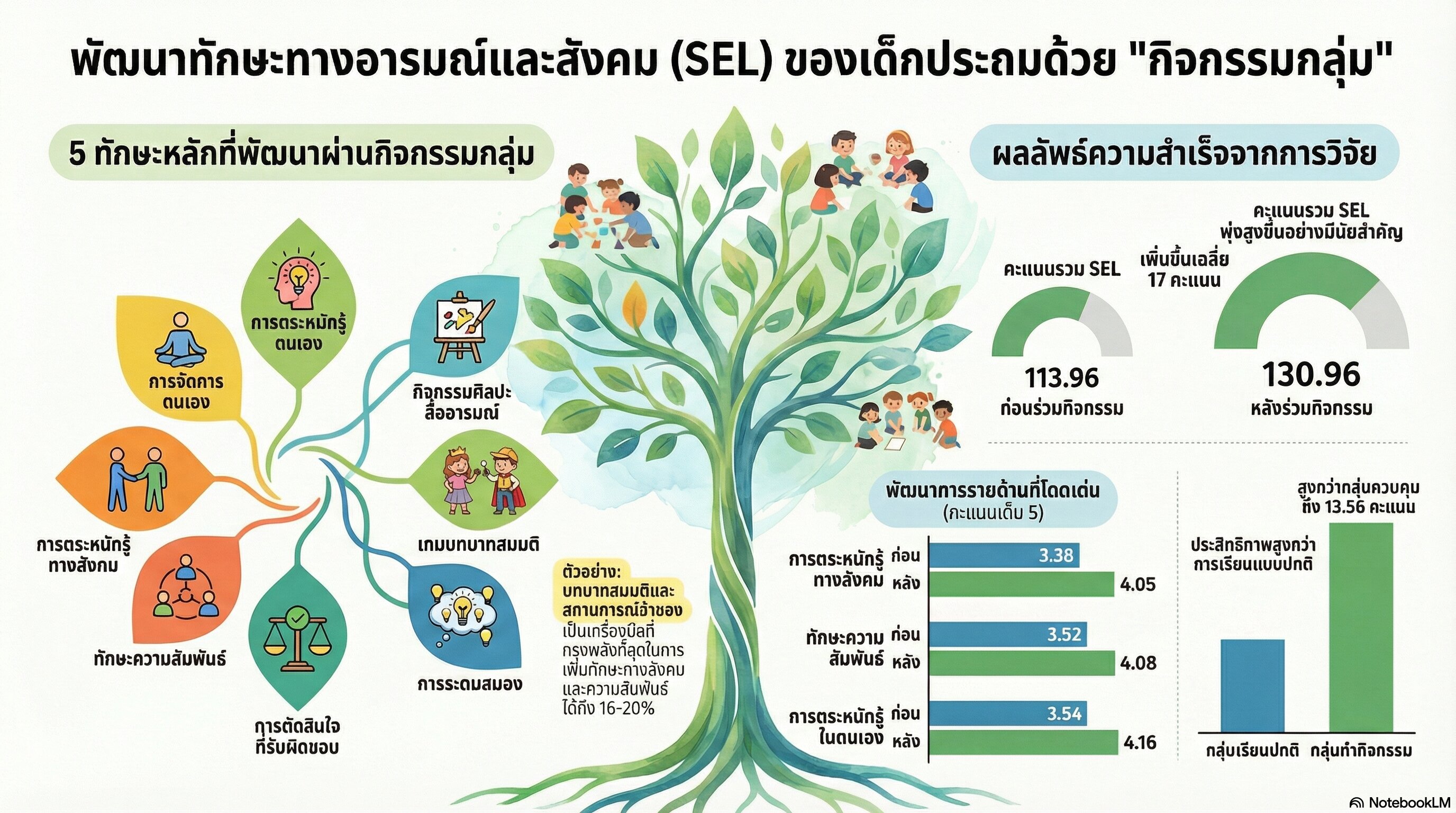
This study aims to: 1) explore the SEL situation of students; 2) compare the SEL levels of students before and after participating in group activities; 3) compare the SEL levels of students in the experimental group and the control group after participating in group activities. The sample comprises third-grade primary students in Ganzhou City, Jiangxi Province, China. A quantitative quasi-experimental design was used. Four classes (200 students) were randomly selected from twelve in stage one, with equal selection probability. In stage two, students completed questionnaires, and two low-scoring classes with no significant differences were randomly assigned to the experimental and control groups, each with 50 students. The research tools are group activities and questionnaires. Quantitative data descriptive statistical analysis, including mean and standard deviation, and t-test dependent were used to compare and analyze SEL data before and after participating in group activity, and t-test independent was used to compare and analyze the SEL of the experimental group. The research results are as follows: 1) The overall SEL level of the students is relatively high. 2) After participating in group activities, the SEL scores of the experimental group were significantly higher than those before the activities. 3) After the group activity intervention, the SEL scores of the experimental group were significantly higher than those of the control group, and the difference was statistically significant.
References
Agırkan, M. (2023). The mediating effect of social emotional learning between relationship on basic psychological needs and technology addiction. Journal of Education in Science Environment and Health, 9(4), 268-280.
AlMutairi, A. N. M. (2015). The Effect of Using Brainstorming Strategy in Developing Creative Problem Solving Skills among Male Students in Kuwait: A Field Study on Saud Al-Kharji School in Kuwait City. Journal of Education and Practice, 6(3), 136-145.
Ashrafzade, T., Mesrabadi, J., Yarigholi, B., & Sheikhalizade, S. (2023). Meta-analysis of the Impact of Cooperative Learning on Academic Performance. Journal of Educational Sciences, 30(2), 17-40.
Banaschewski, T., Becker, K., Döpfner, M., Holtmann, M., Rösler, M., & Romanos, M. (2017). Attention-deficit/hyperactivity disorder: a current overview. Deutsches Ärzteblatt International, 114(9), 149.
Bandura, A., & Walters, R. H. (1977). Social learning theory (Vol. 1). Prentice hall Englewood Cliffs, NJ.
Campbell, D. T., & Cook, T. D. (1979). Quasi-experimentation. Chicago, IL: Rand Mc-Nally, 1(1), 1-384.
Cherniss, C., Roche, C., & Barbarasch, B. (2004). Emotional intelligence. Encyclopedia of applied psychology, 3.
Diamond, A., & Lee, K. (2011). Interventions shown to aid executive function development in children 4 to 12 years old. Science, 333(6045), 959-964.
Elias, M. J., & Clabby, J. F. (1992). Building social problem-solving skills: Guidelines from a school-based program. Jossey-Bass.
Forsyth, D. R. (2014). Group dynamics. Wadsworth Cengage Learning.
Gao, T., Meng, X., Qin, Z., Zhang, H., Gao, J., Kong, Y., Hu, Y., & Mei, S. (2018). Association between parental marital conflict and Internet addiction: A moderated mediation analysis. Journal of affective disorders, 240, 27-32.
Gillies, R. M. (2016). Cooperative learning: Review of research and practice. Australian Journal of Teacher Education (Online), 41(3), 39-54.
Gray, P. (2017). What exactly is play, and why is it such a powerful vehicle for learning? Topics in Language Disorders, 37(3), 217-228.
Gueldner, B. A., Feuerborn, L. L., & Merrell, K. W. (2020). Social and emotional learning in the classroom: Promoting mental health and academic success. Guilford Publications.
Harrington, D. W., & Simon, L. V. (2019). Designing a simulation scenario.
Johnson, S. R., Seidenfeld, A. M., Izard, C. E., & Kobak, R. (2013). Can classroom emotional support enhance prosocial development among children with depressed caregivers? Early Childhood Research Quarterly, 28(2), 282-290.
Jones, S., Brush, K., Ramirez, T., Mao, Z., Marenus, M., Wettje, S., Finney, K., Raisch, N., Podoloff, N., & Kahn, J. (2021). Navigating SEL from the inside out–Looking inside & across 33 leading SEL programs: A practical resource for schools and OST providers (Revised & expanded second edition). The EASEL Lab, Harvard Graduate School of Education, and The Wallace Foundation.
Kolb, D. A., Boyatzis, R. E., & Mainemelis, C. (2014). Experiential learning theory: Previous research and new directions. In Perspectives on thinking, learning, and cognitive styles (pp. 227-247). Routledge.
Kutnick, P., Ota, C., & Berdondini, L. (2008). Improving the effects of group working in classrooms with young school-aged children: Facilitating attainment, interaction and classroom activity. Learning and Instruction, 18(1), 83-95.
Lillard, A. S., Lerner, M. D., Hopkins, E. J., Dore, R. A., Smith, E. D., & Palmquist, C. M. (2013). The impact of pretend play on children's development: a review of the evidence. Psychological bulletin, 139(1), 1.
Agırkan, M. (2023). The mediating effect of social emotional learning between relationship on basic psychological needs and technology addiction. Journal of Education in Science Environment and Health, 9(4), 268-280.
Diamond, A., & Lee, K. (2011). Interventions shown to aid executive function development in children 4 to 12 years old. Science, 333(6045), 959-964.
Gueldner, B. A., Feuerborn, L. L., & Merrell, K. W. (2020). Social and emotional learning in the classroom: Promoting mental health and academic success. Guilford Publications.
Li, F., Cui, Y., Li, Y., Guo, L., Ke, X., Liu, J., Luo, X., Zheng, Y., & Leckman, J. F. (2022). Prevalence of mental disorders in school children and adolescents in China: diagnostic data from detailed clinical assessments of 17,524 individuals. Journal of Child Psychology and Psychiatry, 63(1), 34-46.
Organization, W. H., & Fund, U. N. C. s. (2024). Marketing of breast-milk substitutes: national implementation of the International Code, status report 2024. World Health Organization.
Selman, R. L. (2003). Promotion of Social Awareness: Powerful Lessons for the Partnership of Developmental Theory and. Russell Sage Foundation.
Malchiodi, C. A. (2020). Trauma and expressive arts therapy: Brain, body, and imagination in the healing process. Guilford Publications.
Organization, W. H., & Fund, U. N. C. s. (2024). Marketing of breast-milk substitutes: national implementation of the International Code, status report 2024. World Health Organization.
Olweus, D., & Breivik, K. (2014). Plight of victims of school bullying: The opposite of well-being. Handbook of child well-being, 2593, 2626.
Roeser, R. W., Galla, B., & Baelen, R. N. (2020). Mindfulness in schools: Evidence on the impacts of school-based mindfulness programs on student outcomes in P–12 educational settings.
Schwartz, S. J., Hardy, S. A., Zamboanga, B. L., Meca, A., Waterman, A. S., Picariello, S., Luyckx, K., Crocetti, E., Kim, S. Y., & Brittian, A. S. (2015). Identity in young adulthood: Links with mental health and risky behavior. Journal of Applied Developmental Psychology, 36, 39-52.
Selman, R. L. (2003). Promotion of Social Awareness: Powerful Lessons for the Partnership of Developmental Theory and. Russell Sage Foundation.
Yang, Y., & Wang, S. (2023). The relationship between exam anxiety, academic performance and peer support among 9th grade students in Shenzhen, China. Curriculum & Innovation, 1(1), 8-18.
Zhou, M., & Ee, J. (2012). Development and validation of the social emotional competence questionnaire (SECQ).
Downloads
Published
How to Cite
Issue
Section
Categories
License
Copyright (c) 2026 Journal of Buddhist Education and Research (JBER)

This work is licensed under a Creative Commons Attribution-NonCommercial-NoDerivatives 4.0 International License.