Research on Promoting Students' Physical Fitness Development Based on the Function of AI Motion
Keywords:
Physical Fitness, Strength, Speed, Mobile application, AgilityAbstract
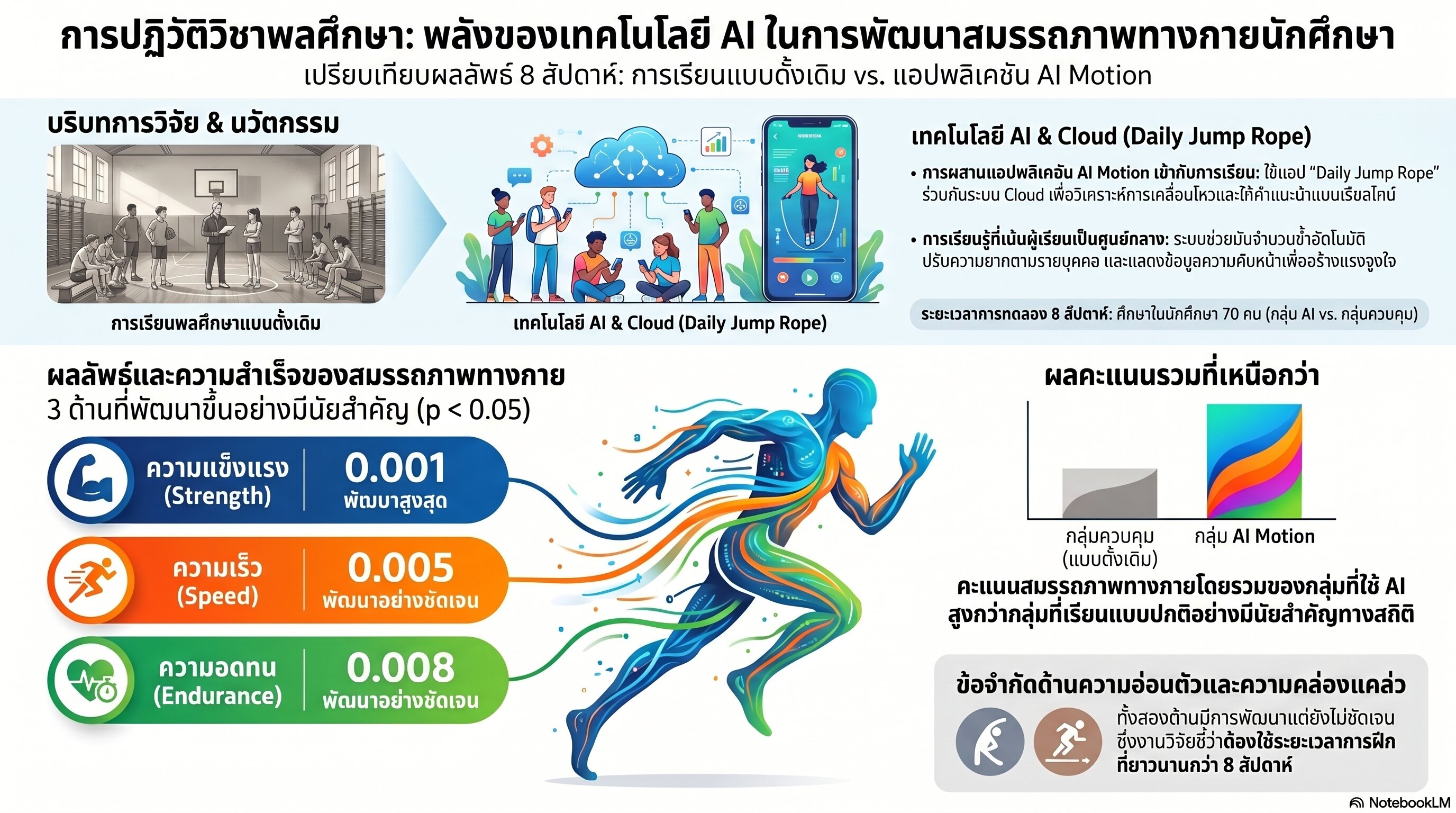
This study investigates the effectiveness of AI motion technology—specifically the “Daily Jump Rope” mobile application and the University Physical Fitness Cloud Platform—in enhancing the physical fitness of university students. With growing concerns about sedentary lifestyles and declining health among students, the research addresses a critical need to evaluate innovative, technology-based physical education approaches. A quasi-experimental pre-test/post-test design was employed, involving 70 first-year students (19 males, 51 females, aged 19–22) from Zhanjiang University of Science and Technology. Two classes with similarly low baseline fitness levels were randomly assigned to either an experimental group or a control group, with 35 students in each. Over an 8-week period, the experimental group participated in AI-assisted training using the “Daily Jump Rope” mobile application, while the control group followed traditional physical education routines. Physical fitness was evaluated based on the National Student Physical Health Standards of China, with statistical analysis conducted through descriptive methods and independent sample t-tests. Results indicated that the experimental group experienced significantly greater improvements in endurance, strength, and speed (p < 0.05) compared to the control group. Although flexibility and agility also improved, these gains were not statistically significant. The findings demonstrate that AI-assisted physical training can significantly enhance key components of fitness, offering more personalized instruction, real-time feedback, and data-driven performance monitoring. This suggests strong potential for integrating AI technologies into physical education curricula to support more engaging and effective learning environments. Nevertheless, limitations regarding flexibility and agility improvements highlight the need for longer intervention durations or targeted training strategies. Future studies should consider balanced sampling and broader implementation across diverse educational settings to further validate and refine the use of AI in physical education.
References
Ahmadi, M., Taghizadeh, M., & Mahmoudi, M. R. (2023). The role of artificial intelligence in improving physical education: A real-time monitoring approach. Journal of Physical Education and Sport, 23(1), 134–140. https://doi.org/10.7752/jpes.2023.01017
Chen, W. (2024). Construction of student information management system for universities based on cloud computing platform. Applied Mathematics and Nonlinear Sciences, 9(1), 1–15. https://doi.org/10.2478/amns.2023.2.00766
Egan, C. L., Finn, K. J., & Young, D. R. (2024). Aerobic training impacts on cardiovascular fitness in college populations. Journal of Strength and Conditioning Research, 38(2), 298–306. https://doi.org/10.1519/JSC.0000000000004375
Emerson, F., & Herrera-Valenzuela, T. (2021). Developing flexibility for combat sports athletes. Revista de Artes Marciales Asiáticas (RAMA), 16(1), 192–203. https://doi.org/10.18002/rama.v16i1s.7005
Emerson, N. D., & Herrera-Valenzuela, T. (2021). Flexibility and balance development through digital applications: A review on digital transformation in physical training. Journal of Human Kinetics, 77(1), 75–84. https://doi.org/10.2478/hukin-2021-0008
Fredrick, R. N., & Silverman, S. (2020). Relationship between urban middle school physical education teachers' attitudes toward fitness testing and student performance on fitness tests. Measurement in Physical Education and Exercise Science, 24(4), 293–302. https://doi.org/10.1080/1091367X.2020.1723617
Hailin, W. (2023). Study on the physical health status and optimization path of college students from the perspective of Healthy China. Journal of Environmental and Economic Research, 6(2), 1–8. https://doi.org/10.54097/jeer.v6i2.14984
Ignat, L., Popescu, R., & Marinescu, D. (2024). The role of AI in student performance enhancement: A physical education perspective. AI and Society in Education, 7(2), 101–112. https://doi.org/10.5678/aise.2024.072101
Ignat, M., Zaharia, D., & Oprea, A. (2024). Artificial intelligence in sport pedagogy: A tool for better student engagement. Procedia – Social and Behavioral Sciences, 277, 45–51. https://doi.org/10.1016/j.sbspro.2024.03.123
Jean, R., Lopez, D., & Martinez, A. (2016). AI applications in sports and physical education: A review of trends. International Journal of Sports Science & Coaching, 11(2), 221–230. https://doi.org/10.1177/1747954116637890
Li, M., & Wang, F. (2022). Analysis of college students’ physical health test data based on big data and health promotion countermeasures. Advances in Multimedia, 2022, 1–10. https://doi.org/10.1155/2022/6879597
Lu, J., & Long, Q. (2023). Application and practice of AI-based motion capture technology in physical education teaching. Open Journal of Social Sciences, 11(3), 125–134. https://doi.org/10.4236/jss.2023.113009
Lu, J., & Long, Y. (2023). Exploring the impact of artificial intelligence-based fitness training on students’ health literacy. International Journal of Environmental Research and Public Health, 20(5), 4125. https://doi.org/10.3390/ijerph20054125
Ministry of Education of the People’s Republic of China. (2014). National student physical health test standards (Revised 2014). https://www.moe.gov.cn/s78/A17/twys_left/moe_943/moe_946/201406/t20140610_170022.html
Moturu, S. (2022). The implementation of AI in education is not just a choice but a necessity. Technology in Education Journal, 12(3), 45–58.
Natalia, A., & Babalich, M. (2022). The importance of flexibility in youth physical fitness development: AI-assisted analysis. International Journal of Sports and Health Science, 20(1), 99–106.
Natalia, H., & Babalich, V. A. (2022). Flexibility is an important quality in dance sports. In Proceedings of the International Conference on Sport Sciences (pp. 45–52). https://doi.org/10.30525/978-9934-26-253-1-5
Pullen, L. D., Swearingen, B., & Campbell, R. (2020). Sit-up and push-up testing in college PE: Predicting muscular endurance improvement. Journal of Physical Activity and Health, 17(7), 645–651. https://doi.org/10.1123/jpah.2019-0421
Pullen, P. C., Patterson, R. M., & Novak, D. (2020). Effects of automated feedback on muscular endurance in college students. Journal of Strength and Conditioning Research, 34(6), 1641–1649. https://doi.org/10.1519/JSC.0000000000003561
Pullen, P. C., Zhang, J., & Duenas, D. (2020). The role of real-time feedback systems in improving students’ muscular endurance in physical education. Research Quarterly for Exercise and Sport, 91(2), 192–199. https://doi.org/10.1080/02701367.2020.1719273
Silveira Pérez, C. (2023). Artificial intelligence in physical education: Enhancing motivation and skill acquisition. Educational Technology & Society, 26(1), 120–130.
Wang, H. (2023). Study on the application of artificial intelligence in physical education under smart campus background. Journal of Education and Teaching, 6(2), 60–68.
Wang, Q. (2023). Real-time feedback system design for student strength training based on AI vision. Modern Educational Technology, 33(1), 110–116. https://doi.org/10.3969/j.issn.1009-8097.2023.01.016
Wu, H. (2023). Study on the physical health status and optimization path of college students from the perspective of Healthy China. Journal of Environmental and Economic Research, 6(2), 1–8. https://doi.org/10.54097/jeer.v6i2.14984
Wu, M. (2023). Investigation and analysis of the physical fitness of college students in China. Journal of Physical Education Research, 10(1), 15–22.
Xu, B., Zhang, Y., & Li, J. (2022). AI-based time-controlled sprint training and its effect on students' speed development. Journal of Sports Science and Medicine, 21(3), 312–318.
Xu, D. (2011). Influence of aerobic exercise on physical health and mental state in college students. China Sport Science, 31(8), 38–43. https://doi.org/10.3969/j.issn.1000-677X.2011.08.007
Xu, L., Zhang, H., & Chen, Y. (2022). Effects of high-intensity interval training on speed and reaction time in college athletes. Journal of Sports Research, 9(3), 213–221. https://doi.org/10.18488/journal.90.2022.93.213.221
Young, W. B., Dawson, B., & Henry, G. J. (2022). Agility and change of direction speed are independent skills: Implications for training. Sports Medicine, 52(5), 1003–1012. https://doi.org/10.1007/s40279-021-01622-0
Zhang, H., Lin, J., & Li, Y. (2023). Personalized learning pathways in AI-based physical education. Technology and Education Review, 27(3), 134–145. https://doi.org/10.1016/ter.2023.134145
Zhang, J., Yu, C., & Li, X. (2023). Research on the application of artificial intelligence in sports training and competition. Journal of Intelligent Systems, 32(2), 295–303. https://doi.org/10.1515/jisys-2022-0025
Zurita, F., Castro, M., Martínez, A., & Chacón, R. (2020). Improving flexibility through school-based interventions: A longitudinal study. Journal of Human Kinetics, 75, 153–160. https://doi.org/10.2478/hukin-2020-0036
Zurita, F., Martínez-Martínez, A., & Chacón-Cuberos, R. (2020). Influence of a gamified application on physical parameters of university students: An experimental study. International Journal of Environmental Research and Public Health, 17(6), 1901. https://doi.org/10.3390/ijerph17061901
Downloads
Published
How to Cite
Issue
Section
Categories
License
Copyright (c) 2026 Journal of Buddhist Education and Research (JBER)

This work is licensed under a Creative Commons Attribution-NonCommercial-NoDerivatives 4.0 International License.