The Role of Extensive Reading in Enhancing Reading Ability of Thai EFL Undergraduate Learners
Abstract
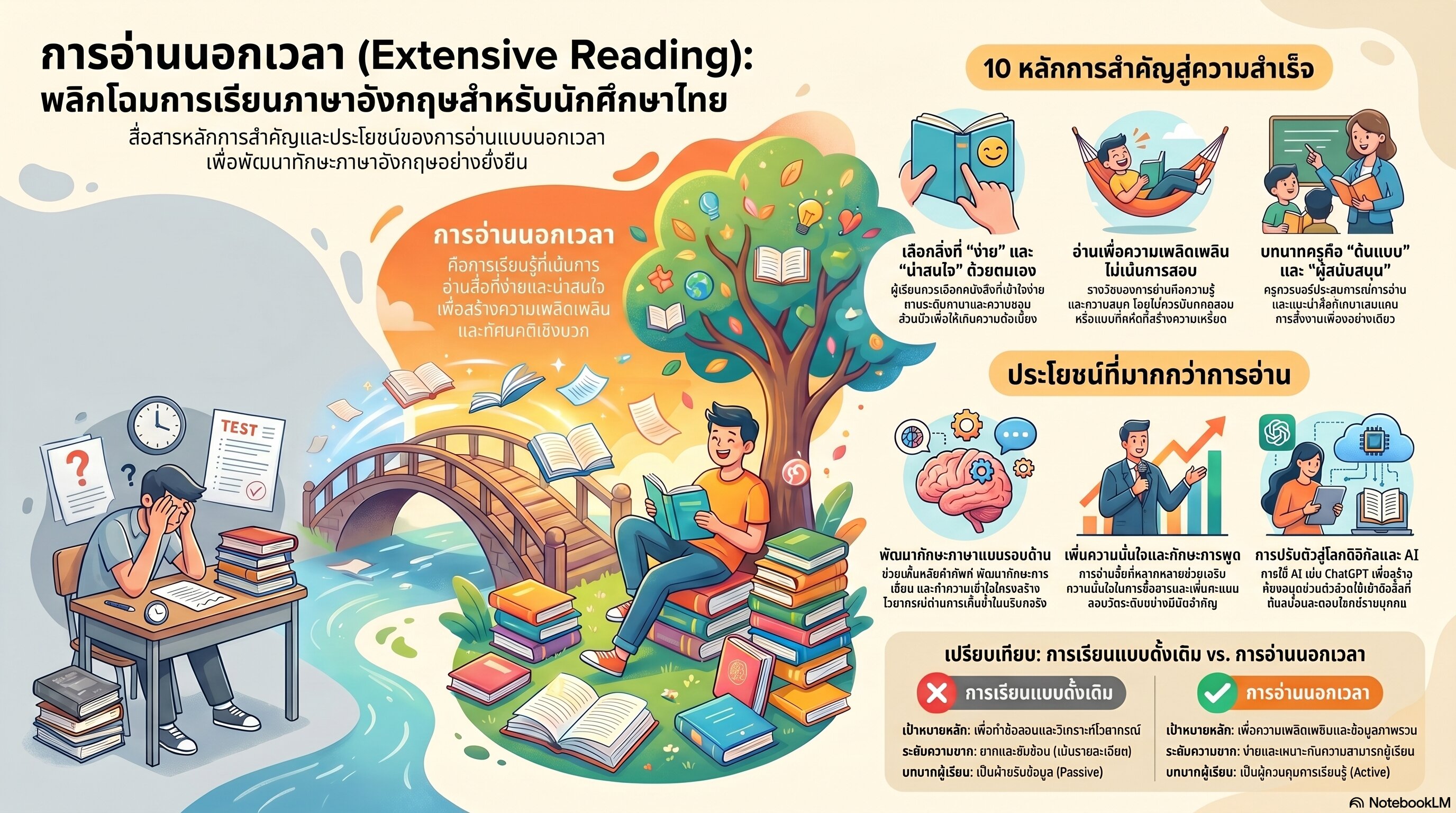
Since reading is one of the essential skills that helps learners improve all parts of the English language, bringing extensive reading (ER) apart from using only textbooks into learners’ attention is worthwhile spending time looking into it. It is widely known that many commercial textbooks used in English classes in all levels may not interest the learners in terms of level of difficulty, content, organization of the book etc. Consequently, the teaching approach in English reading should be employed some alternative reading activities into the class curriculum to increase learners’ interest and motivation in learning English. In this article, ER is discussed as a vital teaching approach that enhances Thai EFL undergraduate learners’ reading ability. Many researchers have investigated the effects of reading ability through the learning by using ER on Thai EFL learners and this article aims to provide the evidence for the role of ER in enhancing reading’s ability of Thai EFL undergraduate learners and discussed how teachers and learners can utilize this method in their courses.
References
Abame, A., Biraga, M., Abe, T., & Fantu, S. (2017). Improving reading comprehension through extensive reading: The case of WCU 2nd year English majoring students. International Journal of Research, 4(1), 660–668.
Azmuddin, R. A., Ali, Z., Ngah, E., Mohd Tamili, L., & Mohd Ruslim, N. (2014). Extensive reading using graded readers. International Journal of Research in Social Sciences, 3(8), 109–113.
Bamford, J., & Day, R. R. (Eds.). (2004). Extensive reading activities for teaching language. Cambridge University Press.
Celik, B. (2019). The role of extensive reading in fostering the development of grammar and vocabulary knowledge. International Journal of Social Sciences & Educational Studies, 6(1), 215–223. https://doi.org/10.23918/ijsses.v6i1p215
Day, R., & Bamford, J. (2002). Top ten principles for teaching extensive reading. Reading in a Foreign Language, 14(2), 136–141. http://jaltpublications.org/old_tlt/files/97/may/extensive.html
Freiermuth, M. R., & Ito, M. (2022). Battling with books: The gamification of an EFL extensive reading class. Simulation & Gaming, 53(1), 22–55. https://doi.org/10.1177/104687812110618
Grabe, W., & Stoller, F. L. (2011). Teaching and researching reading (2nd ed.). Routledge.
Han, J. (2010). Extensive reading conjoined with writing activities as an effective component of English as a second/foreign language programs (Master’s thesis). University of Wisconsin–River Falls. MINDS@UW. https://minds.wisconsin.edu/bitstream/handle/1793/39198/Han.pdf?sequence=1&isAllowed=y
Hayikaleng, N., Nair, S. M., & Krishnasamy, H. (2016). Thai students’ motivation of English reading comprehension. International Journal of Education and Research, 4(6), 1–10.
Hill, D. (2008). Graded readers in English. ELT Journal, 62(2), 184–204.
Huang, Y. C. (2015). Why don’t they do it? A study on the implementation of extensive reading in Taiwan. Cogent Education, 2(1), 1–13. https://doi.org/10.1080/2331186X.2015.1099187
Matyakhan, T., Chaowanakritsanakul, T., & Santos, J. A. L. (2024). Implementing gamification to enhance reading engagement and reading comprehension of Thai EFL university students. LEARN Journal: Language Education and Acquisition Research Network, 17(1), 121–239. https://so04.tci-thaijo.org/index.php/LEARN/article/view/270383
Mikami, A. (2017). Students' attitudes toward extensive reading in the Japanese EFL context. TESOL Journal, 8(2), 471–488. https://doi.org/10.1002/tesj.283
Mikeladze, T. (2014). Extensive reading. Telavi Lakob Gogebashvili State University.
Mision, M. (2025). Utilizing artificial intelligence for creating an extensive reading library: A case study with ChatGPT. JALTCALL Trends, 1(1), 2141–2141. https://doi.org/10.29140/jct.v1n1.2141
Nation, P., & Wang, M. T. (1999). Graded readers and vocabulary. Reading in a Foreign Language, 12(2), 355–379.
Ng, Q. R., Renandya, W. A., & Chong, M. Y. C. (2019). Extensive reading: Theory, research and implementation. TEFLIN Journal, 30(2), 171–186. http://dx.doi.org/10.15639/teflinjournal.v30i2/171-186
Nhapulo, M. A., Simon, E., & Van Herreweghe, M. (2017). Enhancing academic reading skills through extensive reading. Southern African Linguistics and Applied Language Studies, 35(1), 17–40. https://doi.org/10.2989/16073614.2016.1267578
Nutalak, P. (2019). The effects of extensive reading on English reading ability and attitudes of business English major students. Southeast Bangkok Journal, 5(1), 88–102.
Pino-Silva, J. (2006). Extensive reading through the internet: Is it worth the while? The Reading Matrix, 6(1), 85–96.
Pongsatornpipat, W. (2022). An implementation of online extensive reading to improve reading comprehension of social work students. Theory and Practice in Language Studies, 12(11), 2291–2297. https://doi.org/10.17507/tpls.1211.08
Pratontep, C., & Chinwonno, A. (2008). Self-regulated learning by Thai university students in an EFL extensive reading program. MANUSYA: Journal of Humanities, 11(2), 104–124.
Puripunyavanich, M. (2021). Revealing university students’ attitudes toward online extensive reading in Thailand. REFLections, 28(2), 267–292.
Rao, P. S. (2019). The role of English as a global language. Research Journal of English, 4(1), 65–79.
Saengboon, S. (2019). Shadow education in Thailand: A case study of Thai English tutors’ perspectives towards the roles of private supplementary tutoring in improving English language skills. LEARN Journal: Language Education and Acquisition Research Network, 12(1), 38–54. https://so04.tci-thaijo.org/index.php/LEARN/article/view/168575
Samaraweera, S. G. S. (2024). The role of extensive reading-based activity approach in developing speaking skills of second language (English) adult learners. Vidyodaya Journal of Humanities and Social Sciences, 9(2). http://doi.org/10.31357/fhss/vjhss.v09i02.11
Sek, S., Katenga, J. E., & Mushunje, A. T. (2021). Reading comprehension of Thai students improved by extensive reading when learning English as a foreign language. Human Behavior, Development and Society, 22(3), 95–104.
Shareef, L. A. (2023). Improving IELTS speaking skills of EFL learners through extensive reading at a tertiary level. Amazonia Investiga, 12(63), 123–133. https://doi.org/10.34069/AI/2023.63.03.11
Smadi, O., & Al-Zawahreh, A. (2013). The effect of printed extensive reading instructional program on Jordanian secondary school stage students’ proficiency in English. European Scientific Journal, 9(16).
Tamrackitkun, K. (2010). Extensive reading: An empirical study of its effects on EFL Thai students’ reading comprehension, reading fluency and attitudes [Doctoral dissertation, University of Salford]. Salford Repository. https://salford-repository.worktribe.com/output/1336945/extensive-reading-an-empirical-study-of-its-effects-on-efl-thai-students-reading-comprehension-reading-fluency-and-attitudes
Taye, T., & Teshome, G. (2025). The efficacy of extensive reading strategies for enhancing reading comprehension among 4th year EFL students at Mizan Tepi University. Social Sciences & Humanities Open, 11, 101616. https://doi.org/10.1016/j.ssaho.2025.101616
Thongsan, N. C., & Waring, R. (2024). Challenges in implementing extensive reading in Thailand. REFLections, 31(2), 457–477. https://doi.org/10.61508/refl.v31i2.274278
Uraiman, Y. (2011). Developing secondary school students’ reading ability and motivation using an extensive reading program [Master’s thesis, Srinakharinwirot University]. http://thesis.swu.ac.th/swuthesis/Eng(M.A.)/Yuthana_U.pdf
Villas, M. (2016). Extensive reading: Its effects to learners’ general language competence. The Online Journal of New Horizons in Education, 6(4), 80–85.
Waring, R., & Takaki, M. (2003). At what rate do learners learn and retain new vocabulary from reading a graded reader? Reading in a Foreign Language, 15, 130–163. https://doi.org/10.1177/003368828501600214
Wisaijorn, P. (2017). Effects of extensive reading on Thai university students. PASAA PARITAT Journal, 32, 29–62.
Yerukneh, Y., Olana, T., & Zewdie, M. (2023). Enhancing learners’ EFL writing performance through extensive reading strategy training into the writing process. Education Research International, 2023(1), 8940114. https://doi.org/10.1155/2023/8940114
Yphantides, J., & Gallagher, C. (2014). Extensive reading: A graded reader approach. Language Research Bulletin, 29, 1–10.
Yuria, M. F. (2018). Extensive reading for Indonesian university students: An alternative framework for implementation. LLT Journal: A Journal on Language and Language Teaching, 21(2), 207–218. https://doi.org/10.24071/llt.2018.210210
Downloads
Published
How to Cite
Issue
Section
Categories
License
Copyright (c) 2026 Journal of Buddhist Education and Research (JBER)

This work is licensed under a Creative Commons Attribution-NonCommercial-NoDerivatives 4.0 International License.