The Instructional Guidelines of Business English by Using Blended Learning for Undergraduate Students in Chongoing Vocational College of Media
Abstract
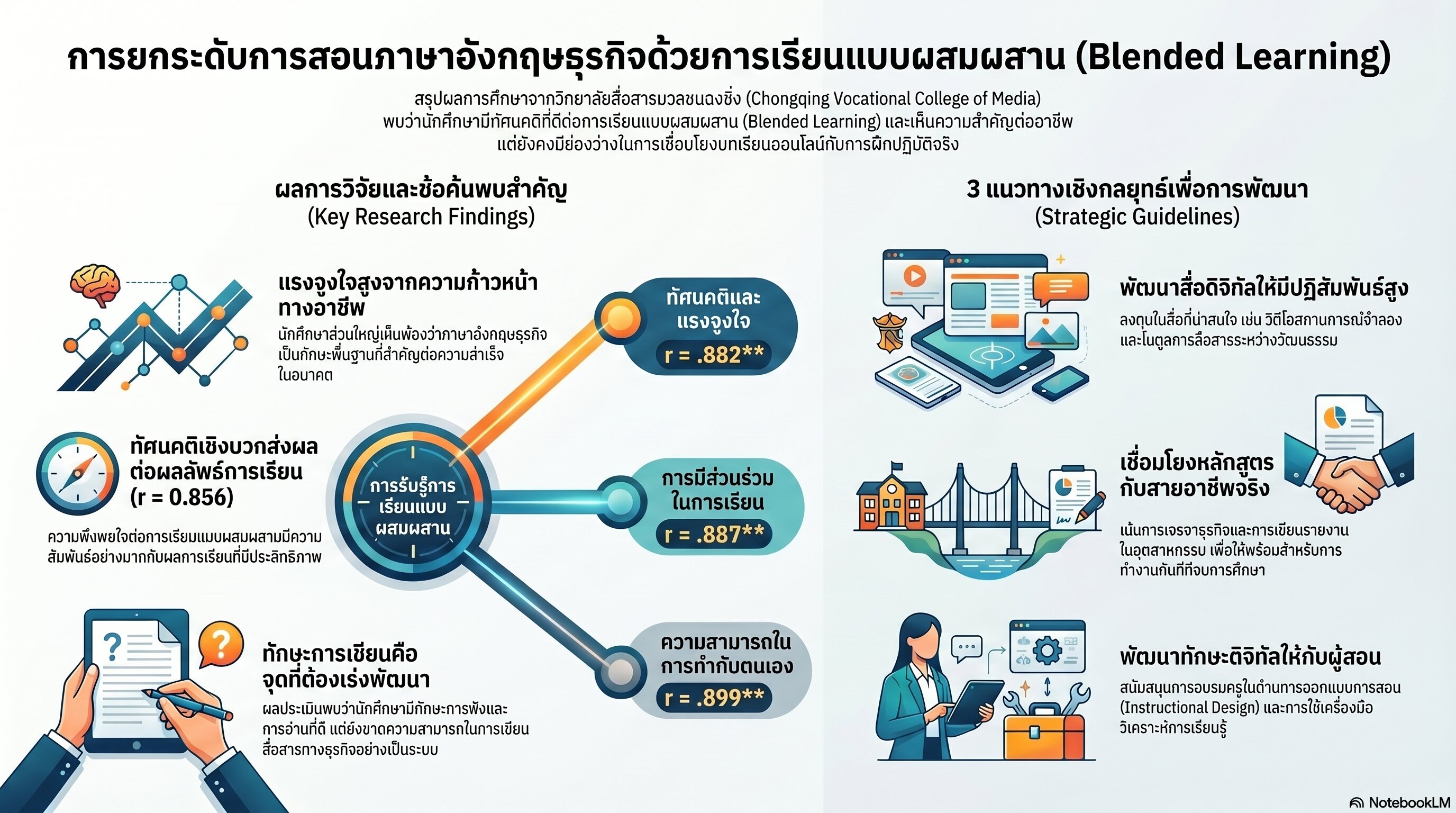
This study aims to explore the instructional guidelines for applying blended learning in Business English education, with undergraduate students at Chongqing Vocational College of Media as the target group. A questionnaire survey and statistical analysis were employed to investigate students’ performance in five key dimensions: learning attitudes and motivation, perceptions of blended learning, learning activities and resources, autonomy and responsibility, as well as learning outcomes and skill development. The findings reveal that most students hold a positive attitude toward blended learning, particularly recognizing its effectiveness in enhancing intercultural communication, fostering learner autonomy, and improving professional English skills. However, challenges remain in areas such as the attractiveness of learning resources, the sustainability of learning motivation, and the interactivity of digital platforms. Based on these results, the study recommends enriching digital learning resources, strengthening teachers’ competence in digital pedagogy, aligning curricula with career-oriented goals, and establishing continuous assessment and feedback mechanisms. This research not only provides practical insights for improving Business English curricula but also offers theoretical support for vocational colleges in advancing effective blended learning practices.
References
Alharbi, A. (2022). Business English as a branch of ESP: Definitions, scope, and pedagogy. Journal of Language Teaching and Research, 13(2), 301–309. https://doi.org/10.17507/jltr.1302.15
Athiyaman, A. (1997). Linking student satisfaction and service quality perceptions: The case of university education. European Journal of Marketing, 31(7), 528–540. https://doi.org/10.1108/03090569710176655
Cheng, R. (2023). Challenges in implementing blended learning in Chinese vocational colleges. Asian Journal of Education and Training, 9(1), 10–19. https://doi.org/10.20448/journal.522.2023.91.10.19
Chinese Ministry of Education. (2019, October 30). Implementation views on the construction of first-class undergraduate courses. Retrieved from http://www.moe.gov.cn/srcsite/A08/s7056/201910/t20191031_406269.html
Dudley-Evans, T., & St John, M. J. (1998). Developments in English for specific purposes: A multi-disciplinary approach. Cambridge University Press.
Huang, C., Han, Z., Li, M., Wang, X., & Zhao, W. (2021). Sentiment evolution with interaction levels in blended learning environments: Using learning analytics and epistemic network analysis. Australasian Journal of Educational Technology, 37(2), 81–95. https://doi.org/10.14742/ajet.6749
Li, X. (2019). An analysis of the factors influencing college students' satisfaction with higher education teaching: A case study of English teaching at 9 universities in Hainan Province. Diao Yan Shi Jie, 9(2), 49–54.
Liu, X. (2023). Redesigning teaching methods in blended learning environments. China Education Review, 44(2), 15–22.
McHone, C. (2020). Blended learning integration: Student motivation and autonomy in a blended learning environment (Doctoral dissertation, East Tennessee State University).
Osguthorpe, R. T., & Graham, C. R. (2003). Blended learning environments: Definitions and directions. Quarterly Review of Distance Education, 4(3), 227–233.
Peng, R., & Fu, R. (2020). The impact of blended learning on Chinese EFL students’ intrinsic motivation. International Journal of Emerging Technologies in Learning, 15(1), 123–135. https://doi.org/10.3991/ijet.v15i01.11744
Shi, J. (2023). A comparative study of blended learning and traditional methods in college English. Foreign Language World, 6(1), 45–56.
Talbert, R., & Bergmann, J. (2023). Flipped learning: A guide for higher education faculty. Routledge.
Zhang, S., Chen, D., Cao, R., Wang, S., Wang, X., & Qi, Y. (2020). The impact of primary and secondary school students' self-directed learning ability on online learning satisfaction. Chinese Journal of Special Education, 20(6), 89–96.
Downloads
Published
How to Cite
Issue
Section
Categories
License
Copyright (c) 2026 Journal of Buddhist Education and Research (JBER)

This work is licensed under a Creative Commons Attribution-NonCommercial-NoDerivatives 4.0 International License.