Exploring the Roles, Practices and Challenges of Kindergarten Chinese Teachers at an International School
Abstract
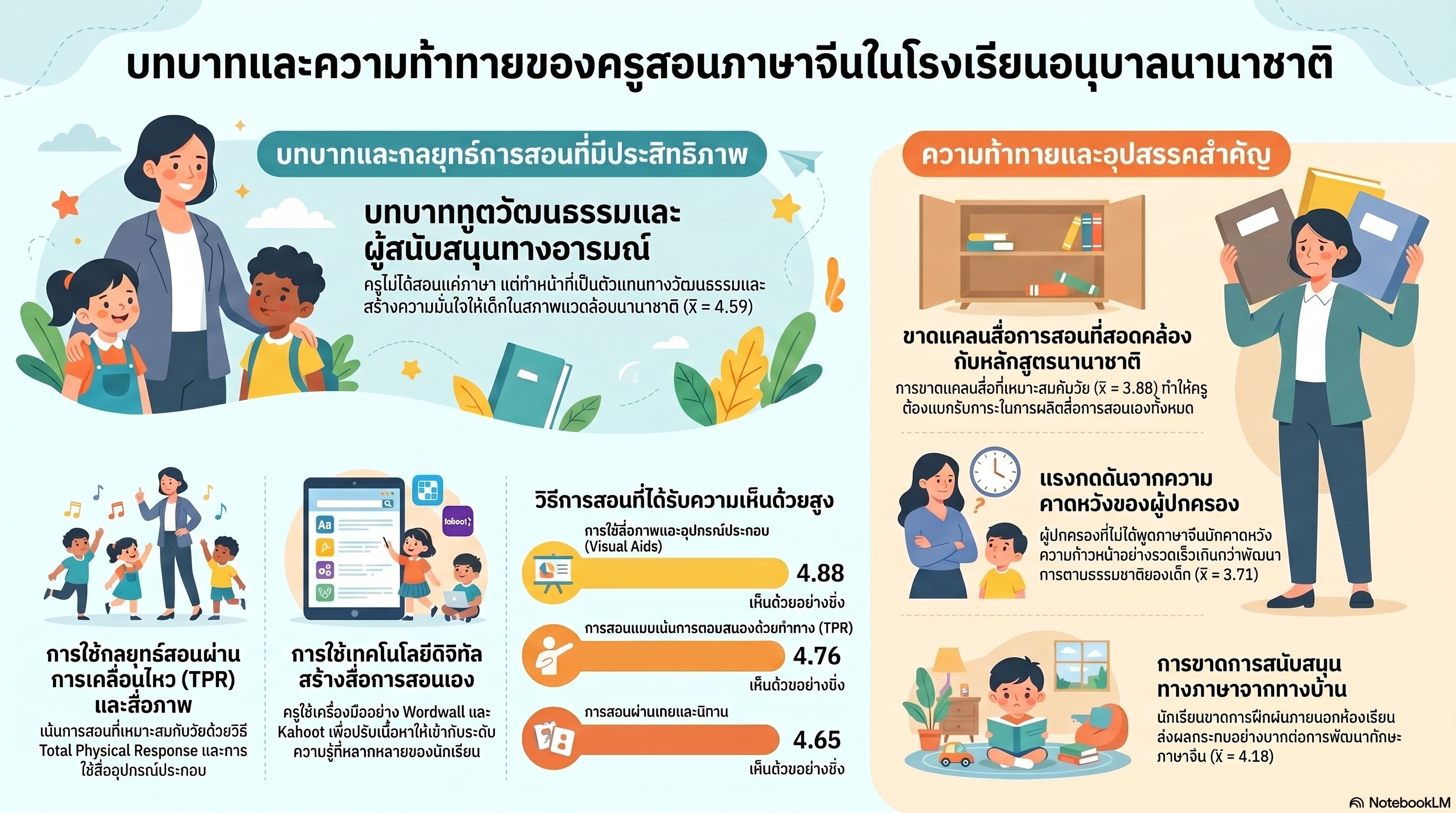
This study explored the roles, instructional practices, and challenges faced by Chinese language teachers in an international school with a multicultural educational context. Adopting a mixed-methods approach, data were collected through a 33-item questionnaire completed by 17 Chinese kindergarten teachers in an international school in Thailand and semi-structured interviews with five of them. Quantitative findings showed that teachers strongly identified with their dual role as language educators and cultural ambassadors, with high agreement on integrating Chinese culture into teaching (x̅ = 4.42, SD = 0.61). Commonly adopted teaching strategies included Total Physical Response (TPR) (x̅ = 4.35, SD = 0.65) and Game-based Learning (x̅ = 4.29, SD = 0.72). Challenges reported included a lack of age-appropriate Mandarin teaching resources (x̅ = 3.88, SD = 0.83) and pressure from non-Chinese-speaking parents (x̅ = 3.71, SD = 0.67). Qualitative data, analyzed using Lichtman’s (2013) “Codes–Categories–Concepts” model, generated 54 codes, 31 categories, and 23 key concepts. The results revealed that teachers not only integrated cultural content and adapt instruction to students’ varied language proficiencies but also navigated complex expectations from schools and families. This study offers valuable insights into Chinese teachers' experiences in international early childhood settings and provides recommendations for curriculum planning, professional development, and institutional support. This study highlights teachers’ lived experiences and provides actionable insights for supporting Chinese language education in multicultural early childhood contexts.
References
Albert, F., Vengat, S., & Young, S. (2022). Parental Expectations and Deciding Factors for Kindergartens in China (Doctoral dissertation). Worcester Polytechnic Institute, China.
Baker, C., & Wright, W. E. (2017). Foundations of bilingual education and bilingualism (6th ed.). Bristol, England: Multilingual Matters.
Brunsek, A., Perlman, M., McMullen, E., Falenchuk, O., Fletcher, B., Nocita, G., ... & Shah, P. S. (2020). A meta-analysis and systematic review of the associations between professional development of early childhood educators and children's outcomes. Early Childhood Research Quarterly, 53, 217-248. https://doi.org/10. 1016/j.ecresq.2020.03.003
Chan, L. K. S., & Chan, L. (2003). Early childhood education in Hong Kong and its challenges. Early Child Development and Care, 173(1), 7–17.
Chansiri, K. (2023). Bilingual education policy and practice in Thai early childhood contexts. Journal of Education Studies in Thailand, 21(2), 55–70.
Charlesworth, R., Hart, C., Burts, D., & Hernandez, S. (1991). Kindergarten teachers’ beliefs and practices. Early Development and Care, 70, 17–25.
Chen, T., & González, O. (2022). A comparative study of motivation for and situational interest in learning Chinese as a foreign language among Thai upper elementary school students. In AU Hybrid International Conference 2024 on “Entrepreneurship & Sustainability in the Digital Era” under the theme of “People Centric Knowledge in Intelligence World” (Vol. 3, No. 1, pp. 177-188).
Copple, C., & Bredekamp, S. (Eds.). (2009). Developmentally appropriate practice in early childhood programs: Serving children from birth through age 8 (3rd ed.). Washington, DC: National Association for the Education of Young Children.
Cummins, J. (2001). Language, power, and pedagogy: Bilingual children in the crossfire. Bristol, England: Multilingual Matters.
Duff, P. A., & Li, D. (2009). Issues in Mandarin language instruction: Theory, research, and practice. Annual Review of Applied Linguistics, 29, 221–244.
Edwards, C., Gandini, L., & Foreman, G. (1998). The 100 languages of children: The Reggio Emilia approach, advanced reflections (2nd ed.). Westport, CT: Ablex Publishing.
Ellis, R. (2008). The Study of Second Language Acquisition. Oxford: Oxford University Press.
Gao, X. (2023). Technology-enhanced international Chinese education: An overview. International Journal of Chinese Language Teaching, 4(3), 1-11.
García, O., & Wei, L. (2014). Translanguaging: Language, bilingualism and education. London: Palgrave Macmillan.
Gil, J. (2021). The rise of Chinese as a global language: Prospects and obstacles. New York: Springer. https://doi.org/10.1007/978-3-030-76171-4
Gunn, A. A., Bennett, S. V., Alley, K. M., Barrera IV, E. S., Cantrell, S. C., Moore, L., & Welsh, J. L. (2021). Revisiting culturally responsive teaching practices for early childhood preservice teachers. Journal of Early Childhood Teacher Education, 42(3), 265-280.
Hu, B. Y., & Li, K. (2012). The quality rating system of Chinese preschool education: Prospects and challenges. Childhood Education, 88(1), 14–22.
Hyson, M., Tomlinson, H. B., & Morris, C. A. (2009). Quality improvement in early childhood teacher education: Faculty perspectives and recommendations for the future. Early Childhood Research & Practice, 11(1), 98-110.
Jin, L., & Cortazzi, M. (2017). Researching Chinese learners: Skills, perceptions, and intercultural adaptations. London: Palgrave Macmillan.
Lan, S., Lan, Y., Di, H., Li, H., Zhou, J., & Li, F. (2021). Development and validation of the Chinese kindergarten teacher quality scale in Shanghai. Children and Youth Services Review, 131, 106272. https://doi.org/10.1016/j.childyouth.2021.106272
Li, J., & Elicker, J. (2005). Teacher-child interaction in Chinese kindergartens: An observational analysis. International Journal of Early Years Education, 12(2), 129–143.
McCarty, T. L., Yamamoto, A. Y., Watahomigie, L. J., & Zepeda, O. (2001). Indigenous educators as change agents: Case studies of two language institutes. In L. Hinton & K. Hale (Eds.), The green book of language revitalization in practice (pp. 371–383). San Diego, CA: Academic Press
Ng, P. T., & Tan, C. (2021). The Singapore education system: A historical and policy perspective. London: Routledge.
Nikolopoulou, K., & Gialamas, V. (2015). Barriers to the integration of computers in early childhood settings: Teachers’ perceptions. Educational Information Technology, 20, 285–301.
Orton, J., & Scrimgeour, A. (2019). Teaching Chinese as a second language: The way of the learner. New York: Routledge.
Shin, J. K., & Crandall, J. A. (2014). Teaching Young Learners English: From Theory to Practice. Boston, MA: National Geographic Learning.
Subban, P. (2006). Differentiated instruction: A research basis. International Education Journal, 7(7), 935–947.
Suksan, P., & Nimmannit, S. (2022). Multilingual teaching practices in Bangkok international schools. Thai Journal of Early Childhood Education, 14(1), 33–48.
Tian, X., & Hong, X. (2022). Early Childhood Teachers’ Professional Learning About ICT Implementation in Kindergarten Curriculum: A Qualitative Exploratory Study in China. Frontiers in psychology, 13, 1008372.
Tobin, J., Hsueh, Y., & Karasawa, M. (2009). Preschool in three cultures revisited: China, Japan, and the United States. Chicago: University of Chicago Press.
Vygotsky, L. S. (1978). Mind in society: The development of higher psychological processes. Cambridge, MA: Harvard University Press.
Winskel, H., & Zhou, J. (2017). Challenges of foreign language learning in early childhood. In Global language policies and local educational practices and cultures. Global language policies and local educational practices and cultures, 7(2), 142-156.
Zhang, J. (2022). Current issues in Chinese language teaching. In Proceedings of the 2021 International Conference on Education, Language and Art (ICELA 2021) (pp. 135–138). Atlantis Press. https://doi.org/10.2991/assehr.k.220131.024
Downloads
Published
How to Cite
Issue
Section
Categories
License
Copyright (c) 2026 Journal of Buddhist Education and Research (JBER)

This work is licensed under a Creative Commons Attribution-NonCommercial-NoDerivatives 4.0 International License.