Effects of Chinese Popular Songs on Chinese Pronunciation Skills of Matthayom 5 Thai School Students
Abstract
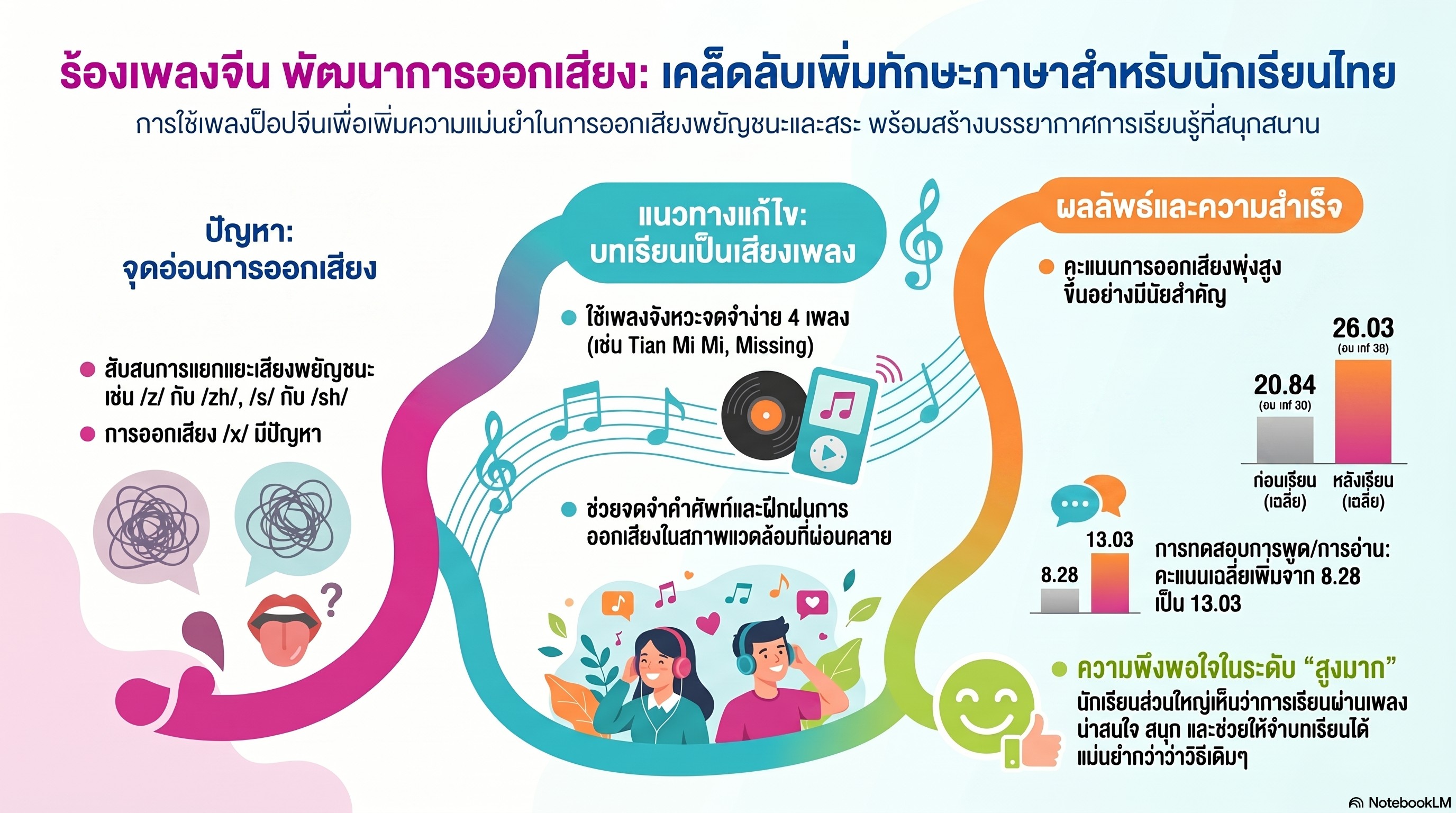
This study examines whether integrating Chinese popular songs into instruction enhances Thai high school students’ Chinese pronunciation and explores their satisfaction with a one-month targeted course. A quantitative experimental design was employed, combining (1) pre-/post-tests to measure pronunciation gains and (2) a questionnaire to assess student satisfaction. The intervention comprised 10 pronunciation lessons incorporating four Chinese popular songs. Participants were 32 Matthayom 5 students at a Thai high school. Mean scores increased from 20.84 (pre-test) to 26.03 (post-test), and a paired-samples t-test showed a significant improvement (t = −8.698, p < .001). Instruments demonstrated strong content validity (IOC = .96) and acceptable internal consistency (Cronbach’s α > .70). Findings indicate that integrating Chinese popular songs effectively helps correct students’ Chinese pronunciation and simultaneously fosters interest and enthusiasm for pronunciation practice.
References
Best, J. W. (1981). Research in education (4th ed.). Englewood Cliffs, NJ: Prentice Hall.
Cai, J. (2012). A study on Thai learners’ difficulties in Chinese pronunciation. Journal of Yunnan Normal University (Teaching and Research on Chinese as a Foreign Language Edition), 10(4), 67–73.
Davis, K., & Fan, W. (2016). The role of music in second language acquisition: A review. International Journal of Language Studies, 10(3), 1–16.
Engh, D. (2013). Why use music in English language learning? A survey of the literature. English Language Teaching, 6(2), 113–127. https://doi.org/10.5539/elt.v6n2p113
Ginsborg, J., & Sloboda, J. A. (2007). The acquisition of song and speech by children. In G. O’Neill (Ed.), Proceedings of the 5th International Symposium on Performance Science (pp. 5–10). Porto, Portugal.
Huang, C. (2007). The impact of music-based teaching on listening and speaking in Chinese as a foreign language. Journal of Language Teaching and Research, 4(2), 201–208.
Huang, R. (2016). A survey of Chinese learning motivation among Thai high school students. Journal of Chinese Language Studies, 12(4), 78–89.
Kanonidou, E. (2018). Songs as a tool for teaching pronunciation in foreign language classes. European Journal of Language and Literature Studies, 4(1), 14–22. https://doi.org/10.26417/ejls.v4i1.p14-22
Li, M. (2010). A practical study on Chinese songs in summer camp teaching. International Chinese Education, 1(1), 88–94.
Liang, Y. (2009). A study on the use of songs in oral Chinese teaching for foreign students. Chinese Language Education Research, 5(3), 45–52.
Likert, R. (1932). A technique for the measurement of attitudes. Archives of Psychology, 22(140), 1–55.
Luo, J. (1997). On the role of songs in Chinese phonetic teaching. Language Education, 3(1), 56–60.
Ma, Q. (2018). Phonological awareness and tonal acquisition in Chinese as a second language. Journal of Chinese Linguistics, 46(2), 321–345.
Music and Dance Editorial Committee. (1989). Chinese Popular Music Anthology. Beijing: People’s Music Publishing House.
Ouyang, J. (2009). The development of Chinese education in Thailand. Overseas Chinese Education, 6(3), 15–20.
Schoepp, K. (2001). Reasons for using songs in the ESL/EFL classroom. The Internet TESL Journal, 7(2). http://iteslj.org/Articles/Schoepp-Songs.html
Shehadeh, A., & Farrah, M. (2016). The role of songs in EFL classrooms: From motivation to learning enhancement. Palestinian Journal of Language Studies, 4(1), 33–45.
Shi, W. (2016). Popular music and cultural identity: A study of Chinese pop songs. Journal of Chinese Culture Studies, 22(3), 88–95.
Thiessen, E. D., & Saffran, J. R. (2009). How the melody facilitates the message and vice versa in infant learning and memory. Annals of the New York Academy of Sciences, 1169(1), 225–233. https://doi.org/10.1111/j.1749-6632.2009.04547.x
Tse, A. Y. H. (2015). The effectiveness of songs in teaching English to young learners in Hong Kong. Global Journal of Human-Social Science: Linguistics & Education, 15(9), 23–33.
Wallace, W. T. (1994). Memory for music: Effect of melody on recall of text. Journal of Experimental Psychology: Learning, Memory, and Cognition, 20(6), 1471–1485. https://doi.org/10.1037/0278-7393.20.6.1471
Wang, H. (2005). The development of Chinese popular music and its social influence. Social Sciences in China, 26(4), 155–164.
Wang, X. (2012). The effectiveness of using Chinese songs in Thai primary school classrooms. Journal of International Chinese Teaching, 9(2), 112–120.
Wang, Y. (1984). The function of music in foreign language teaching. Foreign Language World, 2(1), 32–38.
Wiener, S., & Turnbull, R. (2016). Constraints of tones in second language acquisition of Mandarin Chinese. Second Language Research, 32(2), 249–278. https://doi.org/10.1177/ 0267658315601883
Yu, S. (1999). The value of songs in Chinese language teaching. Chinese Teaching in the World, 13(2), 45–52.
Zhang, J., Baills, F., & Pieto, X. (2023). Singing facilitates L2 pronunciation and vocabulary learning. Language Learning, 73(2), 456–480. https://doi.org/10.1111/lang.12512
Zhao, Y. (2006). Chinese language education in Thailand: Status and challenges. World Chinese Teaching, 20(1), 1–10.
Downloads
Published
How to Cite
Issue
Section
Categories
License
Copyright (c) 2026 Journal of Buddhist Education and Research (JBER)

This work is licensed under a Creative Commons Attribution-NonCommercial-NoDerivatives 4.0 International License.