Exploring Digital Skills Among Pharmacy Students in Vocational Institutions: Evidence from Jiangsu, China
Keywords:
Digital literacy; Pharmacy education; Vocational colleges; DigComp framework; ChinaAbstract
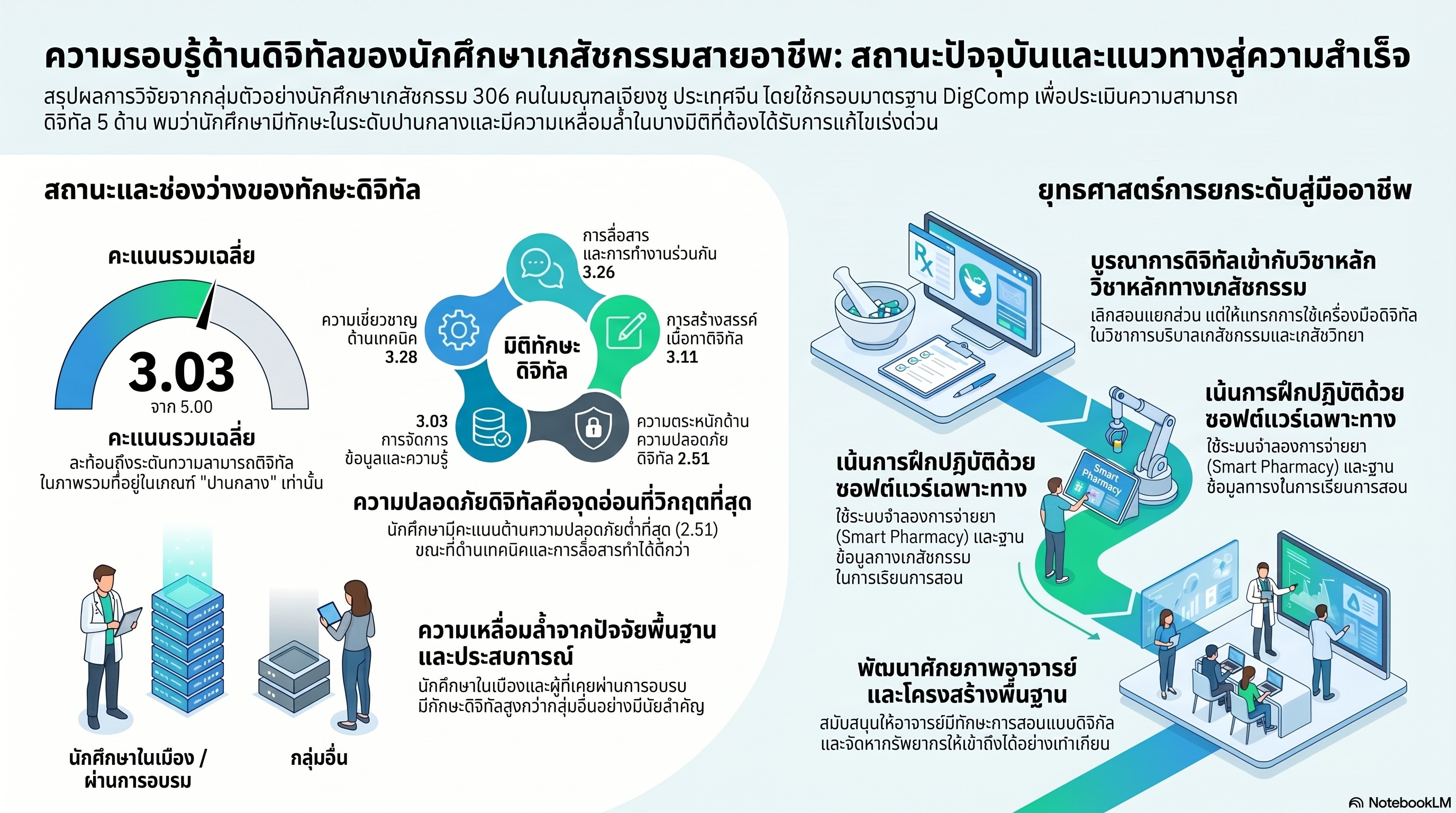
This study investigates the digital literacy of 306 pharmacy students from a vocational college in Jiangsu Province, China, using a mixed-methods design based on the European Digital Competence Framework (DigComp). Five core dimensions—information management literacy, technical proficiency, digital security awareness, digital communication and collaboration, and content creation and knowledge building—were assessed through a structured questionnaire and thematic analysis. The findings reveal a moderate overall level of digital competence (M=3.03), with relatively strong performance in technical proficiency and communication, but notable deficiencies in digital security and content creation. Significant disparities were observed across academic year, geographic background, and prior training experience, highlighting uneven development of digital literacy. Qualitative results further indicate insufficient access to pharmacy-specific digital tools and limited curriculum integration. The study concludes by recommending the embedding of digital literacy into core pharmacy courses, enhanced faculty development, and the adoption of authentic, context-driven digital learning tasks. These insights provide empirical evidence and practical implications for advancing the digital transformation of vocational pharmacy education in China.
References
Alhur, A., Hedesh, R., Alshehri, M., Al Qasim, S., Alkhaldi, R., Bazuhair, W., Bin Shamlan, W., Alshahrani, S., Alshahrani, S., Alasiri, A., Alshalwi, R., Alnefaie, S., Alotaibi, R., Aljehani, R. K., & Alzahrani, L. (2023). Incorporating technology in pharmacy education: Students’ preferences and learning outcomes. Cureus, 15(12), e50158. https://doi.org/10.7759/cureus.50158
Bautista, J. R., et al. (2020). A curriculum redesign for pharmacy students emphasizing telehealth outreach and interprofessional collaboration during COVID-19. Journal of Pharmacy Education and Practice, 8(3), 123–131.
Blayone, T. J. B., Mykhailenko, O., Kavtaradze, M., Kokhan, M., vanOostveen, R., & Barber, W. (2018). Profiling the digital readiness of higher education students for transformative online learning in the post-Soviet nations of Georgia and Ukraine. International Journal of Educational Technology in Higher Education, 15(37). https://doi.org/10.1186/s41239-018-0119-9
Detsom, K., & Vehachart, R. (2021). Development of digital citizenship of student in the 21st century. Journal of Academic Research in Business and Social Sciences, 11(1), 212–222. https://doi.org/10.14456/pyuj.2021.11
Eshet-Alkalai, Y. (2012). Thinking in the digital era: A revised model for digital literacy. Issues in Informing Science and Information Technology, 9, 267-276. https://doi.org/10.28945/1621
Gilster, P. (1997). Digital Literacy. https://www.goodreads.com/work/editions/2346785-digital-literacy
Gross, M., & Latham, D. (2011). Experiences with and perceptions of information: A phenomenographic study of first-year college students. The Library Quarterly, 81(2), 161–186. https://doi.org/10.1086/658867
He, T., & Zhu, C. (2017). Digital informal learning behaviors and digital competencies among Chinese university students. International Journal of Educational Technology, 12(4), 321–335.
Hu, J., Zhang, Q., Chu, Y., & Wu, J. (2024). Research on configuration paths of digital literacy empowering medical students' innovative behaviors: Based on fuzzy-set qualitative comparative analysis. School of Health Management, Anhui Medical University, 55(4), 964–971. https://doi.org/10.12182/20240760302
Krejcie, R., & Morgan, D. (1970). Determining sample size for research activities. Educational and Psychological Measurement, 30(3), 607–610. https://doi.org/10.1177/001316447003000308
Ling, Z. (2020). Current situation, problems, and educational path of college students' digital literacy in China. Information Studies: Theory & Application, 43(7), 43-47, 53. https://doi.org/10.16353/j.cnki.1000-7490.2020.07.008
Liu, Y. (2023). Digital literacy development in vocational college students: An empirical study of several vocational colleges. Journal of Vocational Education and Training Research, 15(2), 100–115.
Martin, A., & Grudziecki, J. (2006). DIGEULIT: Concepts and Tools for Digital Literacy Development. Innovation in Teaching and Learning in Information and Computer Sciences, 5(4), 249–267. https://doi.org/10.11120/ital.2006.05040249
Martzoukou, K., Fulton, C., Kostagiolas, P., & Lavranos, C. (2020). A study of higher education students’ self-perceived digital competences for learning and everyday life online participation. Journal of Documentation, 76(6), 1413–1458. https://doi.org/10.1108/jd-03-2020-0041
Ministry of Education of the People's Republic of China. (2017, September 11). Guiding opinions on further promoting the development of vocational education informatization. http://www.moe.gov.cn/srcsite/A07/zcs_zhgg/201709/t20170911_314171.html
Moskal, P. D., Dziuban, C. D., & Hartman, J. (2013). Blended learning: A transformative tool for improving course performance. Journal of the American Association of Colleges of Pharmacy, 77(7), 163. https://doi.org/10.5688/ajpe777163
Nasser, Z., El Masri, A., Jbeili, C., Iskandar, R., Fares, M., & Kara, A. (2024). Pharmacy students’ confidence in digital skills: Validation and implications for curriculum development. Cureus, 16(1), e51613. https://doi.org/10.7759/cureus.51613
National Medical Products Administration, National Health Commission, Ministry of Industry and Information Technology, Ministry of Public Security, Ministry of Finance, Ministry of Commerce, National Healthcare Security Administration, & National Administration of Traditional Chinese Medicine. (2021, October 20). 14th Five-Year Plan for national drug safety and promotion of high-quality development. https://www.gov.cn/xinwen/2022-01/02/5667258/files/ef293766b6a14fa79947d08c7a1c83b6.pdf
Olatoye, O. I., Nekhwevha, F., & Muchaonyerwa, N. (2021). ICT literacy skills proficiency and experience on the use of electronic resources amongst undergraduate students in selected Eastern Cape Universities, South Africa. Library Management, 42(6–7), 433–450. https://doi.org/10.1108/LM-08-2020-0128
Rao, L., & Chen, D. (2024). Analysis of the current state of digital literacy among college students in Fujian Province: An evaluation based on 799 students. Fujian Textile, 4(4), 69-74. https://doi.org/10.3969/j.issn.1007-550X.2024.04.013
Spante, M., Hashemi, S. S., Lundin, M., & Algers, A. (2018). Digital competence and digital literacy in higher education research: Systematic review of concept use. Cogent Education, 5(1), 1519143. https://doi.org/10.1080/2331186X.2018.1519143
State Council. (2022, January 12). Notice on issuing the 14th Five-Year Plan for the development of the digital economy. http://www.gov.cn/zhengce/content/2022-01/12/content_5672174.htm
Sun, S. (2023). An investigation of university students’ digital competence: Perceived level, digital divide and digital experience. Library Development. https://kns.cnki.net/kcms/detail/23.1331.g2.20230320.1328.004.html
Tarhan, N. (2022). Pharmacy students' digital competencies in Lebanon: Validation and correlation of a scale measuring perceived confidence in computer literacy. International Journal of Health and Medical Sciences, 8(1), 20–27. https://doi.org/10.5281/zenodo.7564185
Vuorikari, R., Punie, Y., Carretero, S., & Van den Brande, G. (2022). DigComp 2.2: The Digital Competence Framework for Citizens. European Commission.
Xiong, Y., & Yang, F. (2024). Digital education "1+5" framework: A case study of pharmacy education in vocational colleges. Journal of Digital Education Research, 22(4), 234–250.
Yahui, H., & Manly, N. (2023). Current situation and improvement of secondary vocational students’ digital literacy in China. Advances in Educational Technology and Psychology, 7(16). https://doi.org/10.23977/aetp.2023.071609
Zhang, L. (2024). Cultivation of digital competencies for pharmacy students under digital transformation. Journal of Higher Education in Pharmaceutical Sciences, 12(3), 180–195.
Downloads
Published
How to Cite
Issue
Section
Categories
License
Copyright (c) 2026 Journal of Buddhist Education and Research (JBER)

This work is licensed under a Creative Commons Attribution-NonCommercial-NoDerivatives 4.0 International License.