Research on the Immersive Communication Mechanism of Guangdong Lion Dance Culture in the Context of New Media
Abstract
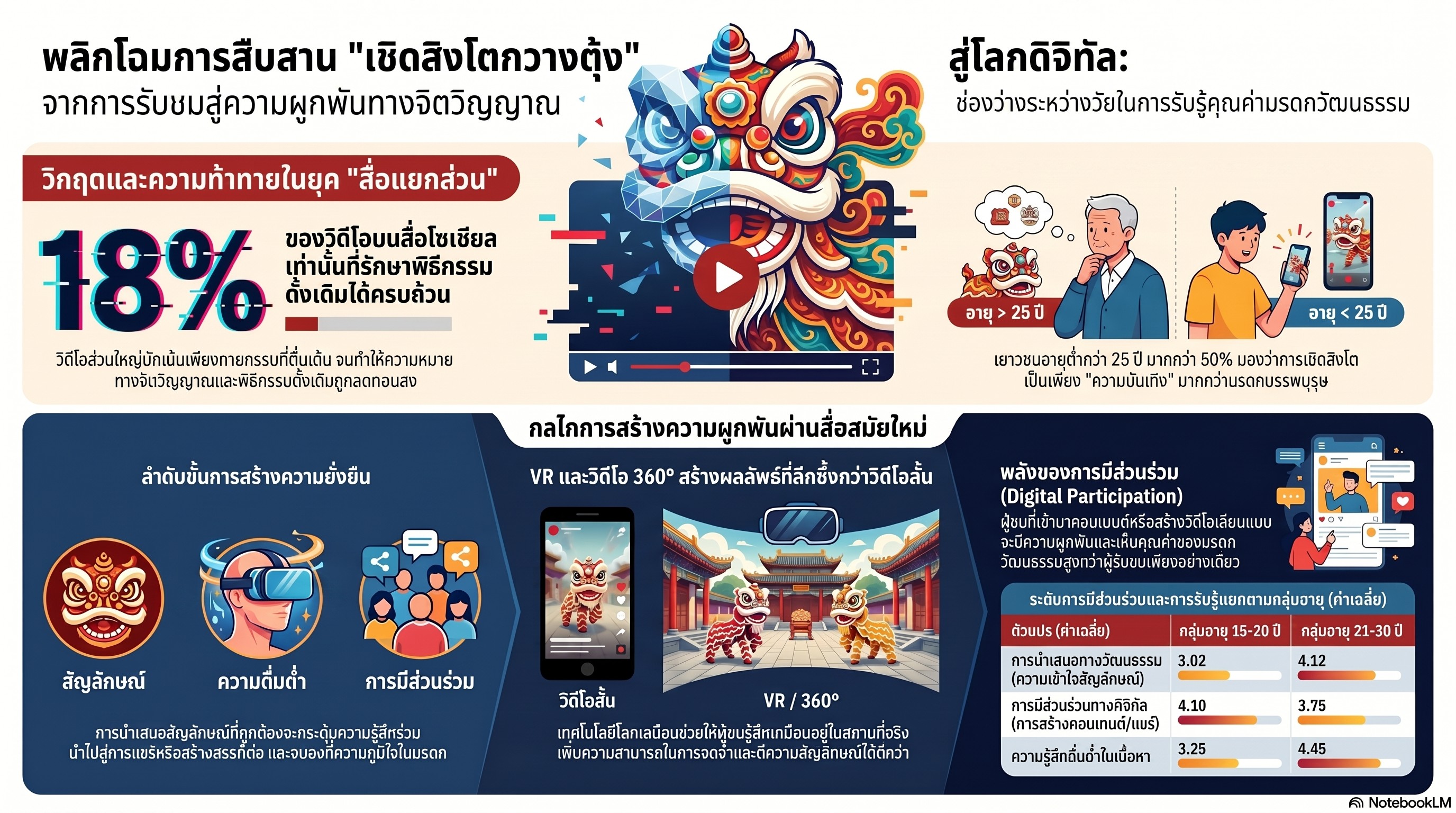
In the digital era, the preservation and communication of intangible cultural heritage (ICH) face both new challenges and opportunities. This study focuses on the Guangdong lion dance—a symbolic ritual traditionally performed in southern China—as a case to examine how immersive and participatory digital media are reshaping cultural transmission. With over 750 million active users on Douyin and nearly 58.6% of internet users in China engaging with traditional content via short-form video, platforms like Douyin, Bilibili, and VR museum apps have emerged as new venues for cultural expression, often displacing traditional festival spaces. The purpose of this research is to investigate how symbolic meaning, emotional engagement, and participatory behavior interact in the digital communication of lion dance culture. A mixed-methods approach was adopted under the pragmatic research paradigm. Quantitatively, data were collected from a sample of 400+ digital media users using a structured questionnaire measuring five latent constructs: Cultural Representation, immersive communication, Digital Participation, Heritage Resonance, and Media Format Type. Structural Equation Modeling (SEM) and Confirmatory Factor Analysis (CFA) were used to validate the conceptual model and test direct, mediated, and moderated effects. Qualitatively, 20 semi-structured interviews and 50+ media artifacts were analyzed using thematic coding via NVivo to capture symbolic, emotional, and narrative interpretations. Findings indicate that authentic cultural representation significantly enhances immersive communication (β = 0.71, p < 0.001), which in turn predicts digital participation (β = 0.64). Participatory behaviors were found to mediate the relationship between immersion and heritage resonance (indirect effect significant, bootstrapped CI excludes 0). Media format moderated the strength of these effects, with VR and 360° formats producing deeper engagement than short-form video. Practically, the study offers actionable insights for policymakers, educators, content creators, and cultural practitioners. It recommends integrating immersive technology in heritage education, prioritizing symbolic depth in content design, and supporting co-creation models that align with community values. Ultimately, the research affirms that digital tools—when used with cultural intent—can sustain living traditions by making them accessible, participatory, and emotionally resonant for new generations. This study also introduces the concept of symbolic literacy as a theoretical innovation, expanding existing intangible cultural heritage (ICH) communication models and offering directions for future interdisciplinary research.
References
Carey, J. W. (1989). Communication as culture: Essays on media and society. Routledge.
Chiapparini, E. (2012). Ritual soundscapes and symbolic codes in Chinese lion dance. Asian Theatre Journal, 29(1), 45–67.
CNNIC. (2023). The Statistical Report on China's Internet Development. China Internet Network Information Center.
Communication University of China. (2022). Research Report on the Current State of Lion Dance Communication on Short Video Platforms. Communication University of China Press.
Creswell, J. W., & Plano Clark, V. L. (2018). Designing and conducting mixed methods research (3rd ed.). SAGE Publications.
Davis, F. D. (1989). Perceived usefulness, perceived ease of use, and user acceptance of information technology. MIS Quarterly, 13(3), 319–340.
Fei, J., & Wong, A. (2024). Virtual reality in intangible cultural heritage education: A case of Chinese lion dance. International Journal of Heritage Studies, 30(2), 115–131.
Guangdong Provincial Department of Culture. (2020). Annual Report on the Protection of Intangible Cultural Heritage in Guangdong Province. Guangdong Provincial Department of Culture.
Harrison, R. (2013). Heritage: Critical approaches. Routledge.
Jenkins, H. (2006). Convergence culture: Where old and new media collide. New York University Press.
Li, Y., & Delgerkhuu, B. (2025). Symbolism and identity in Chinese lion dance performance. Journal of Cultural Studies, 18(2), 210–229.
Lombard, M., & Ditton, T. (1997). At the heart of it all: The concept of presence. *Journal of Computer-Mediated Communication, 3*(2).
Lonardi, F., & Unterpertinger, L. (2022). Short-form videos and heritage fragmentation: Risks for ritual traditions. Media, Culture & Society, 44(8), 1672–1689.
Qiu, L., Zhang, H., & Chen, Y. (2024). Fragmentation of ritual in digital communication: A study on Douyin lion dance videos. Chinese Journal of Communication, 17(1), 88–105.
Qiu, Y. (2023). VR storytelling and cultural symbolism: The case of Cantonese lion dance. Journal of Digital Heritage, 5(4), 299–314.
Skublewska-Paszkowska, M., et al. (2022). Hybrid identities in Chinese diaspora lion dance practices. International Journal of Intangible Heritage, 17(1), 57–70.
Smith, L. (2006). Uses of heritage. Routledge.
UNESCO. (2003). Convention for the safeguarding of the intangible cultural heritage. United Nations Educational, Scientific and Cultural Organization.
Xu, D., Wang, H., & Li, J. (2024). Symbolic literacy in Chinese ritual performance: A framework for heritage communication. Asian Journal of Communication, 34(3), 215–233.
Xu, S., Wong, K., & Chan, T. (2017). Technology acceptance in immersive heritage experiences. Computers in Human Behavior, 75, 567–578.
Xu, W. (2023). Immersion and interactivity in VR-based heritage education. Educational Technology Research and Development, 71(5), 2331–2350.
Yu, P., Chen, M., & Huang, Z. (2025). Lion dance and digital co-creation: A study of participatory practices. Journal of Asian Folklore, 12(1), 77–95.
Zhang, H. (2024). Foshan lion dance and VR choreography: Strength and embodiment in new media. Chinese Theatre Research, 29(2), 54–72.
Zhou, Q. (2023). Research on the rhythm and ritual function of lion dance music. Art Research, 21(4), 88–96.
Downloads
Published
How to Cite
Issue
Section
Categories
License
Copyright (c) 2026 Journal of Buddhist Education and Research (JBER)

This work is licensed under a Creative Commons Attribution-NonCommercial-NoDerivatives 4.0 International License.