An Investigation of English Reading Skill Problems and the Enhancement Strategies of Secondary School Chinese Students at Guangxi Overseas Chinese School
Keywords:
Reading Skills; Problems; Enhancement Strategies; Secondary Students; Chinese StudentsAbstract
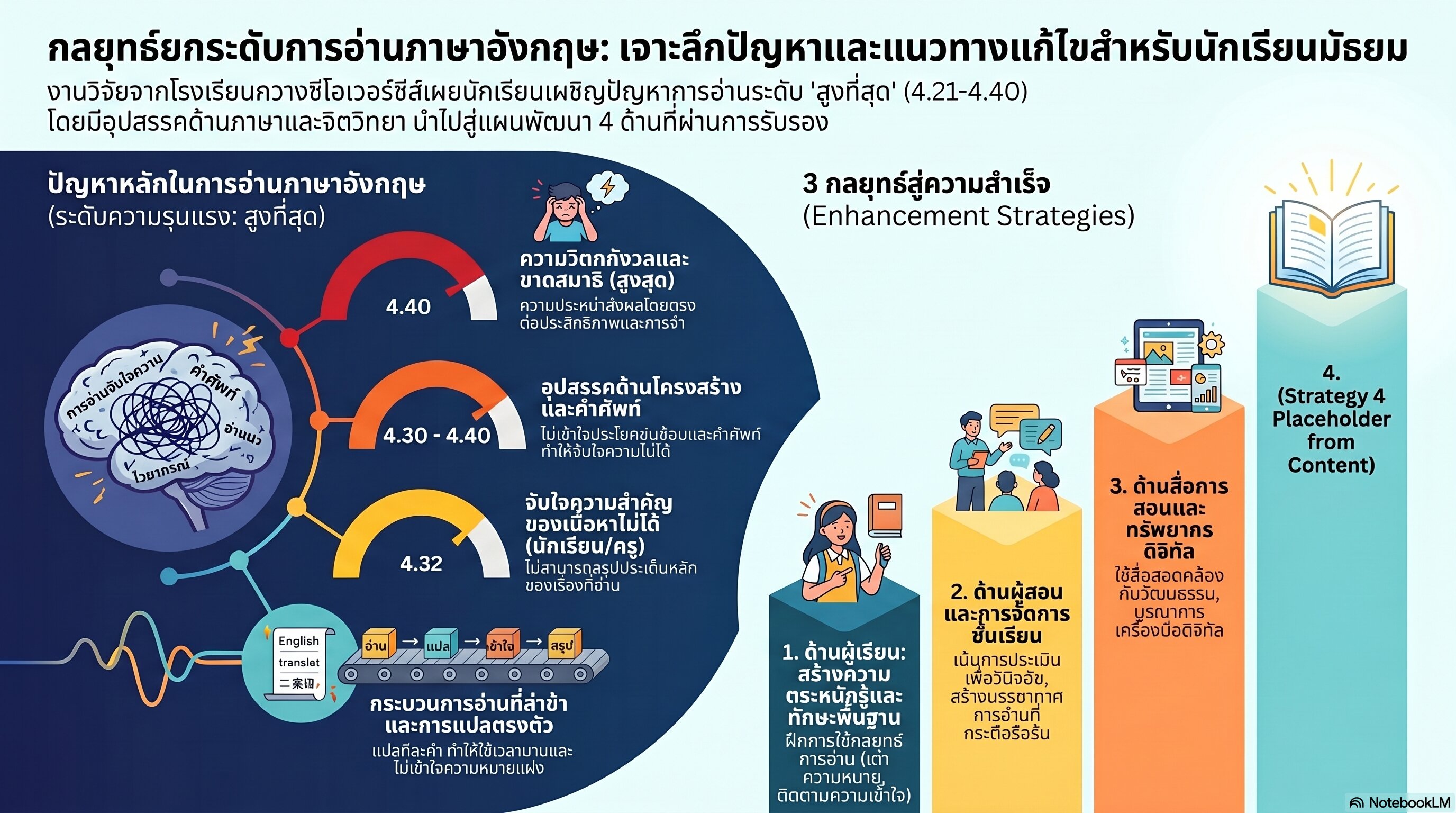
The objectives of this research were to investigate the problems in English reading skills among secondary school Chinese students at Guangxi Overseas Chinese School and to propose enhancement strategies for improving English reading skills of secondary Chinese students at Guangxi Overseas Chinese School. This research was considered a mixed-methods research study conducted at Guangxi Overseas Chinese School. The respondents were divided into two groups: 361 secondary Chinese students and 152 teachers at Guangxi Overseas Chinese School in the academic year 2025. Two research instruments were employed: 1) a questionnaire for investigating problems of reading skills and 2) focus group discussions for evaluating enhancement strategies. The data collected were analyzed through statistical and content analysis methods and presented in terms of frequency count, percentage, mean, and standard deviation. The results indicated that: 1) The problems in English reading skills among secondary school Chinese students were found at the highest level with mean scores ranging from 4.21 to 4.40, including difficulty understanding unfamiliar vocabulary, struggling with long and complex sentences, slow reading speed, and anxiety when reading English texts. 2) The enhancement strategies for improving English reading skills were categorized into four chapters: strategies for learners focusing on reading strategy awareness and fundamental skills development, strategies for instructors emphasizing diagnostic assessment and culturally responsive teaching, classroom management strategies creating reading-rich environments, and teaching-learning materials incorporating culturally relevant and digital resources.
References
Anderson, N. (2018). Exploring second language reading. Cengage Learning.
Birsch, J. R. (2011). Multisensory teaching of basic language skills. Paul H. Brookes Publishing.
Carrell, P. L., & Eisterhold, J. C. (1983). Schema theory and ESL reading pedagogy. TESOL Quarterly, 17(4), 553–573.
Chandran, Y., & Shah, P. (2019). Collaborative learning and reading comprehension. Journal of Language Teaching, 15(2), 45–59.
Chantharath, P., & Srisuwan, T. (2024). Collaborative reading tasks for Thai students. Thai TESOL International Journal, 37(1), 77–95.
Chen, Y. (2021). English reading difficulties of Chinese high school students. Asian EFL Journal, 23(3), 112–130.
Chantarath, P. (2021). Digital learning tools for reading comprehension in Thailand. Journal of English Teaching, 14(1), 88–102.
Dixon, L., Zhao, J., & Quiroz, B. (2020). Reading development of EAL learners in the UK. International Journal of Applied Linguistics, 30(4), 567–583.
Gilakjani, A. P., & Sabouri, N. B. (2016). How can students improve their reading comprehension skill? Journal of Studies in Education, 6(2), 229–240.
Grabe, W. (2020). Reading in a second language: Moving from theory to practice. Cambridge University Press.
Guthrie, J. T., & Klauda, S. L. (2018). Engagement and motivation in reading. Reading Research Quarterly, 53(1), 49–66.
Huang, L. (2024). Effects of digital reading apps on EFL learners. Language Learning and Technology, 28(1), 1–20.
Kittikhun, S., & Boonyaprakob, K. (2023). Reading comprehension problems in Thai high school students. Thai TESOL Journal, 36(2), 89–105.
Kongkaew, P. (2019). Reading strategy use of Thai university students. Journal of English Studies, 17(1), 55–71.
Li, X. (2021). Motivation and English reading comprehension in Chinese high schools. Journal of Language and Education, 7(4), 44–59.
Liu, J., & Zhang, W. (2020). Strategy use in Chinese high school reading. Chinese Journal of Applied Linguistics, 43(2), 175–192.
Mokhtari, K., & Reichard, C. (2002). Assessing students’ metacognitive awareness of reading strategies. Journal of Educational Psychology, 94(2), 249–259.
Nguyen, M. (2020). Metacognitive reading strategies among Vietnamese learners. Asia-Pacific Education Researcher, 29(3), 217–230.
Rumelhart, D. E. (1994). Toward an interactive model of reading. In R. B. Ruddell et al. (Eds.), Theoretical models and processes of reading (pp. 864–894). International Reading Association.
Siahaan, A. (2022). Teacher feedback and reading comprehension in Indonesian EFL classes. Indonesian Journal of English Teaching, 10(3), 101–117.
Somphong, P., & Yimwilai, S. (2022). English reading comprehension difficulties among vocational students in Thailand. Journal of Education Studies, 30(1), 45–61.
Spencer, M., & Wagner, R. K. (2018). The comprehension problems of ESL learners. Journal of Educational Psychology, 110(1), 22–36.
Sweller, J., Ayres, P., & Kalyuga, S. (2019). Cognitive load theory. Springer.
Tran, H., & Le, T. (2023). Critical reading in Vietnamese high schools. Asia-Pacific Education Researcher, 32(2), 211–225.
Wang, Y. (2019). The role of rote memorization in Chinese EFL reading. Chinese Journal of Foreign Language Education, 42(3), 233–248.
Wutthisingchai, P. (2018). Reading comprehension difficulties of Thai secondary students. English Language Teaching Journal, 11(6), 87–95.
Zhang, H., & Guo, Y. (2020). Background knowledge and reading comprehension among Chinese students. Journal of Asia TEFL, 17(4), 1189–1205.
Zhou, Q., & Li, M. (2022). Vocabulary and grammar knowledge in Chinese EFL learners. Journal of Applied Linguistics in China, 15(2), 201–220.
Downloads
Published
How to Cite
Issue
Section
Categories
License
Copyright (c) 2026 Journal of Buddhist Education and Research (JBER)

This work is licensed under a Creative Commons Attribution-NonCommercial-NoDerivatives 4.0 International License.