An Investigation of English Analytical Reading Skills Problems and Enhancement Strategies for Undergraduate Chinese Students at Guangxi University
Abstract
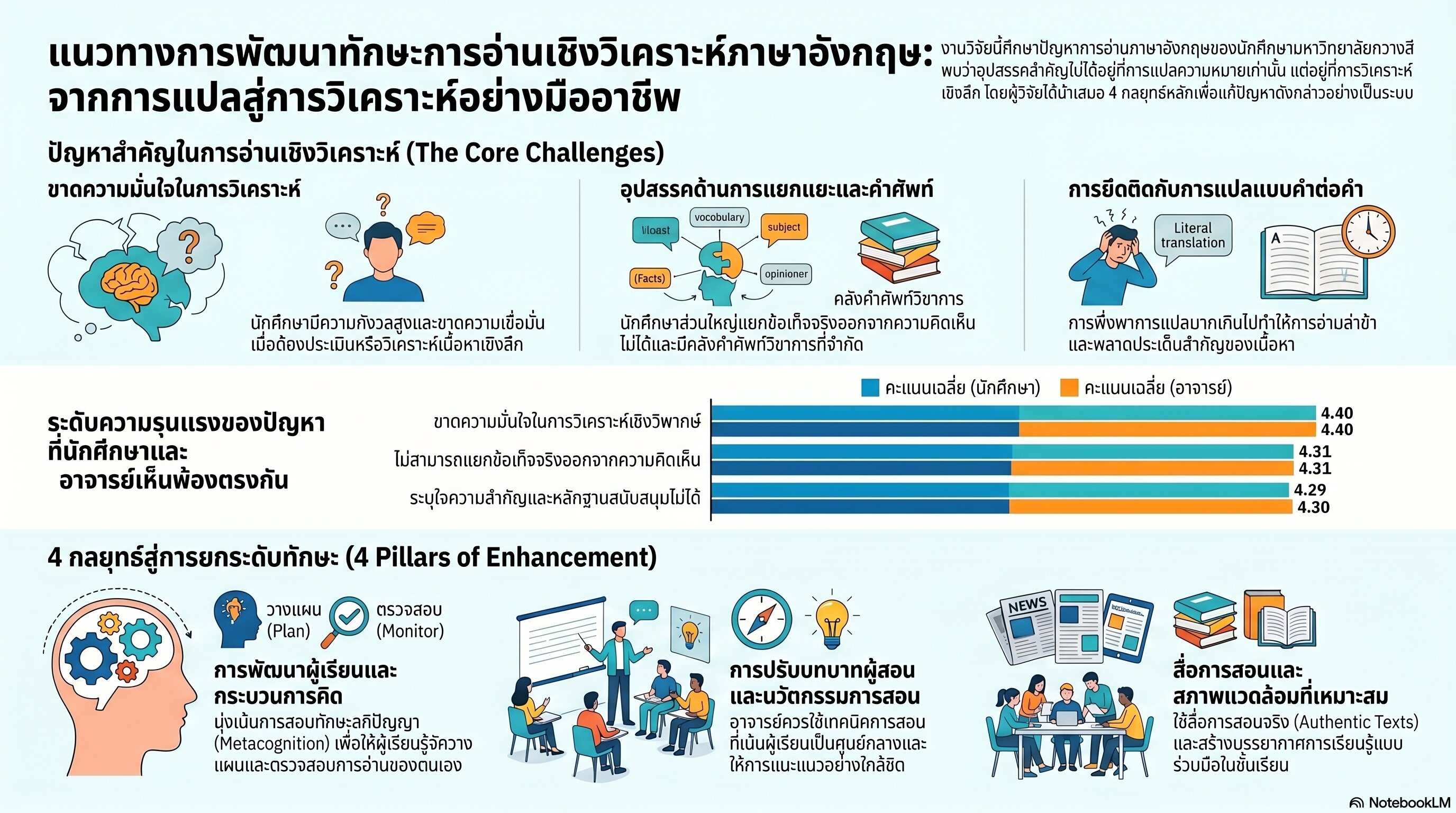
The purposes of this study were: 1) to investigate problems of English analytical reading skills of undergraduate Chinese students at Guangxi University of Foreign Languages, 2) to construct enhancement strategies for English reading skills of undergraduate Chinese students at Guangxi University of foreign language. The research employed a mixed-methods approach. The sample group in this research project were divided into 2 groups; namely,217 Chinese students and 38 teachers at Guangxi University of Foreign Language in the academic year2025. Data collection utilized questionnaires to identify analytical reading difficulties and focus group discussions to evaluate proposed development strategies. The findings revealed that both students and teachers rated analytical reading problems at the highest level (mean scores ranging from 4.20 to 4.45 on a 5-point Likert scale), with the most significant challenges including difficulty distinguishing facts from opinions, lack of confidence in critical analysis, and struggles with identifying main arguments and supporting evidence. Key problems identified were vocabulary limitations, insufficient exposure to authentic English texts, over-reliance on translation strategies, and inadequate metacognitive reading strategy instruction. The study developed a comprehensive four-chapter framework for enhancement strategies focusing on: (1) learner-centered skill building and metacognitive development, (2) instructor guidance and innovative pedagogical approaches, (3) supportive classroom management and collaborative learning environments, and (4) authentic materials and comprehensive assessment methods. The proposed strategies were validated by three specialists with Index of Congruence (IOC) values ranging from 0.66 to 1.00, confirming their suitability for implementation. This research contributes to understanding analytical reading challenges specific to Chinese EFL learners and provides evidence-based enhancement strategies that can be adapted across similar educational contexts.
References
Afflerbach, P. (Ed.). (2022). Handbook of individual differences in reading. Routledge.
Alvermann, D. E., & Griffin, C. (2021). Teaching disciplinary literacy: Graphic organizers and text structures. Reading Research Quarterly, 56(S1), S185–S199.
Alyousef, H. S. (2020). Critical reading pedagogy in EAP: A systematic review. Journal of English for Academic Purposes, 46, 100867.
Anderson, N. J. (2018). Exploring second language reading (2nd ed.). Cengage.
Anderson, T., & Kim, J. (2020). Reciprocal teaching to develop inferencing in university EFL learners. Language Teaching Research, 24(5), 620–642.
Chen, X., & Hyland, K. (2021). Stance and evidence use in undergraduate reading-to-write tasks in China. Journal of Second Language Writing, 51, 100798.
Chen, Y. (2021). Chinese undergraduates’ challenges in reading dense academic texts in English. Journal of English for Academic Purposes, 49, 100934.
Gao, L., & Zhang, W. (2020). Cohesion, coherence and inference-making in Chinese EFL reading. Chinese Journal of Applied Linguistics, 43(2), 175–192.
Grabe, W. (2020). Reading in a second language: Moving from theory to practice (2nd ed.). Cambridge University Press.
Grabe, W., & Stoller, F. L. (2019). Teaching and researching reading (3rd ed.). Routledge.
Gu, P. Y., & Johnson, R. (2019). Vocabulary depth and critical comprehension among Chinese EFL learners. System, 81, 1–12.
Huang, L. (2023). Corpus-informed reading: Building collocational awareness to improve evaluation of sources. Language Learning & Technology, 27(2), 25–44.
Hyland, K. (2019). Second language writing. Cambridge University Press.
Khalifa, H., & Weir, C. (2009). Examining reading: The Cambridge approach to assessing reading. Cambridge University Press.
Koda, K. (2018). Insights into second language reading: A cross-linguistic approach (Updated ed.). Routledge.
Liu, J., & Zhang, H. (2021). Metacognitive awareness and critical reading performance of Chinese undergraduates. Asia-Pacific Education Researcher, 30(6), 541–553.
Liu, Y., & Stapleton, P. (2018). Critical thinking in L2 reading–writing integration: EAP classrooms in China. System, 72, 98–109.
Li, X. (2022). Genre-based reading instruction and analytical comprehension gains in Chinese universities. System, 108, 102867.
McLean, S., & Stoeckel, T. (2021). Extensive reading plus strategy training: Effects on higher-order comprehension. Reading in a Foreign Language, 33(1), 1–27.
McNamara, D. S., Graesser, A. C., & Louwerse, M. (2020). Comprehension strategies for complex texts. In P. Afflerbach (Ed.), Handbook of individual differences in reading (pp. 231–248). Routledge.
Nation, I. S. P., & Macalister, J. (2021). Teaching ESL/EFL reading and writing (2nd ed.). Routledge.
Oakhill, J., & Cain, K. (2019). Inference instruction and comprehension monitoring with older readers: A meta-analysis. Review of Educational Research, 89(3), 368–403.
Pang, J., & Liu, Y. (2022). Teaching inferencing and evaluation in Chinese EAP reading. ELT Journal, 76(3), 321–331.
Perfetti, C., & Stafura, J. (2014). Word knowledge in a theory of reading comprehension. Scientific Studies of Reading, 18(1), 22–37.
Sun, H., & Wang, L. (2019). Exposure to international journals and analytical reading performance. Journal of English for Academic Purposes, 38, 112–122.
Teng, F. (2020). Metacognitive strategy instruction for EFL reading: A classroom study. ELT Journal, 74(3), 295–306.
Wallace, C. (2018). Critical reading in language education (2nd ed.). Routledge.
Wang, Y. (2022). Teaching argument mapping for critical reading in EAP classes. TESOL Quarterly, 56(4), 1235–1254.
Xu, Z., & Chen, S. (2024). Reading-to-write integration and evaluation skills in Chinese EAP contexts. Journal of Second Language Writing, 64, 101163.
Zhang, H., & Guo, Y. (2020). Topic familiarity and inference quality in EFL academic reading. Journal of Asia TEFL, 17(4), 1189–1205.
Zhang, X. (2024). Peer-led questioning cycles (QAR/Socratic) for analytical reading. Asia-Pacific Education Researcher, 33(1), 55–70.
Zhang, X., & Qin, L. (2023). Teaching text-structure-based summarizing to improve analytical reading in EFL undergraduates. Reading in a Foreign Language, 35(2), 145–170.
Zhou, Q., & Li, M. (2022). Collocations and lexical bundles as predictors of advanced reading comprehension. System, 109, 102901.
Downloads
Published
How to Cite
Issue
Section
Categories
License
Copyright (c) 2026 Journal of Buddhist Education and Research (JBER)

This work is licensed under a Creative Commons Attribution-NonCommercial-NoDerivatives 4.0 International License.