Problems and Strategies for the Improvement of English Writing Skills of Secondary Students at Laibin No.8 Middle School in Guangxi Province
Abstract
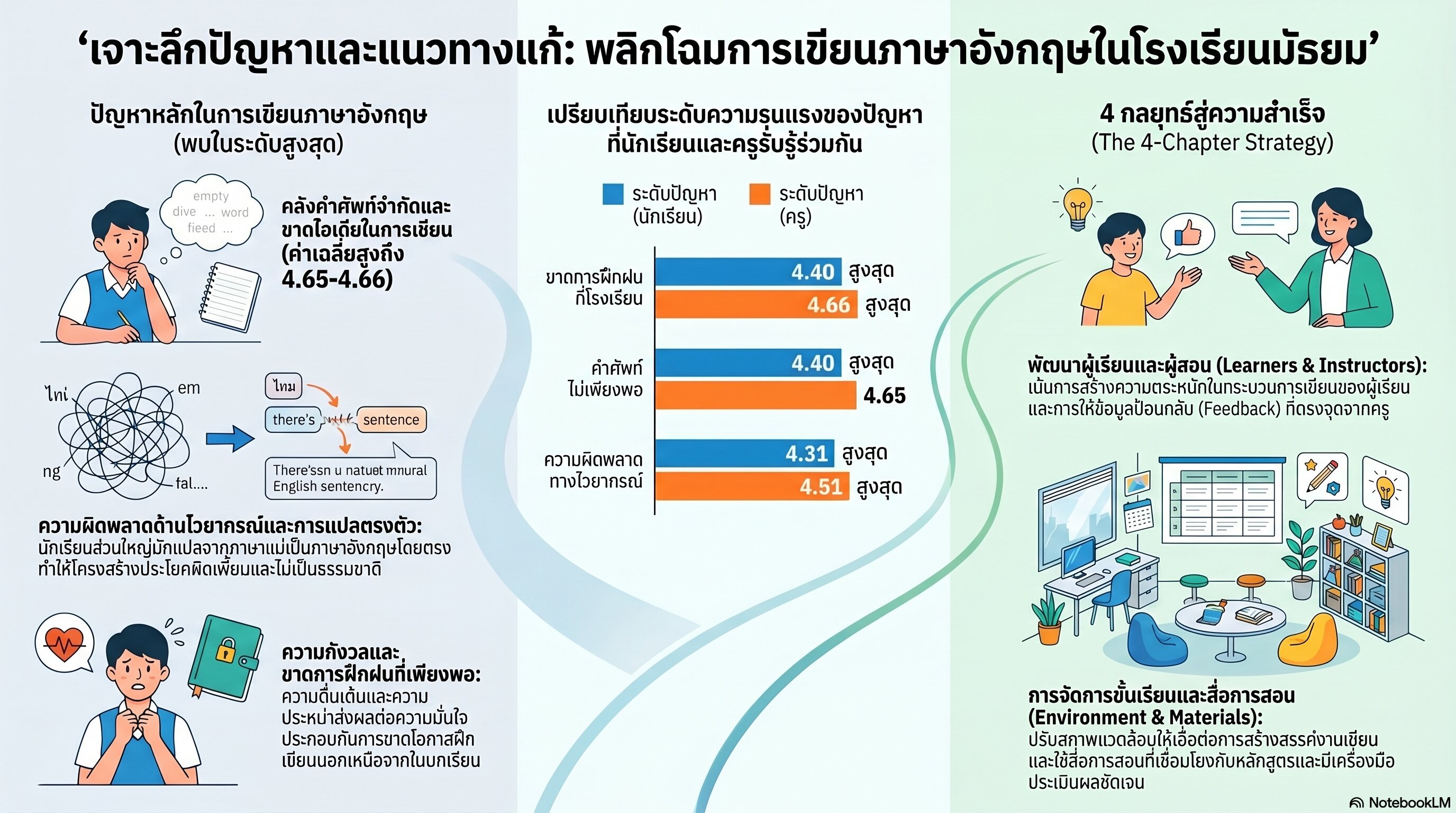
The objectives of this research were: 1) to investigate the problems in English writing experienced by secondary Chinese students at Laibin No.8 Middle School in Guangxi Province, and 2) to construct strategies for the improvement of English writing skills of secondary Chinese students at Laibin No.8 Middle School in Guangxi Province. This research was considered a mixed-method research study conducted at Laibin No.8 Middle School in Guangxi Province. The respondents were divided into two groups; namely, 1) 338 secondary school Chinese students, and 2) 90 teachers at Laibin No.8 Middle School in the academic year 2025. Two research instruments were employed; namely, 1) a questionnaire for investigating problems of writing skills, and 2) a set of questions for the focus group discussion meeting for evaluating the constructed strategies. The data collected were analyzed presented in terms of frequency count, percentage, mean, and standard deviation. In addition, the comments of the three specialists towards the correctness and suitability of the constructed strategies were collected and analyzed through the content analysis method. The results indicated that: The problems in English writing experienced by secondary school Chinese students were found at the highest level with mean scores ranging from 4.21 to 4.66. The most concerned problems included: 1) difficulty generating ideas, 2) grammar mistakes, 3) limited vocabulary, 4) logical organization problems, and 5) insufficient writing practice. In addition, the strategies for the improvement of English writing skills were categorized into 4 chapters; namely, 1) strategies for learners focusing on writing process awareness and self-regulation, 2) strategies for instructors emphasizing culturally responsive teaching and effective feedback, 3) classroom management strategies creating writing-conducive environments, and 4) teaching-learning materials incorporating curriculum-aligned resources and assessment tools.
References
Brown, D. (2022). Effectiveness of written corrective feedback in developing L2 writers. Language Teaching Research. https://doi.org/10.1177/13621688221147374
EUrASEANs Journal. (2024). Challenges faced by Chinese teachers in teaching continuation writing in Guangxi. The EUrASEANs, 1, 289–300. Retrieved from https://euraseans.com/index.php/journal/article/download/656/577/
Fan, N., & Ma, Y. (2022). The effects of automated writing evaluation feedback on students’ English writing quality: A systematic literature review. Language Teaching Research Quarterly, 28, 53–73. Retrieved from https://files.eric.ed.gov/fulltext/EJ1361364.pdf
Guo, H. (2024). The effect of electronic portfolio-based writing instruction on Chinese EFL learners. SAGE Open. https://doi.org/10.1177/21582440241257697
Kawinkoonlasate, P. (2024). Utilizing a digital-flipped classroom approach to enhance writing skills among Thai EFL learners. International Journal of Education and Literacy Studies. Retrieved from https://journals.aiac.org.au/index.php/IJELS/article/view/8240
Li, S. (2022). Core competencies in senior high school English textbooks under China’s curriculum standards. Arab World English Journal. Retrieved from https://awej.org/an-analysis-of-senior-high-school-english-textbooks-core-competencies-using-chinas-english-curriculum-standard-framework/
Liu, C. (2022). A genre-based approach in the secondary school English language classroom: Student-teachers’ knowledge and use [Open-access preprint].
Liu, W. (2024). Validity, effects and engagement in online peer and automated feedback on EFL writing. Interactive Learning Environments, 30(1), 4–16. Retrieved from https://files.eric.ed.gov/fulltext/EJ1456678.pdf
Ma, Y. (2024). A full-flipped classroom mode from the perspective of junior high English teachers in Guangxi, China. Heliyon, 10(1). Retrieved from https://pmc.ncbi.nlm.nih.gov/articles/PMC10835369/
Prompan, J., & Piamsai, C. (2023). The effects of peer feedback and self-regulated learning on Thai EFL students’ writing ability and self-regulation. LEARN Journal, 17(1), 100–132. Retrieved from https://files.eric.ed.gov/fulltext/EJ1415494.pdf
ResearchGate. (2023). Reading–Thinking–Expressing model: An empirical study in Laibin, Guangxi. Retrieved from https://www.researchgate.net/publication/375106807
Scherer, S., et al. (2024). How effective is feedback for L1, L2, and FL learners’ writing? Computers & Education, 215, 104935. https://doi.org/10.1016/j.compedu.2024.104935
Sun, J. (2024). Exploring writing anxiety during the writing process among Chinese EFL learners. Qualitative Research in Education. Retrieved from https://hipatiapress.com/hpjournals/index.php/qre/article/view/12938
Thongchalerm, S. (2020). Effect of a genre-based teaching cycle on EFL writing in Thailand. International Journal of Instruction, 13(1). Retrieved from https://files.eric.ed.gov/fulltext/EJ1239196.pdf
Wilson, J., et al. (2024). Predictors of middle school students’ perceptions of automated writing evaluation. Computers & Education. Retrieved from https://www.sciencedirect.com/science/article/pii/S0360131523002622
Wondim, B. M. (2024). Effectiveness of teachers’ direct and indirect written corrective feedback. Heliyon. Retrieved from https://pmc.ncbi.nlm.nih.gov/articles/PMC10830576/
Wonglakorn, P. (2023). The effects of a collaborative process writing approach on Thai secondary school students’ writing. English Language Teaching, 16(1). Retrieved from https://files.eric.ed.gov/fulltext/EJ1380755.pdf
Yang, J., et al. (2025). Urban–rural discrepancies in reading and writing development in China. Computers & Education. Retrieved from https://www.sciencedirect.com/science/article/pii/S0959475225000696
Yang, L. F. (2023). Self-regulation and engagement with teacher written feedback in a Chinese EFL context. Assessing Writing, 58, 100979. Retrieved from https://www.sciencedirect.com/science/article/abs/pii/S1475158523000127
Yu, Y., Fan, J., & Lin, Z. (2022). Understanding Chinese EFL learners’ writing anxiety for sustainable development of writing skills. Frontiers in Psychology, 13, 1010010. Retrieved from https://www.frontiersin.org/articles/10.3389/fpsyg.2022.1010010/pdf
Zhang, S., & Zhang, W. (2018). Adoption and use of Pigai AWE in China. In N. Fan & Y. Ma (2022), The effects of automated writing evaluation feedback on students’ English writing quality: A systematic literature review. Language Teaching Research Quarterly, 28, 53–73.
Downloads
Published
How to Cite
Issue
Section
Categories
License
Copyright (c) 2026 Journal of Buddhist Education and Research (JBER)

This work is licensed under a Creative Commons Attribution-NonCommercial-NoDerivatives 4.0 International License.