An Investigation of English Reading Comprehension Difficulties and Improvement Methods of Undergraduate Chinese Students at Guangxi University of Foreign Languages
Abstract
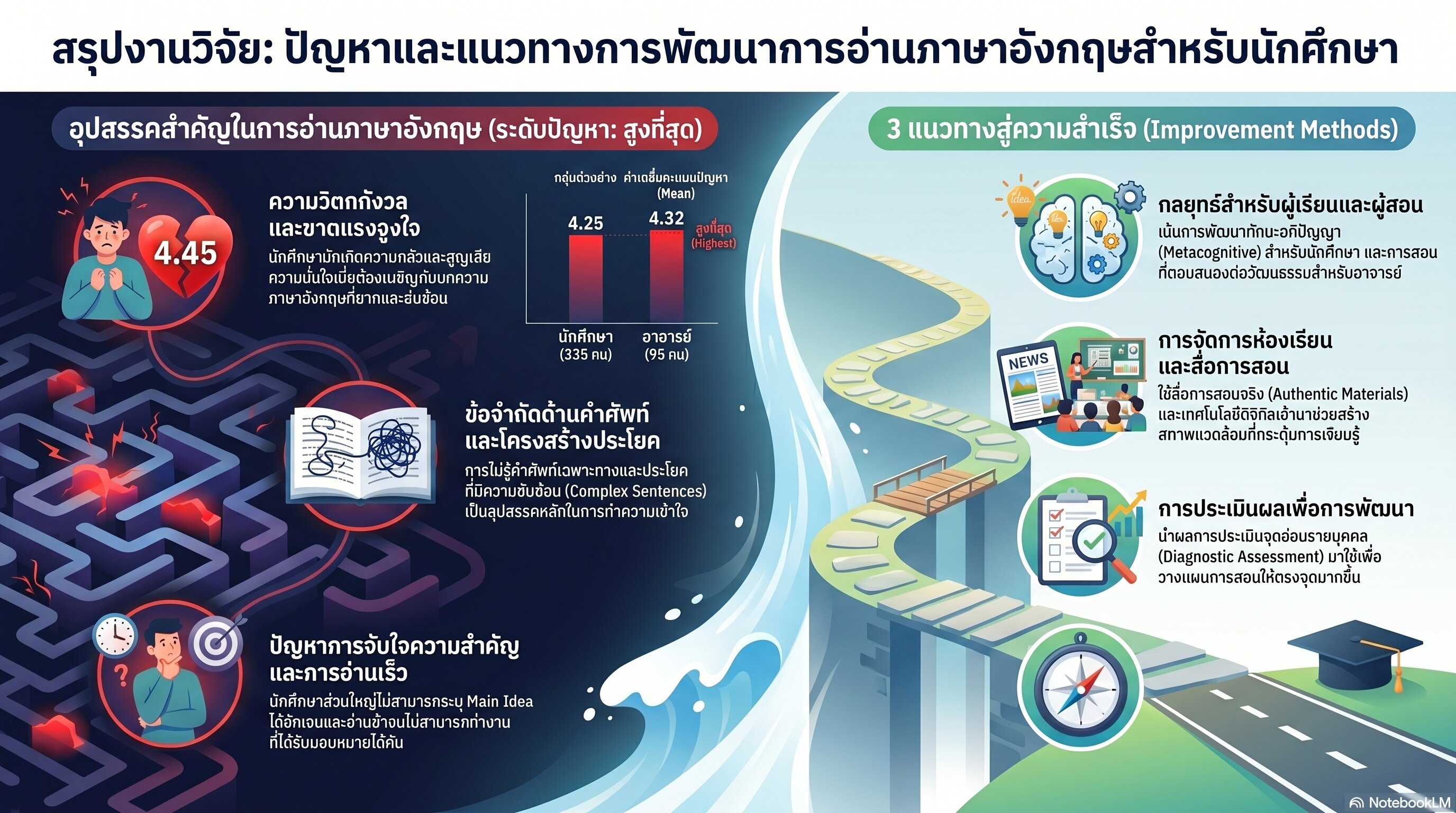
The objectives of this research were to investigate the difficulties in English reading comprehension experienced by undergraduate Chinese students at Guangxi University of Foreign Languages and to construct improvement methods of English reading comprehension for undergraduate Chinese students at Guangxi University of Foreign Languages. This research was considered a mixed-methods research study conducted at Guangxi University of Foreign Languages. The respondents were divided into two groups: 335 undergraduate Chinese students and 95 teachers at Guangxi University of Foreign Languages in the academic year 2025. Two research instruments were employed: 1) a questionnaire for investigating difficulties of reading comprehension and 2) focus group discussions for evaluating the improvement methods. The data collected were analyzed through statistical and content analysis methods and presented in terms of frequency count, percentage, mean, and standard deviation. The results indicated that: 1) The difficulties in English reading comprehension experienced by undergraduate Chinese students were found at the highest level with mean scores ranging from 4.21 to 4.40, including difficulty understanding unfamiliar vocabulary, struggling to identify main ideas, difficulty with long and complex sentences, and anxiety when reading English texts. 2) The improvement methods of English reading comprehension were categorized into four chapters: methods for learners focusing on metacognitive strategy development and vocabulary enhancement, methods for instructors emphasizing diagnostic assessment and culturally responsive teaching, classroom management strategies creating supportive environments, and teaching-learning materials incorporating authentic resources and digital integration. Keywords: Reading Comprehension; Difficulties; Improvement Methods; Chinese Students; English as Foreign Language
References
Alavi, S. (2021). The implementation of writing through technology-mediated English course to enhance Thai university students' writing skills. Rangsit Journal of Educational Studies, 8(2), 50–65. Retrieved from https://doi.org/10.14456/rjes.2021.11
Boonyarattanasoontorn, P. (2017). An investigation of Thai students’ English language writing difficulties and their use of writing strategies. Journal of Advanced Research in Social Sciences and Humanities, 2(2), 111–118. Retrieved from https://dx.doi.org/10.26500/JARSSH-02-2017-0205
Decharotchanawirun, T. (2015). A study of problems in the business English writing skills of Thai employees at The Classic Chairs Company (Unpublished master’s thesis). Thammasat University, Bangkok, Thailand.
Dueraman, B. (2015). The crucial point in time where Thai students are introduced to English language writing. English Language Teaching, 8(9), 96–103. Retrieved from https://doi.org/10.5539/elt.v8n9p1
Fleckenstein, J., et al. (2023). International Journal of Educational Technology in Higher Education, 20(1), 24.
Inkaew, M. (2020). An analysis of EFL students’ perceptions and motivations towards fundamental English writing learning: A comparative study of classes conducted by native English instructors and Thai teachers in a Thai classroom context. Journal of Education Naresuan University, 22(4), 16–36.
Kampookaew, P. (2020). An analysis of grammatical errors made by Thai EFL university students in an EAP writing class: Issues and recommendations. rEFLections, 27(2), 246–273.
Kawinkoonlasate, P. (2018). A comparative study of e-writing and traditional writing classroom to improve English writing ability and motivate autonomous learning of Thai EFL learners (Unpublished master’s thesis). Huachiew Chalermprakiet University.
Khemanuwong, T., Muangnakin, P., Phairot, E., & Kho, S. H. (2020, March). Difficulties in writing English language research paper: The experience of Thai NNES postgraduate students. In Panyapiwat International Conference on Social Science and Management. King Mongkut's Institute of Technology Ladkrabang.
Kongkaew, S., & Cedar, P. (n.d.). An analysis of errors in online English writing made by Thai EFL authors. International Journal of Applied Linguistics & English Literature, 86–96. Retrieved from https://www.ijalel.aiac.org.au
Padgate, W. (2008). Beliefs and opinions about English writing of students at a Thai university. PASAA, 42, 31–53.
Promsupa, P., Varasarin, P., & Brudhiprabha, P. (2017). An analysis of grammatical errors in English writing of Thai university students. HRD Journal, 8(1), 93–104.
Sasmita, Y. V., & Setyowati, L. (2021). Problems faced by EFL students in learning to write. Linguista: Jurnal Ilmiah Bahasa, Sastra dan Pembelajaranya, 5(1), 11–25. Retrieved from http://ejournal.unipma.ac.id/index.php/linguista
Sermsook, K., Liamnimitr, J., & Pochakorn, R. (2017). An analysis of errors in written English sentences: A case study of Thai EFL students. English Language Teaching, 10(3), 101–110. Retrieved from https://doi.org/10.5539/elt.v10n3p101
Shi, H., & Deocampo, M. F. (2024). Challenges faced by Chinese teachers teaching continuation writing to senior high school students. The EUrASEANs Journal, 1, 289–300.
Singchai, P., & Jaturapitakkul, N. (n.d.). Cohesion in narrative essay writing of EFL secondary students in Thailand. The New English Teacher, 10(2), 89–111.
Sor, T., Intanoo, K., & Prachanant, N. (2017). An error analysis of English composition written by Cambodia and Thai grade twelve students. Journal of Asia Graduate College, 7(Special Issue), 440–450.
Srikrai, P., Lin, D., Lakaisone, S., & Seepho, S. (2016). English language difficulties of non-native English postgraduate students in an English for academic purposes at a Thai university. In Proceedings of CLaSIC 2016 (pp. 301–315). Suranaree University of Technology.
Stone, G. (2017). Implementation of critical literacy for English writing classes in the Thai context. The New English Teacher, 11(2), 65–76.
Toan, L. A., Dan, T. C., Da, T. C., Chau, P. T. H., Ngoan, C. T., Thien, M. B., & Anh, P. H. D. (2020). A study about EFL English-major students’ challenges in writing argumentative essays at Soc Trang Teachers’ Training College, Vietnam. In Proceedings of RSU International Research Conference 2020 (p. 1544). Rangsit University. Retrieved from https://rsucon.rsu.ac.th/proceedings
Watcharapunyawong, S., & Usaha, S. (2013). Thai EFL students’ writing errors in different text types: The interference of the first language. English Language Teaching, 6(1), 67–78. Retrieved from https://doi.org/10.5539/elt.v6n1p1
Downloads
Published
How to Cite
Issue
Section
Categories
License
Copyright (c) 2026 Journal of Buddhist Education and Research (JBER)

This work is licensed under a Creative Commons Attribution-NonCommercial-NoDerivatives 4.0 International License.