A Study on Problems and Improvement Strategies of English Listening and Speaking Skills of Students Studying in Mattayomsuksa 1 at Nawamintrachinuthit Benjamarachalai School in Bangkok
บทคัดย่อ
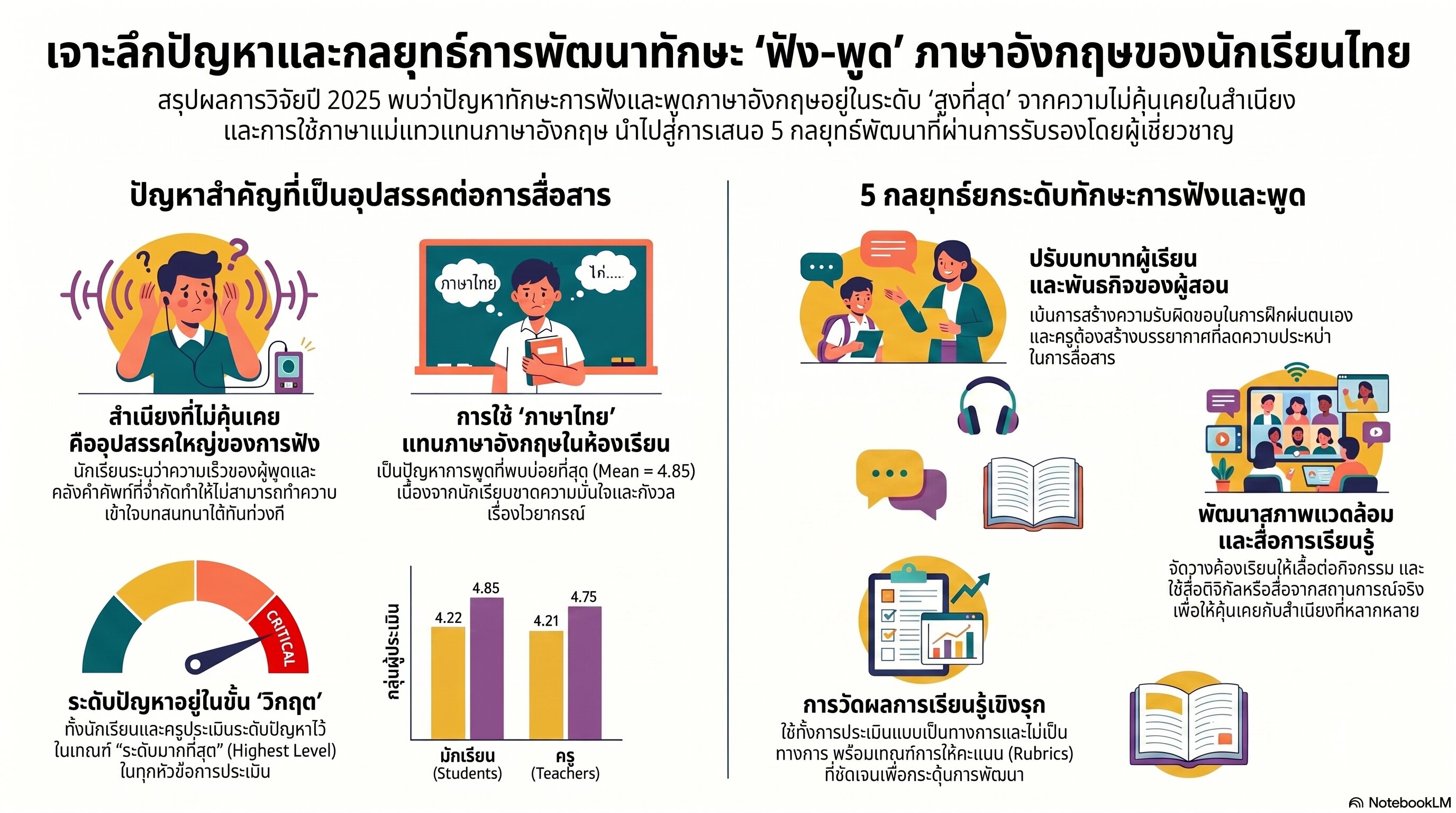
The objectives of this study were: 1) to investigate the problems in English listening and speaking skills of students studying in Mattayomsuksa 1 at Nawamintrachinuthit Benjamarachalai School in Bangkok, and 2) to construct improvement strategies to enhance the English listening and speaking skills of the students. The participants of this study consisted of 224 students and 24 teachers at Nawamintrachinuthit Benjamarachalai School in the academic year 2025, obtained through the Simple Random Sampling Method. A mixed-method design was employed in this study. The research instruments were: 1) questionnaires for investigating students' English listening and speaking skill problems and 2) a set of questions for the focus group discussion meeting for the evaluation and approval of the improvement strategies. The data and information collected were analyzed through statistical devices and the content analysis method and then presented in terms of frequency count, percentage, mean, and standard deviation. The results indicated that: 1) the problems in English listening and speaking skills of students were found at the highest level rated by the students and teachers. The students rated the problems in the range of mean from 4.22 to 4.85; while teachers rated the problems in the range of mean from 4.21 to 4.75. Unfamiliar accent was found the major English listening problems; while using mother tongue (Thai) instead of English was considered the main speaking problems, and 2) the improvement strategies for enhancing English listening and speaking skills were categorized into five chapters, namely, Chapter 1: Learner Responsibility, Chapter 2: Instructor Mission, Chapter 3: Classroom Environment, Chapter 4: Instructional Materials, and Chapter 5: Learning Assessment. The strategies were approved for their correctness and suitability by the three specialists; therefore, they could be used for the enhancement of English listening and speaking skills of the students.
เอกสารอ้างอิง
Al Hosni, S. (2014). Speaking difficulties encountered by young EFL learners. International Journal on Studies in English Language and Literature (IJSELL), 2(6), 22–30.
Alamri, W. (2025). Evaluating the benefits and challenges of using authentic materials in EFL context for listening purpose. Frontiers in Education, 10, 1611308.
Ali, Y. (2020). Difficulties faced by tertiary level EFL learners in listening. British Journal of English Linguistics, 8(2), 90–112.
Erzad, A. M. (2020). Exploring English listening problems among EFL students at IAIN Kudus. Edulingua: Jurnal Linguistiks Terapan dan Pendidikan Bahasa Inggris, 7(1).
Gilakjani, A. P., & Sabouri, N. B. (2016). Learners' listening comprehension difficulties in English language learning: A literature review. English Language Teaching, 9(6), 123–133.
Hadijah, S. (2014). Investigating the problems of English speaking of the students of Islamic boarding school program at STAIN Samarinda. Dinamika Ilmu, 14(2), 240–247.
Jaelani, A., & Zabidi, O. W. (2020). Junior high school students’ difficulties of English language learning in the speaking and listening section. ELT Forum: Journal of English Language Teaching, 9(1), 45–54. https://doi.org/10.15294/elt.v9i1.38287
Khampool, W. (2024). The study of English listening problems of Thai EFL university students. Education and New Developments.
Khamprated, N. (2012). The problems with the English listening and speaking of students studying at a private vocational school in Bangkok, Thailand (Unpublished master's thesis). Srinakharinwirot University.
Lemons, R., & Tao-Ngoen, S. (2024). Study of Phetchabun Rajabhat University second and third year students’ listening and speaking difficulties in English language. Journal of Asian Language Teaching and Learning, 5(2), 1–12. https://so10.tci-thaijo.org/index.php/jote/article/view/1401
Nadhira, S., & Warni, S. (2021). Students’ listening difficulties in English as a foreign language learning at secondary school in Indonesian context. In Proceedings of the 1st Annual International Conference on Natural and Social Science Education (ICNSSE 2020) (pp. 186–193). Atlantis Press.
Normawati, A., Nugrahaeni, D. A., Manggolo, N. S. K. H., & Susanto, A. I. F. (2023). EFL learners’ difficulties in speaking English. English Language and Education Spectrum, 3(1).
Nushi, M., & Orouji, F. (2020). Investigating EFL teachers’ views on listening difficulties among their learners: The case of Iranian context. SAGE Open, 10(2), 2158244020917393.
Riadil, I. G. (2020). A study of students’ perception: Identifying EFL learners’ problems in speaking skill. IJELR: International Journal of Education, Language, and Religion, 2(1), 31–38.
Shen, M. Y., & Chiu, T. Y. (2019). EFL learners’ English speaking difficulties and strategy use. Education and Linguistics Research, 5(2), 88–102.
Thangpradit, P. (2020). Analysis of secondary school Thai ESL students’ English listening problems [Master’s thesis, Thammasat University, Language Institute].
Wahyuningsih, S., & Afandi, M. (2020). Investigating English speaking problems: Implications for speaking curriculum development in Indonesia. European Journal of Educational Research, 9(3), 967–977.
Yamane, T. (1973). Statistics: An introductory analysis (3rd ed.). Harper & Row.
Zhu, Z. (2021). A discussion of foreign language listening problems and their causes. Journal of Contemporary Educational Research, 5(8).
ดาวน์โหลด
เผยแพร่แล้ว
รูปแบบการอ้างอิง
ฉบับ
ประเภทบทความ
หมวดหมู่
สัญญาอนุญาต
ลิขสิทธิ์ (c) 2026 Journal of Buddhist Education and Research (JBER)

อนุญาตภายใต้เงื่อนไข Creative Commons Attribution-NonCommercial-NoDerivatives 4.0 International License.