The Development of Learning Effectiveness by Using Music Studies in Guizhou Qiannan Economic College in China
Keywords:
Music Education, Learning Effectiveness ,Kodály–Orff ApproachAbstract
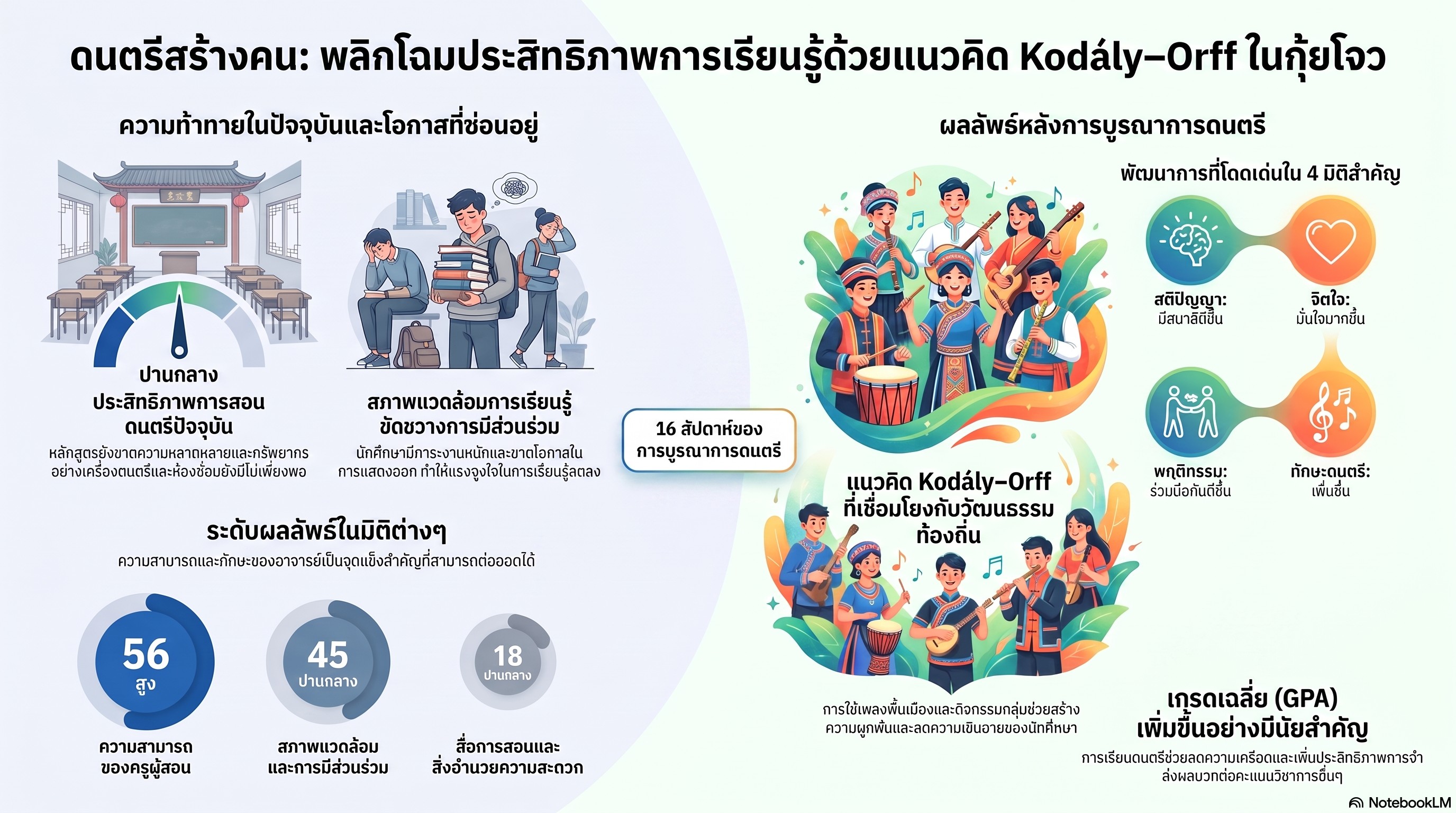
Music general education in private universities located in China’s ethnic regions is often limited by curriculum constraints, insufficient resources, and varying levels of teaching quality. These challenges reduce the potential of music education to support broader academic and personal development among non-music majors. This study aimed to: (1) examine the current situation and problems of music teaching at Guizhou Qiannan Economic College; (2) provide guidelines for using music to improve students’ learning efficiency; (3) develop learning effectiveness through structured music studies; and (4) evaluate the outcomes of the music-based intervention. An embedded mixed-methods design was used. Quantitative data were collected from 390 students through a structured questionnaire, while qualitative data were obtained from interviews with 25 music teachers and 10 students, classroom observations, and document analysis. A 16-week Kodály–Orff integrated program was implemented with 39 student volunteers to test the proposed guidelines and measure changes in learning effectiveness. Findings show that students perceive teacher competence positively, yet curriculum design, learning resources, and participation opportunities remain only moderate. The developed guidelines emphasize emotional engagement, cultural relevance, and alignment between music activities and learning tasks. Evaluation of the 16-week intervention indicates improvements across cognitive, affective, behavioural, and music-skill dimensions. Participants also demonstrated a significant increase in semester GPA, suggesting positive academic spillover effects. The study concludes that structured and culturally responsive music studies can effectively enhance learning effectiveness in ethnic regional colleges.
References
Chen, Y. (2023). Enhancing non-music majors' engagement through Kodály–Orff integrated pedagogy: Evidence from Chinese applied universities. Journal of Music Education Research, 45(2), 113-125.
Huang, L., & Mei, Q. (2022). Student engagement in general music courses in private universities. Journal of Contemporary Education Studies, 18(3), 112-123.
Liu, J., & Zhang, P. (2021). Teacher competence and student motivation in general music education: A survey of Chinese universities. International Review of Education Studies, 9(4), 55-75.
Qiao, X. (2024). Challenges and innovations in music general education in ethnic minority regions of China. Journal of Ethnic Education Development, 7(1), 33-45.
Sun, J., & Li, W. (2020). The impact of music learning on attention and emotional regulation among college students. Asian Journal of Educational Psychology, 5(2), 89-110.
Tan, Y. (2024). Cultural identity and music education in minority-region colleges. International Review of Humanities and Arts Education, 12(1), 76-89.
Wang, S., & He, Q. (2022). Curriculum issues in general music education in private colleges: A national survey. Journal of Higher Education Development, 33(2), 122-135.
Zhao, K. (2025). Motivation and academic performance: The mediating role of music-based learning. Journal of Learning Sciences in Asia, 6(1), 101–118.
Downloads
Published
How to Cite
Issue
Section
Categories
License
Copyright (c) 2026 Journal of Buddhist Education and Research (JBER)

This work is licensed under a Creative Commons Attribution-NonCommercial-NoDerivatives 4.0 International License.