Constructing for Middle School Students Vocal Exercise Book
Keywords:
Middle school students, Vocal exercise book, Voice change period, cultural integrationAbstract
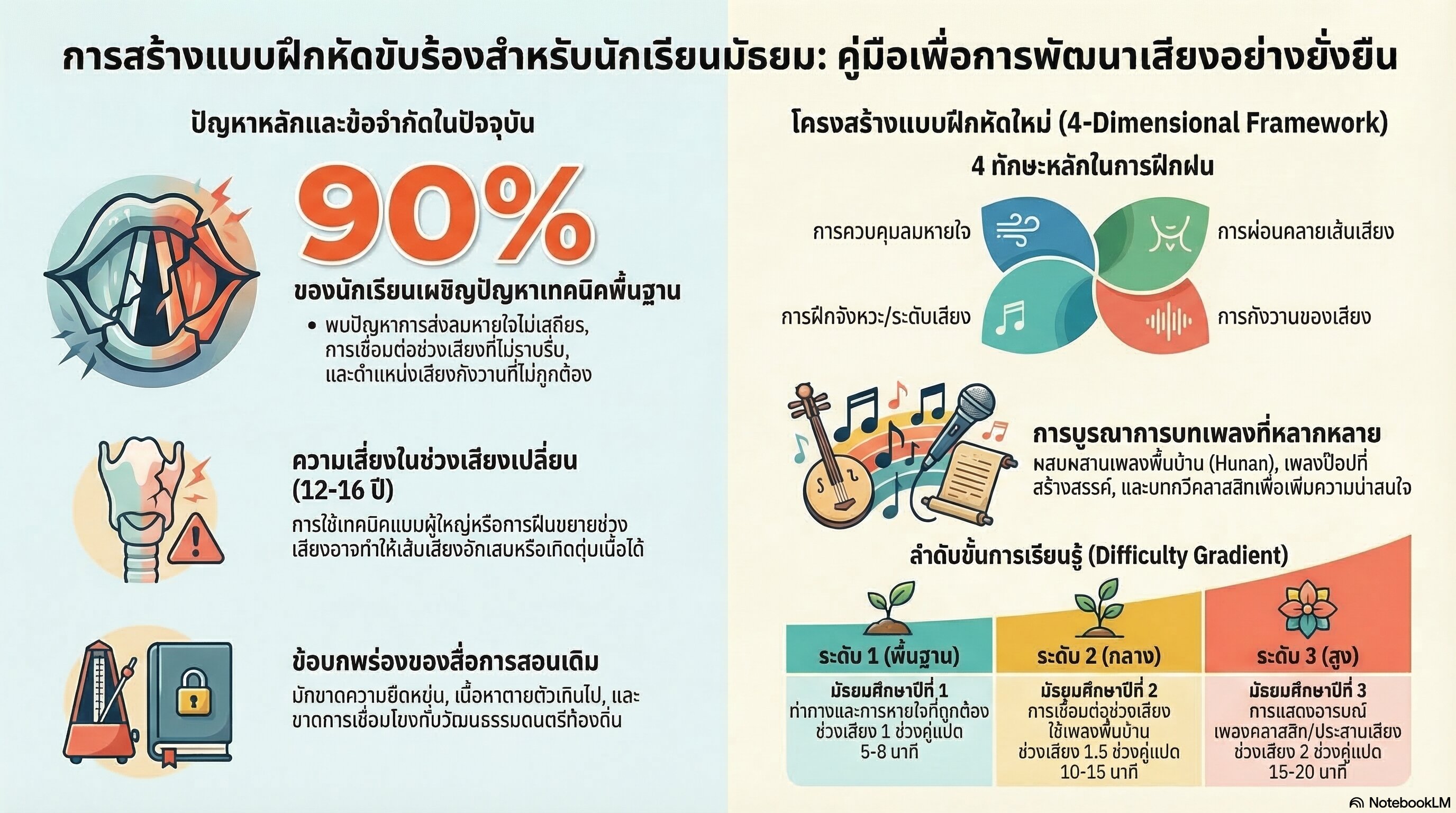
This study aims to address the mismatches between existing vocal training materials and the developmental characteristics of middle school students aged 12-16, as well as the lack of regional relevance in vocal education. It constructs a scientific, targeted, and Hunan-localized vocal exercise book to promote healthy vocal development and enhance learning enthusiasm among adolescents. A qualitative research method was adopted, including in-depth one-on-one interviews with 3 key middle school vocal teachers and 3 expert consultants, as well as field surveys in 3 representative schools in Changsha. Data were analyzed through content analysis and descriptive statistics. The results show that middle school students face core technical difficulties such as unstable breath support, disjointed register transitions, and inaccurate resonance positioning, while existing materials have flaws including poor adaptability to the voice change period, rigid content, and weak regional relevance. The constructed exercise book features a three-level difficulty gradient, integrates four types of core exercises, and incorporates Hunan folk songs, adapted pop music, and classical poetry art songs. The Index of Item-Objective Congruence (IOC) assessment confirms its high scientific and adaptability, with an average score of 0.79. This exercise book provides practical tools for middle school vocal teaching, balancing physiological protection, skill training, interest stimulation, and cultural inheritance.
References
Arnett, J. J. (2019). Adolescence and emerging adulthood: A cultural approach (6th ed.). Pearson.
Bruner, J. S. (1966). The process of education. Harvard University Press.
Clift, S., & Hancox, G. (2010). Singing and well-being: A review of the evidence. Journal of Applied Arts & Health, 1(1), 5–28. https://doi.org/10.1386/jaah.1.1.5_1
Davidson, J. (2019). Vocal health in adolescent singers: A meta-analysis. Journal of Voice, 33(4), 567–573. https://doi.org/10.1016/j.jvoice.2018.11.008
García, M. (2020). Student-centered music curriculum: Aligning with adolescent musical preferences. Music Education Research, 22(3), 312–327. https://doi.org/10.1080/14613808.2019.1678924
Jin, T. (2011). Chinese vocal phonetics. Music Press of China.
Jin, T. (2015). Training course for Chinese national vocal music. China Conservatory of Music Press.
McAllister, A. (2020). Adolescent voice development and singing confidence. Journal of Music Therapy, 57(2), 189–215. https://doi.org/10.1093/jmt/thaa005
Sataloff, R. T., & Spiegel, J. A. (2019). Voice care for singers: The basics and beyond. Plural Publishing.
Welch, G. F., & Howard, S. (2018). The adolescent voice in music education. Oxford University Press. https://doi.org/10.1093/oso/9780198793031.001.0001
Wong, L., & Chen, Y. (2017). Motivation factors in adolescent vocal learning: The role of peer interaction and content relevance. Asian Journal of Music Education, 29(2), 145–158. https://doi.org/10.1177/0219437917715623
Zhou, X. (2018). Transition theory of adolescent vocal training. Shanghai Music Publishing House.
Downloads
Published
How to Cite
Issue
Section
Categories
License
Copyright (c) 2026 Journal of Buddhist Education and Research (JBER)

This work is licensed under a Creative Commons Attribution-NonCommercial-NoDerivatives 4.0 International License.