The SDS M.I.N.D. Model for Compassionate Leadership: Integrating the Brahmaviharas with Modern Management A Case Study of Mae Chee Sansanee Sthirasuta
Abstract
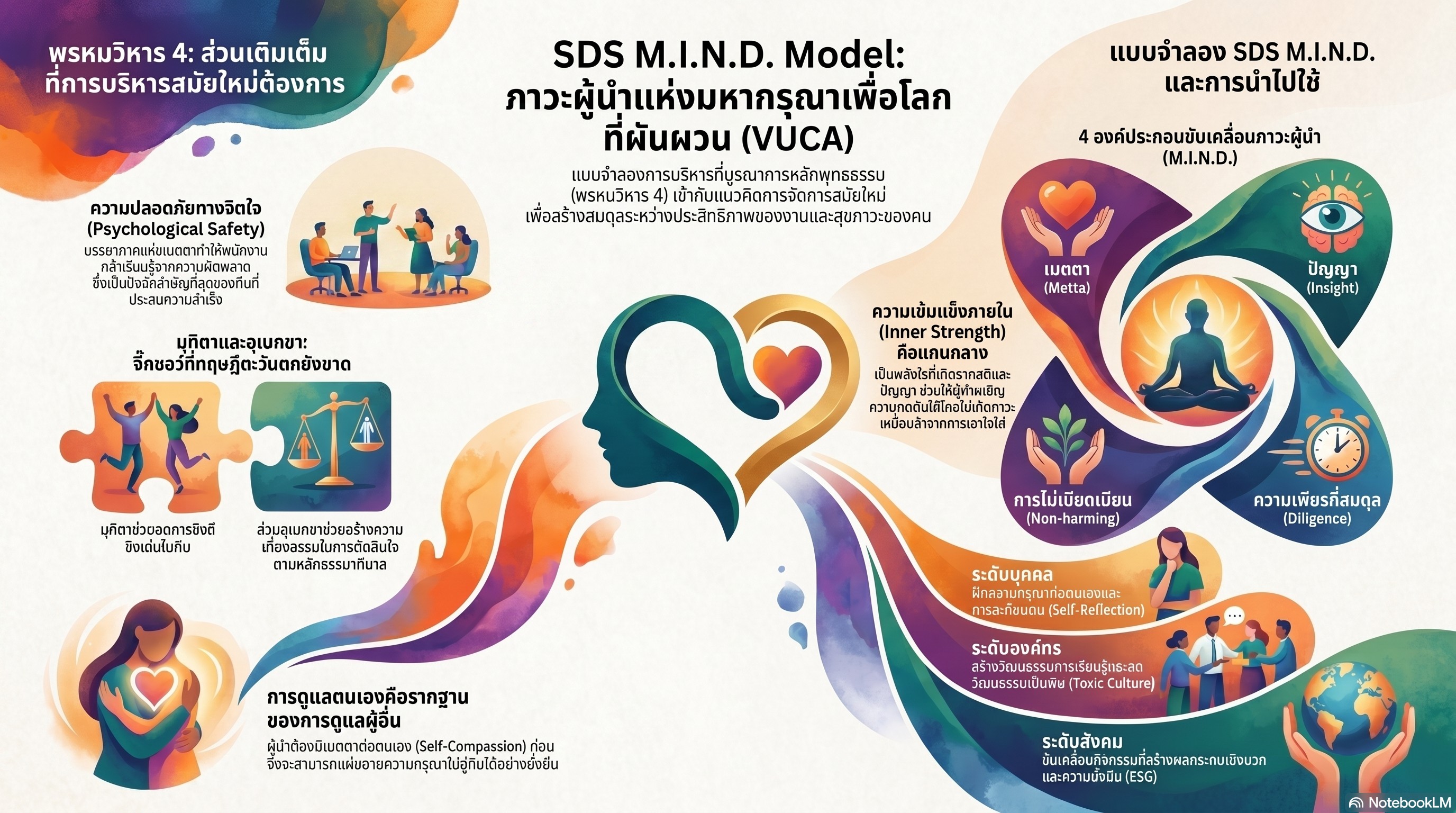
This qualitative documentary study examines how the Brahmavihāras can be integrated with contemporary management perspectives on self-compassion, compassionate leadership, and psychological safety. It aims to (1) compare conceptual alignments and distinctions between the Brahmaviharas and these modern theories, (2) synthesize Mae Chee Sansanee Sthirasuta’s Buddhist approach to applying the Brahmavihāras in managing a social enterprise, and (3) develop the SDS M.I.N.D. model for compassionate leadership in volatile, uncertain, complex, and ambiguous contexts. Sources were systematically collected from the Tipitaka and commentarial texts, peer‑reviewed literature (2000–2025), and documented teachings and materials related to Mae Chee Sansanee. Data were analyzed through qualitative content analysis and comparative thematic analysis, with trustworthiness enhanced via triangulation and an audit trail. Findings show strong overlap in the principle that self-care underpins sustainable care for others and in practices that foster psychologically safe learning climates. The Brahmaviharas further extend modern discourse by clarifying two ethical mechanisms: mudita as a foundation for a non-competitive, cooperative culture, and upekkha as impartiality that strengthens ethical governance and fair decision-making. The proposed SDS M.I.N.D. model integrates Metta, Insightful Wisdom, Non-harming, and Diligence, anchored by Inner Strength as the core enabling mechanism, and outlines applications across individual, organizational, and societal levels to balance performance, well-being, and ethical values.
References
พระธรรมปิฎก (ป.อ. ปยุตฺโต). (2560). พจนานุกรมพุทธศาสน์ ฉบับประมวลศัพท์ (พิมพ์ครั้งที่ 31). สำนักพิมพ์ผลิธัมม์.
สถาบันเสถียรธรรมสถาน. (2567). ประวัติและผลงานแม่ชีศันสนีย์ สเถียรสุต.
Bennett, N., & Lemoine, G. J. (2014). What a difference a word makes: Understanding threats to performance in a VUCA world. Business Horizons, 57(3), 311–317. https://doi.org/10.1016/j.bushor.2014.01.001
Bodhi, B. (2012). The numerical discourses of the Buddha: A translation of the Anguttara Nikaya. Wisdom Publications.
Duhigg, C. (2016, February 25). What Google learned from its quest to build the perfect team. The New York Times Magazine. https://www.nytimes.com/2016/02/28/magazine/what-google-learned-from-its-quest-to-build-the-perfect-team.html
Dutton, J. E., Workman, K. M., & Hardin, A. E. (2014). Compassion at work. Annual Review of Organizational Psychology and Organizational Behavior, 1(1), 277–304. https://doi.org/10.1146/annurev-orgpsych-031413-091221
Edmondson, A. C. (1999). Psychological safety and learning behavior in work teams. Administrative Science Quarterly, 44(2), 350–383. https://doi.org/10.2307/2666999
Edmondson, A. C. (2018). The fearless organization: Creating psychological safety in the workplace for learning, innovation, and growth. Wiley.
Hougaard, R., & Carter, J. (2018). The mind of the leader: How to lead yourself, your people, and your organization for extraordinary results. Harvard Business Review Press.
Hougaard, R., Carter, J., & Hobson, N. (2020). Compassionate leadership is necessary—but not sufficient. Harvard Business Review. https://hbr.org/2020/12/compassionate-leadership-is-necessary-but-not-sufficient
Lincoln, Y. S., & Guba, E. G. (1985). Naturalistic inquiry. Sage Publications.
MacBeth, A., & Gumley, A. (2012). Exploring compassion: A meta-analysis of the association between self-compassion and psychopathology. Clinical Psychology Review, 32(6), 545–552. https://doi.org/10.1016/j.cpr.2012.06.003
Moss, J. (2021). The burnout epidemic: The rise of chronic stress and how we can fix it. Harvard Business Review Press.
Neff, K. D. (2011). Self-compassion: The proven power of being kind to yourself. William Morrow.
Neff, K. D., & Germer, C. K. (2018). The mindful self-compassion workbook: A proven way to accept yourself, build inner strength, and thrive. Guilford Press.
Rozovsky, J. (2015, November 17). The five keys to a successful Google team. Google re:Work. https://www.michigan.gov/-/media/Project/Websites/mdhhs/Folder4/Folder10/Folder3/Folder110/Folder2/Folder210/Folder1/Folder310/Google-and-Psychological-Safety.pdf
Salzberg, S. (2002). Lovingkindness: The revolutionary art of happiness. Shambhala Publications.
Worline, M. C., & Dutton, J. E. (2017). Awakening compassion at work: The quiet power that elevates people and organizations. Berrett-Koehler Publishers.
World Health Organization. (2019). Mental health in the workplace. https://www.who.int/news-room/commentaries/detail/mental-health-in-the-workplace
Downloads
Published
How to Cite
License
Copyright (c) 2026 Journal of Buddhist Education and Research (JBER)

This work is licensed under a Creative Commons Attribution-NonCommercial-NoDerivatives 4.0 International License.