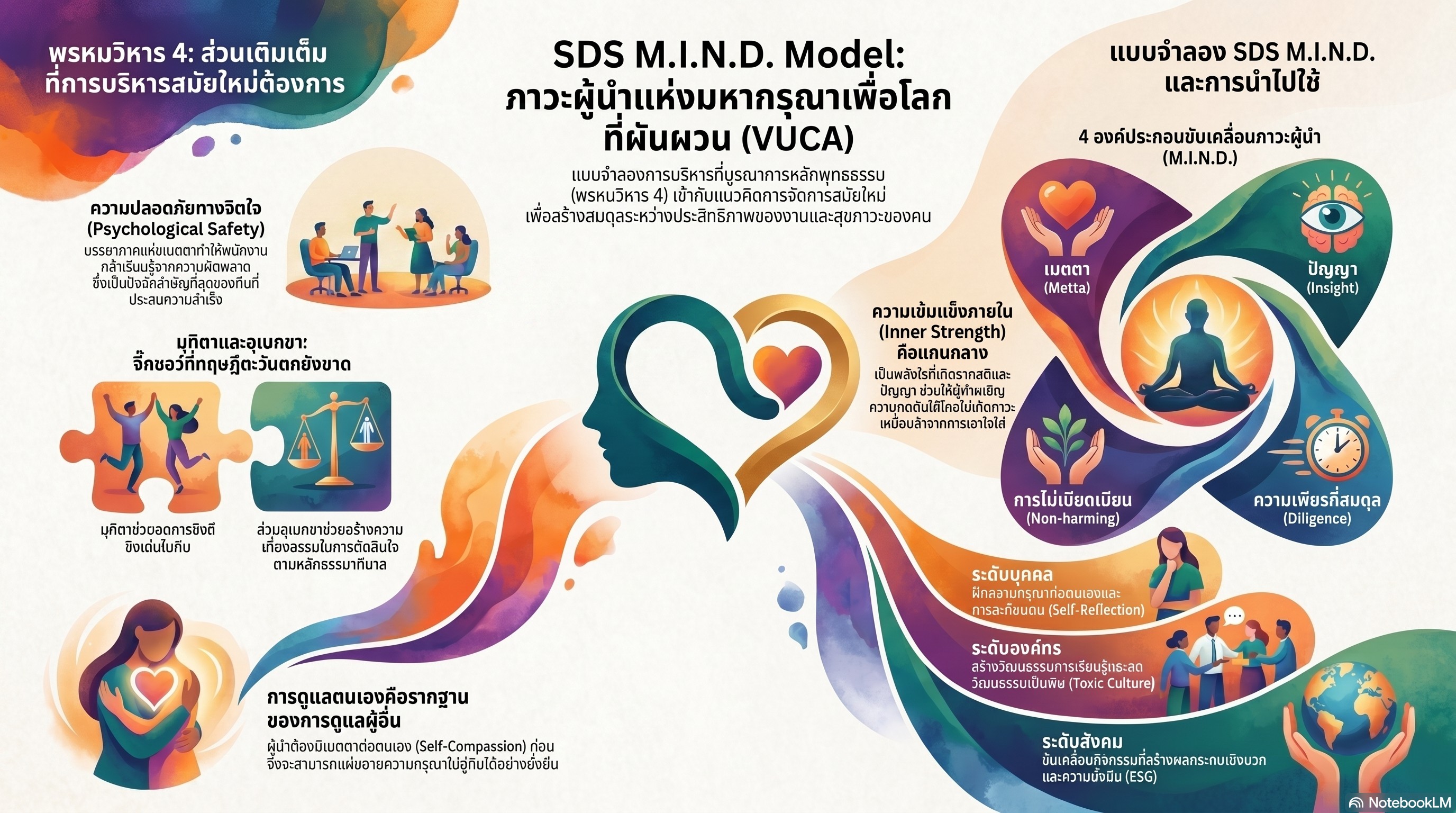
แบบจำลองเอส ดี เอส มายด์เพื่อภาวะผู้นำแห่งมหากรุณา: บูรณาการพรหมวิหาร 4 กับการบริหารสมัยใหม่จากกรณีแม่ชีศันสนีย์ สเถียรสุต
บทคัดย่อ
การวิจัยเชิงเอกสารเชิงคุณภาพนี้มีวัตถุประสงค์เพื่อ (1) เปรียบเทียบความสอดคล้องและความแตกต่างระหว่างหลักพรหมวิหาร 4 (เมตตา กรุณา มุทิตา อุเบกขา) กับแนวคิดการบริหารสมัยใหม่ด้านความกรุณาต่อตนเอง ภาวะผู้นำเชิงกรุณา และความปลอดภัยทางจิตใจ (2) สังเคราะห์พุทธวิธีของแม่ชีศันสนีย์ สเถียรสุต ในการประยุกต์ใช้พรหมวิหาร 4 เพื่อการบริหารองค์กรเพื่อสังคม และ (3) พัฒนาแบบจำลองเอส ดี เอส มายด์เพื่อภาวะผู้นำแห่งมหากรุณาในบริบทโลกที่ผันผวน ไม่แน่นอน ซับซ้อน และคลุมเครือ ข้อมูลได้จากการสืบค้นและคัดเลือกเอกสารอย่างเป็นระบบจากพระไตรปิฎก คัมภีร์อรรถกถา งานวิชาการร่วมสมัย (ค.ศ. 2000–2025) และเอกสารคำสอนของแม่ชีศันสนีย์ จากนั้นวิเคราะห์ด้วยการวิเคราะห์เนื้อหาและการเปรียบเทียบธีม พร้อมตรวจสอบความน่าเชื่อถือด้วยการตรวจสอบข้ามแหล่งข้อมูลและบันทึกร่องรอยการวิเคราะห์ ผลการวิจัยพบว่า พรหมวิหาร 4 สนับสนุนแนวคิด “ดูแลตนเองเป็นฐานของการดูแลผู้อื่น” และการสร้างบรรยากาศที่เอื้อต่อการเรียนรู้จากความผิดพลาด อีกทั้งเติมเต็มมิติที่กรอบสมัยใหม่กล่าวไม่ชัด ได้แก่ มุทิตาในฐานะกลไกสร้างวัฒนธรรมไม่ชิงดีชิงเด่น และอุเบกขาในฐานะหลักความเที่ยงธรรมเพื่อธรรมาภิบาล แบบจำลองเอส ดี เอส มายด์ประกอบด้วย เมตตา ปัญญาเชิงหยั่งรู้ การไม่เบียดเบียน และความเพียร โดยมีความเข้มแข็งภายในเป็นแกนกลาง และเสนอแนวทางประยุกต์ใช้ในระดับบุคคล องค์กร และสังคม เพื่อสมดุลระหว่างประสิทธิภาพ สุขภาวะ และจริยธรรมของภาวะผู้นำ
เอกสารอ้างอิง
พระธรรมปิฎก (ป.อ. ปยุตฺโต). (2560). พจนานุกรมพุทธศาสน์ ฉบับประมวลศัพท์ (พิมพ์ครั้งที่ 31). สำนักพิมพ์ผลิธัมม์.
สถาบันเสถียรธรรมสถาน. (2567). ประวัติและผลงานแม่ชีศันสนีย์ สเถียรสุต.
Bennett, N., & Lemoine, G. J. (2014). What a difference a word makes: Understanding threats to performance in a VUCA world. Business Horizons, 57(3), 311–317. https://doi.org/10.1016/j.bushor.2014.01.001
Bodhi, B. (2012). The numerical discourses of the Buddha: A translation of the Anguttara Nikaya. Wisdom Publications.
Duhigg, C. (2016, February 25). What Google learned from its quest to build the perfect team. The New York Times Magazine. https://www.nytimes.com/2016/02/28/magazine/what-google-learned-from-its-quest-to-build-the-perfect-team.html
Dutton, J. E., Workman, K. M., & Hardin, A. E. (2014). Compassion at work. Annual Review of Organizational Psychology and Organizational Behavior, 1(1), 277–304. https://doi.org/10.1146/annurev-orgpsych-031413-091221
Edmondson, A. C. (1999). Psychological safety and learning behavior in work teams. Administrative Science Quarterly, 44(2), 350–383. https://doi.org/10.2307/2666999
Edmondson, A. C. (2018). The fearless organization: Creating psychological safety in the workplace for learning, innovation, and growth. Wiley.
Hougaard, R., & Carter, J. (2018). The mind of the leader: How to lead yourself, your people, and your organization for extraordinary results. Harvard Business Review Press.
Hougaard, R., Carter, J., & Hobson, N. (2020). Compassionate leadership is necessary—but not sufficient. Harvard Business Review. https://hbr.org/2020/12/compassionate-leadership-is-necessary-but-not-sufficient
Lincoln, Y. S., & Guba, E. G. (1985). Naturalistic inquiry. Sage Publications.
MacBeth, A., & Gumley, A. (2012). Exploring compassion: A meta-analysis of the association between self-compassion and psychopathology. Clinical Psychology Review, 32(6), 545–552. https://doi.org/10.1016/j.cpr.2012.06.003
Moss, J. (2021). The burnout epidemic: The rise of chronic stress and how we can fix it. Harvard Business Review Press.
Neff, K. D. (2011). Self-compassion: The proven power of being kind to yourself. William Morrow.
Neff, K. D., & Germer, C. K. (2018). The mindful self-compassion workbook: A proven way to accept yourself, build inner strength, and thrive. Guilford Press.
Rozovsky, J. (2015, November 17). The five keys to a successful Google team. Google re:Work. https://www.michigan.gov/-/media/Project/Websites/mdhhs/Folder4/Folder10/Folder3/Folder110/Folder2/Folder210/Folder1/Folder310/Google-and-Psychological-Safety.pdf
Salzberg, S. (2002). Lovingkindness: The revolutionary art of happiness. Shambhala Publications.
Worline, M. C., & Dutton, J. E. (2017). Awakening compassion at work: The quiet power that elevates people and organizations. Berrett-Koehler Publishers.
World Health Organization. (2019). Mental health in the workplace. https://www.who.int/news-room/commentaries/detail/mental-health-in-the-workplace
ดาวน์โหลด
เผยแพร่แล้ว
รูปแบบการอ้างอิง
สัญญาอนุญาต
ลิขสิทธิ์ (c) 2026 Journal of Buddhist Education and Research (JBER)

อนุญาตภายใต้เงื่อนไข Creative Commons Attribution-NonCommercial-NoDerivatives 4.0 International License.