Educational Leadership for Social Justice: A Strategic Framework for Equity and Inclusion in School Administration
Keywords:
Social Justice Leadership, Educational Equity, Inclusive School AdministrationAbstract
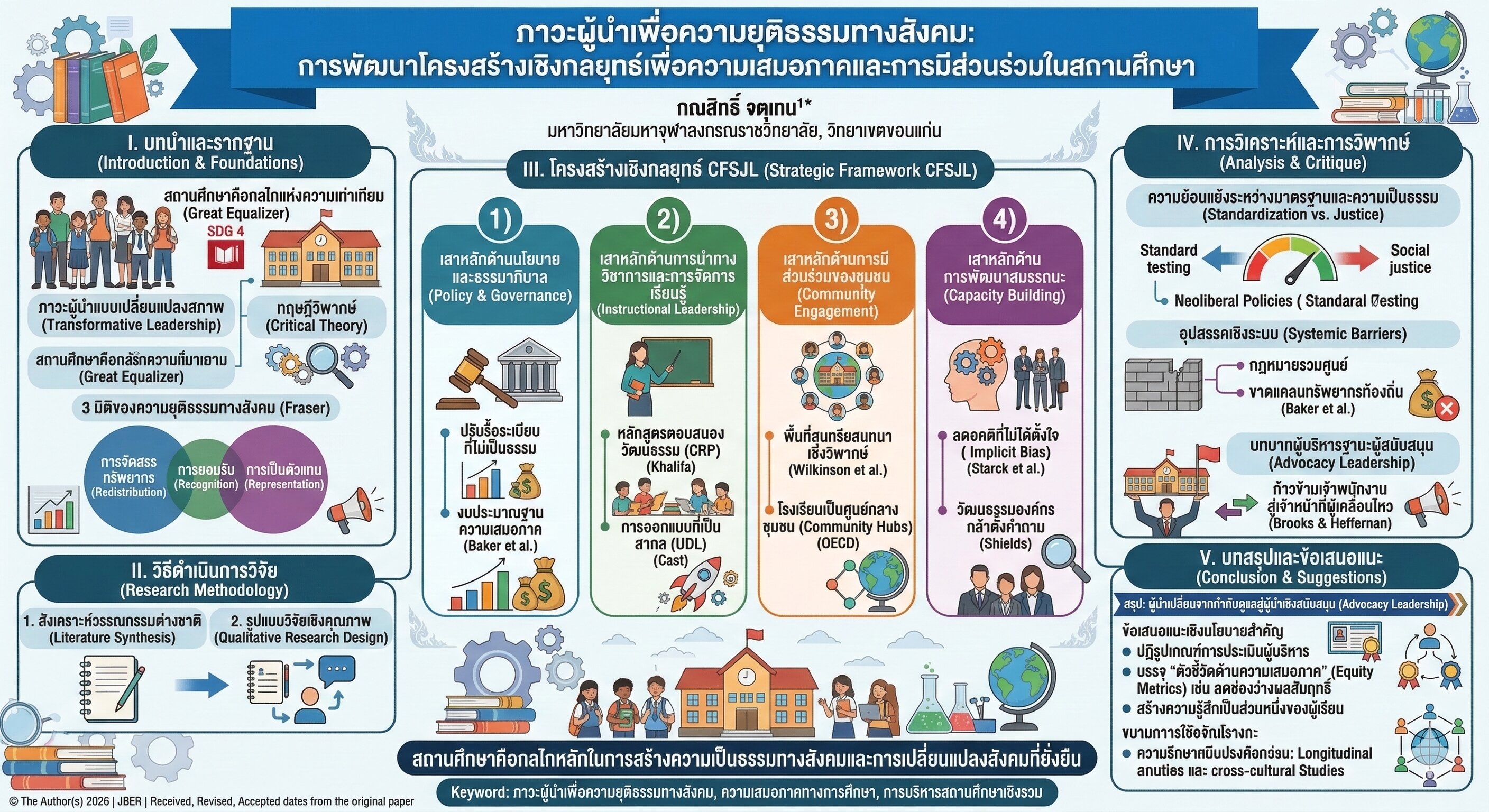
This academic article aims to analyze the essential components of leadership that promote social justice in educational institutions and to present a comprehensive strategic framework encompassing policy, instructional management, and community engagement. In the current global educational landscape, characterized by deepening structural inequalities, educational leadership for social justice has evolved from an ideological preference to a strategic necessity. This study utilizes a qualitative synthesis of contemporary international literature to deconstruct power dynamics within school administration through the lenses of Critical Theory and Transformative Leadership. The proposed “Collaborative Framework for Social Justice Leadership” (CFSJL) is anchored in four pivotal dimensions: 1) Policy and Governance, focusing on deconstructing inequitable regulations and implementing equity-based budgeting; 2) Instructional and Pedagogical Leadership, advocating for Culturally Responsive Pedagogy (CRP) and Universal Design for Learning (UDL); 3) Community and Stakeholder Agency, emphasizing the creation of critical dialogue spaces and the transformation of schools into “Community Hubs”; and 4) Capacity Building and Critical Consciousness, aimed at mitigating implicit biases among educators. The discussion highlights the inherent tension between standardized accountability and social justice, arguing that true academic excellence cannot exist without structural equity. The study concludes that for this framework to be sustainable, educational authorities must shift from traditional administrative oversight to “Advocacy Leadership.” Key policy implications include the reform of school administrator evaluations to incorporate “Equity Metrics,” such as the reduction of achievement gaps for marginalized groups and increased sense of belonging. Future research should prioritize longitudinal and cross-cultural studies in remote or diverse contexts to refine the framework’s applicability. Ultimately, this article asserts that when administrators transition from bureaucratic functionaries to educational activists, schools can function as primary agents for social equity and sustainable societal change.
References
Ainscow, M. (2021). Promoting inclusion and equity in education: Lessons from international experiences. Nordic Journal of Studies in Educational Policy, 7(3), 113–127. https://doi.org/10.1080/20020317.2021.1929111
Baker, B. D., Di Carlo, M., & Weber, M. (2023). The adequacy and equity of state school finance systems (5th ed.). Albert Shanker Institute.
Brooks, J. S., & Heffernan, A. (2021). The principalship in the 21st century: A social justice and educational equity approach. Routledge.
CAST. (2024). Universal design for learning guidelines version 3.0. https://udlguidelines.cast.org
Coyne, M. D., McCoach, D. B., Ware, S. M., Austin, C. R., Loftus-Rattan, S. M., & Baker, D. L. (2024). Resource redistribution and educational equity: Impact on achievement gaps in post-pandemic settings. Journal of Educational Equity and Leadership, 14(1), 45–62.
DeMatthews, D. E., Knight, D., Reyes, P., Benedict, A., & Hoppe, R. (2021). From theory to practice: Retaining equity-oriented administrators in the post-pandemic era. Educational Administration Quarterly, 57(5), 723–758. https://doi.org/10.1177/0013161X211043911
Fraser, N. (2021). Climates of capital: For a trans-environmental social justice. Verso.
Furman, G. (2020). Social justice leadership in education: Hierarchies of meaning. In Oxford Research Encyclopedia of Education. Oxford University Press. https://doi.org/10.1093/acrefore/9780190264093.013.626
Galloway, M. K., & Ishimaru, A. M. (2021). Equitable leadership on the ground: Converging on high-leverage practices. Education Policy Analysis Archives, 29(2), 1–36. https://doi.org/10.14507/epaa.29.5437
Grissom, J. A., Egalite, A. J., & Lindsay, C. A. (2021). How principals affect students and schools: A systematic synthesis of two decades of research. Wallace Foundation.
Gümüş, S., Bellibaş, M. S., Gümüş, E., & Hallinger, P. (2021). Science mapping the landscape of educational leadership and management: A bibliometric analysis of 40 years of research. Educational Management Administration & Leadership, 49(3), 365–390. https://doi.org/10.1177/1741143220903333
Heffernan, A. (2023). Leadership for social justice: Disciplinary policies and the inclusive school. Routledge.
Karakose, T., Tülübaş, T., & Papadakis, S. (2023). Career aspirations: A structural equation model analyzing the role of academic vitality and academic self-regulation. Educational Studies, 1–18. https://doi.org/10.1080/02673843.2025.2559814
Keddie, A. (2021). School autonomy, leadership and social justice: The importance of context and agency. Educational Management Administration & Leadership, 49(3), 390–406. https://doi.org/10.1177/1741143220905084
Khalifa, M. (2022). Culturally responsive school leadership (Rev. ed.). Harvard Education Press.
Mandinach, E. B., & Schildkamp, K. (2021). Misconceptions about data-based decision making in education: An exploration of the literature. Studies in Educational Evaluation, 69, 100842. https://doi.org/10.1016/j.stueduc.2020.100842
Mette, I. M., & DeMatthews, D. (2022). The essential role of critical social justice in school leadership. Routledge.
Milner, H. R., Cunningham, H. B., Delale-O'Connor, L., & Kestenberg, E. G. (2023). These kids are out of control: Why we must reimagine "classroom management" for equity. Corwin Press.
Niesche, R., & Gowlett, C. (2022). Social justice leadership and the decolonization of school rules. Palgrave Macmillan. https://doi.org/10.1007/978-3-030-99000-8
O’Malley, M. P., Shields, C. M., & Anderson, G. L. (2024). The Palgrave handbook of educational leadership and social justice (2nd ed.). Palgrave Macmillan.
Organisation for Economic Co-operation and Development (OECD). (2023). Equity in education: Breaking down barriers to social mobility. OECD Publishing. https://doi.org/10.1787/g2g9v8f3-en
Popp, J., Gerdin, G., & Misiaszek, G. (2021). Transformative educational leadership for social justice: Moving beyond performative diversity. Journal of Critical Education Policy Studies, 19(2), 45–68.
Rao, K., Ok, M. W., Smith, S. J., Evmenova, A. S., & Edyburn, D. (2021). Validation of the UDL reporting criteria: An analysis of UDL research. Exceptional Children, 87(4), 428–445. https://doi.org/10.1177/0014402921998830
Rigney, L. I. (2021). Culturally responsive pedagogy and the politics of recognition. In International Encyclopedia of Education (4th ed.). Elsevier.
Santamaría, L. J., & Santamaría, A. P. (2023). Leading for social justice: Critical international perspectives and innovative practice. Routledge.
Santander, P., & Alarcón, P. (2024). Transformative leadership and social justice: A critical analysis of school management in complex environments. Journal of Educational Administration and History, 1–18. https://doi.org/10.1080/00220620.2024.2314567
Shields, C. M. (2020). Transformative leadership: A response to systemic racism and social injustice. Palgrave Macmillan.
Shields, C. M. (2024). Transformative leadership in education: Equitable and socially just change in an uncertain world (3rd ed.). Routledge.
Starck, J. G., Riddle, T., Sinclair, S., & Warikoo, N. (2021). Teachers are people too: Examining the racial bias of teachers compared to other American adults. Educational Researcher, 50(4), 273–284. https://doi.org/10.3102/0013189X20982436
UNESCO. (2021). Global education monitoring report 2021/2: Non-state actors in education: Who chooses? Who loses? UNESCO.
UNESCO. (2024). Global education monitoring report 2024: Leadership in education: Lead for learning. UNESCO Publishing.
Wang, L. H. (2022). Sustainable leadership for social justice: A case study of transformative practices in urban schools. Journal of Educational Administration, 60(2), 185–201. https://doi.org/10.1108/JEA-05-2021-0102
Wilkinson, J., Niesche, R., & Eacott, S. (2023). Challenges for educational leadership: Policy, values and the public good. Routledge.
Wilkinson, J., Santamaría, L. J., & Santamaría, A. P. (2023). Inclusive and equitable education: High-stakes testing and the leadership of social justice. Educational Management Administration & Leadership. https://doi.org/10.1177/17411432231182741
Downloads
Published
How to Cite
Issue
Section
License
Copyright (c) 2026 Authors

This work is licensed under a Creative Commons Attribution-NonCommercial-NoDerivatives 4.0 International License.