ภาวะผู้นำเพื่อความยุติธรรมทางสังคม: การพัฒนาโครงสร้างเชิงกลยุทธ์เพื่อความเสมอภาคและการมีส่วนร่วมในสถานศึกษา
คำสำคัญ:
ภาวะผู้นำเพื่อความยุติธรรมทางสังคม, ความเสมอภาคทางการศึกษา, การบริหารสถานศึกษาเชิงรวมบทคัดย่อ
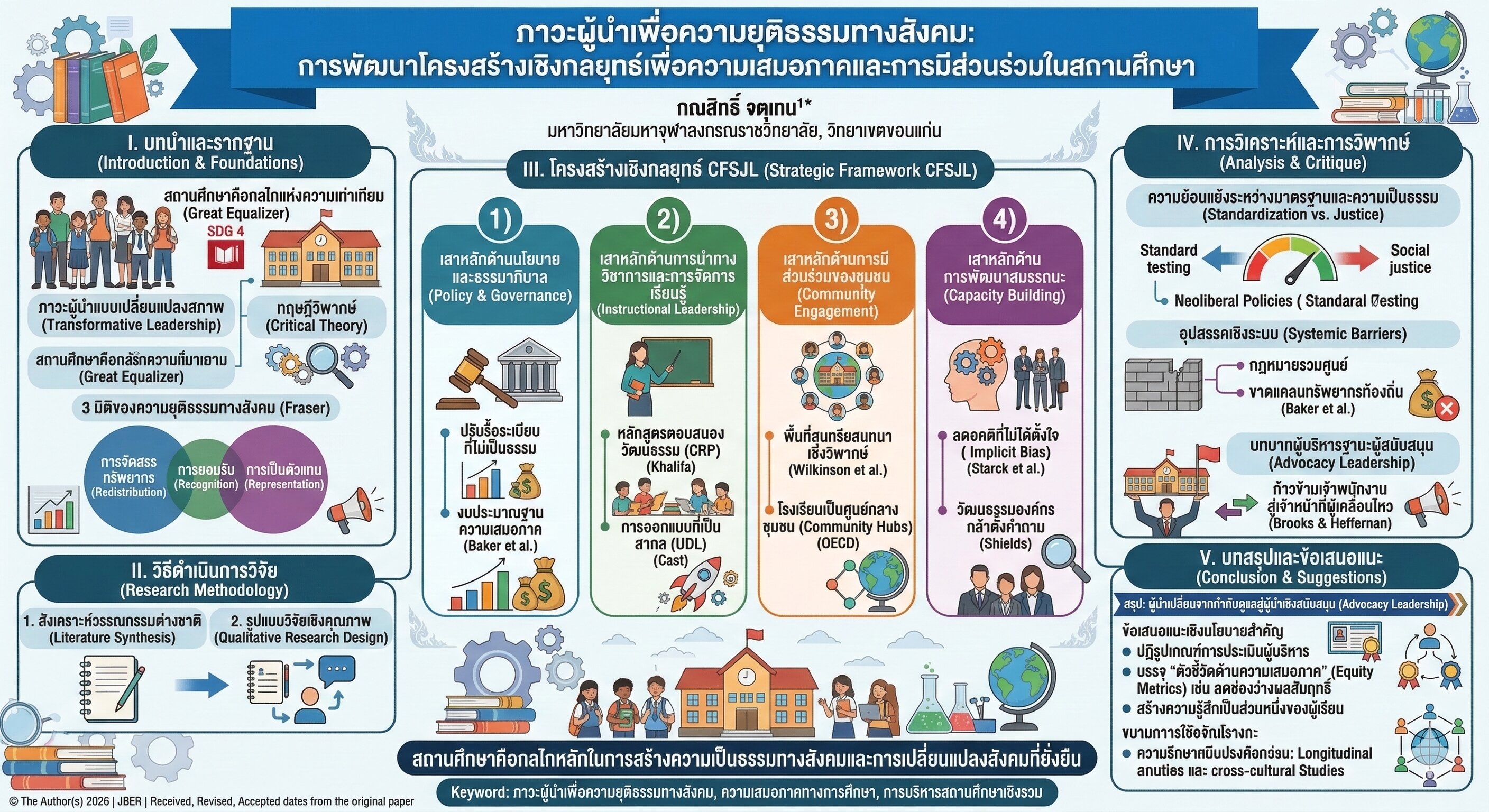
บทความวิชาการฉบับนี้มีวัตถุประสงค์เพื่อวิเคราะห์องค์ประกอบของภาวะผู้นำที่ส่งเสริมความยุติธรรมทางสังคมในสถานศึกษา และนำเสนอโครงสร้างเชิงกลยุทธ์ที่ครอบคลุมทั้งด้านนโยบาย การจัดการเรียนรู้ และการมีส่วนร่วมของชุมชน ในบริบทการศึกษาระดับโลกปัจจุบันที่เผชิญกับความเหลื่อมล้ำเชิงโครงสร้างที่ซับซ้อน ภาวะผู้นำเพื่อความยุติธรรมทางสังคมได้เปลี่ยนสถานะจากทางเลือกเชิงอุดมการณ์สู่ความจำเป็นเร่งด่วนเชิงกลยุทธ์ การศึกษานี้ใช้วิธีการสังเคราะห์วรรณกรรมต่างชาติร่วมสมัยเพื่อวิพากษ์และปรับรื้อพลวัตอำนาจในการบริหารสถานศึกษาผ่านเลนส์ของทฤษฎีวิพากษ์และภาวะผู้นำแบบเปลี่ยนแปลงสภาพ ผู้ศึกษาได้นำเสนอ “กรอบกลยุทธ์ภาวะผู้นำแบบรวมพลังเพื่อความยุติธรรมทางสังคม” (CFSJL) ซึ่งยึดโยงกับ 4 เสาหลักสำคัญ ได้แก่ 1) ด้านนโยบายและธรรมาภิบาล มุ่งเน้นการปรับรื้อกฎระเบียบที่ไม่เป็นธรรมและการจัดสรรงบประมาณฐานความเสมอภาค 2) ด้านการนำทางวิชาการและการจัดการเรียนรู้ ส่งเสริมหลักสูตรที่ตอบสนองต่อวัฒนธรรม (CRP) และการออกแบบการเรียนรู้ที่เป็นสากล (UDL) 3) ด้านการมีส่วนร่วมของชุมชนและภาคีเครือข่าย เน้นการสร้างพื้นที่สุนทรียสนทนาเชิงวิพากษ์และการเปลี่ยนสถานศึกษาให้เป็นศูนย์กลางชุมชน และ 4) ด้านการพัฒนาสมรรถนะและจิตสำนึกวิพากษ์ เพื่อลดอคติที่ไม่ได้ตั้งใจในบุคลากรทางการศึกษา ผลการวิเคราะห์ชี้ให้เห็นถึงความย้อนแย้งระหว่างระบบมาตรฐานและความเป็นธรรม โดยยืนยันว่าความเป็นเลิศทางวิชาการที่แท้จริงไม่อาจเกิดขึ้นได้หากปราศจากความเสมอภาคเชิงโครงสร้าง บทสรุปของการศึกษาเสนอว่าเพื่อให้กรอบกลยุทธ์นี้เกิดความยั่งยืน ผู้บริหารต้องปรับบทบาทจากการกำกับดูแลตามระเบียบไปสู่ภาวะผู้นำเชิงสนับสนุน (Advocacy Leadership) ข้อเสนอแนะเชิงนโยบายที่สำคัญคือการปฏิรูปเกณฑ์การประเมินผู้บริหารสถานศึกษาโดยบรรจุ “ตัวชี้วัดด้านความเสมอภาค” (Equity Metrics) เช่น การลดช่องว่างผลสัมฤทธิ์ของนักเรียนกลุ่มเปราะบาง และการสร้างความรู้สึกเป็นส่วนหนึ่งของผู้เรียน ทิศทางการศึกษาในอนาคตควรเน้นการศึกษาเชิงลึกในบริบทข้ามวัฒนธรรมและพื้นที่ห่างไกล บทความนี้ยืนยันว่าเมื่อผู้บริหารเปลี่ยนผ่านจากเจ้าพนักงานรัฐสู่การเป็นนักเคลื่อนไหวทางการศึกษา สถานศึกษาจะสามารถทำหน้าที่เป็นกลไกหลักในการสร้างความเป็นธรรมทางสังคมและการเปลี่ยนแปลงสังคมที่ยั่งยืน
เอกสารอ้างอิง
Ainscow, M. (2021). Promoting inclusion and equity in education: Lessons from international experiences. Nordic Journal of Studies in Educational Policy, 7(3), 113–127. https://doi.org/10.1080/20020317.2021.1929111
Baker, B. D., Di Carlo, M., & Weber, M. (2023). The adequacy and equity of state school finance systems (5th ed.). Albert Shanker Institute.
Brooks, J. S., & Heffernan, A. (2021). The principalship in the 21st century: A social justice and educational equity approach. Routledge.
CAST. (2024). Universal design for learning guidelines version 3.0. https://udlguidelines.cast.org
Coyne, M. D., McCoach, D. B., Ware, S. M., Austin, C. R., Loftus-Rattan, S. M., & Baker, D. L. (2024). Resource redistribution and educational equity: Impact on achievement gaps in post-pandemic settings. Journal of Educational Equity and Leadership, 14(1), 45–62.
DeMatthews, D. E., Knight, D., Reyes, P., Benedict, A., & Hoppe, R. (2021). From theory to practice: Retaining equity-oriented administrators in the post-pandemic era. Educational Administration Quarterly, 57(5), 723–758. https://doi.org/10.1177/0013161X211043911
Fraser, N. (2021). Climates of capital: For a trans-environmental social justice. Verso.
Furman, G. (2020). Social justice leadership in education: Hierarchies of meaning. In Oxford Research Encyclopedia of Education. Oxford University Press. https://doi.org/10.1093/acrefore/9780190264093.013.626
Galloway, M. K., & Ishimaru, A. M. (2021). Equitable leadership on the ground: Converging on high-leverage practices. Education Policy Analysis Archives, 29(2), 1–36. https://doi.org/10.14507/epaa.29.5437
Grissom, J. A., Egalite, A. J., & Lindsay, C. A. (2021). How principals affect students and schools: A systematic synthesis of two decades of research. Wallace Foundation.
Gümüş, S., Bellibaş, M. S., Gümüş, E., & Hallinger, P. (2021). Science mapping the landscape of educational leadership and management: A bibliometric analysis of 40 years of research. Educational Management Administration & Leadership, 49(3), 365–390. https://doi.org/10.1177/1741143220903333
Heffernan, A. (2023). Leadership for social justice: Disciplinary policies and the inclusive school. Routledge.
Karakose, T., Tülübaş, T., & Papadakis, S. (2023). Career aspirations: A structural equation model analyzing the role of academic vitality and academic self-regulation. Educational Studies, 1–18. https://doi.org/10.1080/02673843.2025.2559814
Keddie, A. (2021). School autonomy, leadership and social justice: The importance of context and agency. Educational Management Administration & Leadership, 49(3), 390–406. https://doi.org/10.1177/1741143220905084
Khalifa, M. (2022). Culturally responsive school leadership (Rev. ed.). Harvard Education Press.
Mandinach, E. B., & Schildkamp, K. (2021). Misconceptions about data-based decision making in education: An exploration of the literature. Studies in Educational Evaluation, 69, 100842. https://doi.org/10.1016/j.stueduc.2020.100842
Mette, I. M., & DeMatthews, D. (2022). The essential role of critical social justice in school leadership. Routledge.
Milner, H. R., Cunningham, H. B., Delale-O'Connor, L., & Kestenberg, E. G. (2023). These kids are out of control: Why we must reimagine "classroom management" for equity. Corwin Press.
Niesche, R., & Gowlett, C. (2022). Social justice leadership and the decolonization of school rules. Palgrave Macmillan. https://doi.org/10.1007/978-3-030-99000-8
O’Malley, M. P., Shields, C. M., & Anderson, G. L. (2024). The Palgrave handbook of educational leadership and social justice (2nd ed.). Palgrave Macmillan.
Organisation for Economic Co-operation and Development (OECD). (2023). Equity in education: Breaking down barriers to social mobility. OECD Publishing. https://doi.org/10.1787/g2g9v8f3-en
Popp, J., Gerdin, G., & Misiaszek, G. (2021). Transformative educational leadership for social justice: Moving beyond performative diversity. Journal of Critical Education Policy Studies, 19(2), 45–68.
Rao, K., Ok, M. W., Smith, S. J., Evmenova, A. S., & Edyburn, D. (2021). Validation of the UDL reporting criteria: An analysis of UDL research. Exceptional Children, 87(4), 428–445. https://doi.org/10.1177/0014402921998830
Rigney, L. I. (2021). Culturally responsive pedagogy and the politics of recognition. In International Encyclopedia of Education (4th ed.). Elsevier.
Santamaría, L. J., & Santamaría, A. P. (2023). Leading for social justice: Critical international perspectives and innovative practice. Routledge.
Santander, P., & Alarcón, P. (2024). Transformative leadership and social justice: A critical analysis of school management in complex environments. Journal of Educational Administration and History, 1–18. https://doi.org/10.1080/00220620.2024.2314567
Shields, C. M. (2020). Transformative leadership: A response to systemic racism and social injustice. Palgrave Macmillan.
Shields, C. M. (2024). Transformative leadership in education: Equitable and socially just change in an uncertain world (3rd ed.). Routledge.
Starck, J. G., Riddle, T., Sinclair, S., & Warikoo, N. (2021). Teachers are people too: Examining the racial bias of teachers compared to other American adults. Educational Researcher, 50(4), 273–284. https://doi.org/10.3102/0013189X20982436
UNESCO. (2021). Global education monitoring report 2021/2: Non-state actors in education: Who chooses? Who loses? UNESCO.
UNESCO. (2024). Global education monitoring report 2024: Leadership in education: Lead for learning. UNESCO Publishing.
Wang, L. H. (2022). Sustainable leadership for social justice: A case study of transformative practices in urban schools. Journal of Educational Administration, 60(2), 185–201. https://doi.org/10.1108/JEA-05-2021-0102
Wilkinson, J., Niesche, R., & Eacott, S. (2023). Challenges for educational leadership: Policy, values and the public good. Routledge.
Wilkinson, J., Santamaría, L. J., & Santamaría, A. P. (2023). Inclusive and equitable education: High-stakes testing and the leadership of social justice. Educational Management Administration & Leadership. https://doi.org/10.1177/17411432231182741
ดาวน์โหลด
เผยแพร่แล้ว
รูปแบบการอ้างอิง
ฉบับ
ประเภทบทความ
สัญญาอนุญาต
ลิขสิทธิ์ (c) 2026 Authors

อนุญาตภายใต้เงื่อนไข Creative Commons Attribution-NonCommercial-NoDerivatives 4.0 International License.