The Development of Reading Ability on Words with Non-Corresponding Final Consonants and Listening-Speaking Abilities by Using Brain-Based Learning Integrated with Educational Games for Grade 1 Students
Abstract
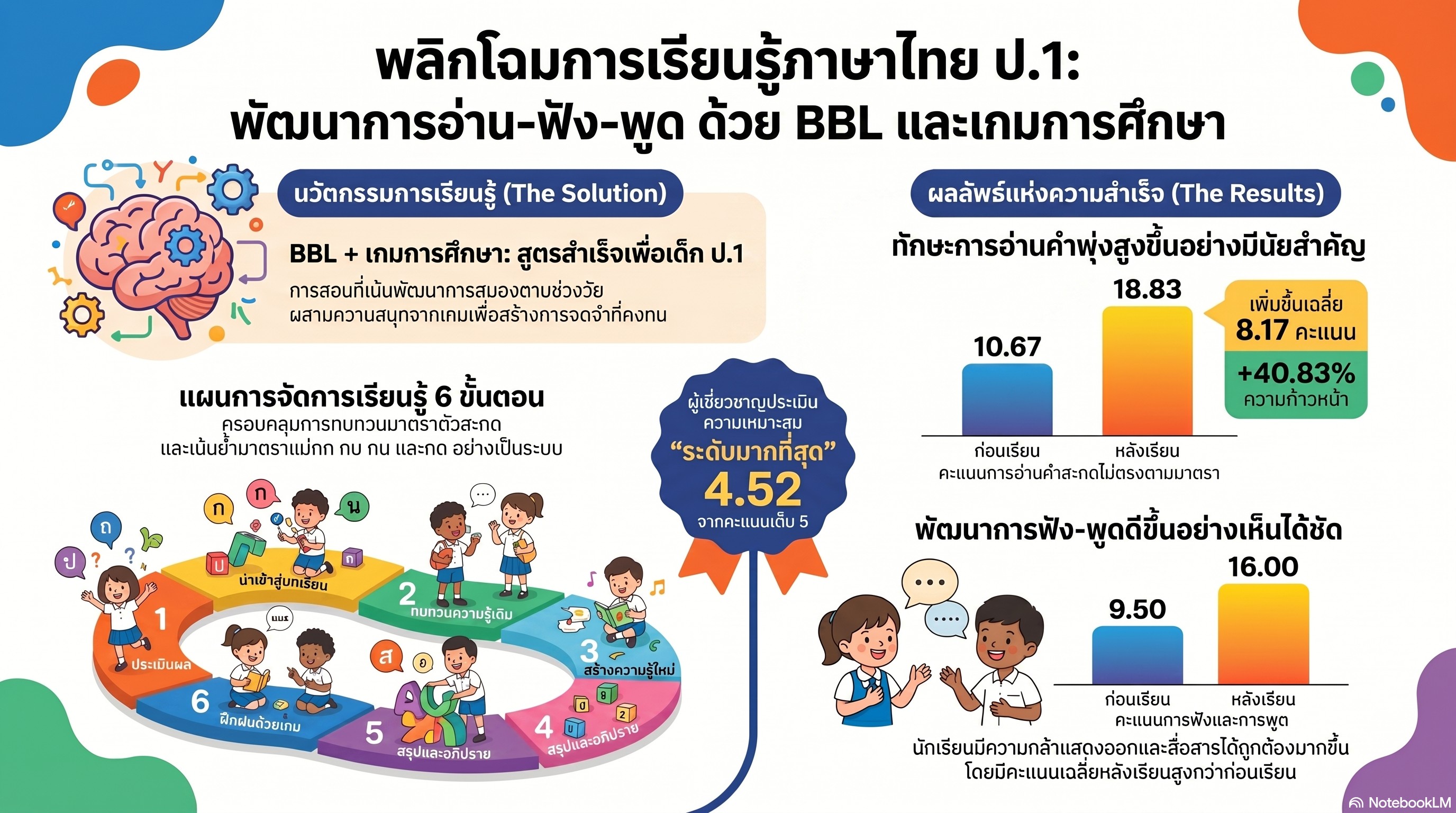
The purpose of this research was : 1) to develop a learning management plan using Brain-Based Learning integrated with Educational games to enhance reading ability on words with non-corresponding final consonants and listening-speaking abilities for Grade 1 students, 2) to compare the reading ability on words with non-corresponding final consonants for Grade 1 students before and after studying, and 3) to compare listening-speaking abilities for Grade 1 students before and after studying. The sample group in this research consisted of 6 Grade 1 students from Semester 2, Academic Year 2025, at Banyangsai Prommaprachason School, Muang District, Sukhothai Province. They were selected using a cluster sampling method, with the school as the sampling unit. The research instruments included: 1) A learning management plan using Brain-Based Learning integrated with educational games to enhance reading ability on words with non-corresponding final consonants and listening-speaking abilities for Grade 1 students, 2) A test to measure the reading ability on words with non-corresponding final consonants, and 3) A test to measure listening-speaking abilities. Data were analyzed using mean, standard deviation, percentage, and the Wilcoxon Signed Rank Test. The research results indicate that: 1) The development of the learning management plan using Brain-Based Learning integrated with Educational games were the highest (x̄ = 4.52, S.D. = 0.51), 2) The comparison of students' reading ability on words with non-corresponding final consonants after studying showed a significant improvement compared to before studying at a statistical significance level of .05, and 3) The comparison of students' listening-speaking abilities after studying showed a significant improvement compared to before studying at a statistical significance level of 0.05.
References
กันยารัตน์ พุดตานดง. (2565). การพัฒนาทักษะการอ่านสะกดคำโดยใช้การจัดการเรียนรู้ด้วยสมองเป็นฐานร่วมกับเกมการศึกษาของนักเรียนชั้นประถมศึกษาปีที่ 4 [การค้นคว้าอิสระการศึกษามหาบัณฑิต, มหาวิทยาลัยนเรศวร].
จริยา สุขแก้ว. (2565). การพัฒนาความสามารถการอ่านคำโดยใช้การจัดกิจกรรมการเรียนรู้ตามแนวคิดสมองเป็นฐานร่วมกับการใช้แบบฝึกทักษะสำหรับนักเรียนชั้นประถมศึกษาปีที่ 1 [การค้นคว้าอิสระการศึกษามหาบัณฑิต, มหาวิทยาลัยนเรศวร].
ณัฐธยาน์ แวงอุบล. (2566). การเรียนรู้ภาษาไทยในศตวรรษที่ 21 โดยใช้สมองเป็นฐาน. Journal of Applied Education, 1(3), 13–14.
ดุษฎี มัชฌิมาภิโร. (2557). มาอ่านหนังสือกันเถอะ. วารสารบัณฑิตศึกษา, 11(52), 3–4.
ทิศนา แขมมณี. (2557). ศาสตร์การสอน: องค์ความรู้เพื่อการจัดกระบวนการเรียนรู้ที่มีประสิทธิภาพ (พิมพ์ครั้งที่ 18). สำนักพิมพ์แห่งจุฬาลงกรณ์มหาวิทยาลัย.
นวภรณ์ อุ่นเรือน. (2560). ภาษาไทยเพื่อสื่อสารในงานอาชีพ. ซีเอ็ดยูเคชั่น.
นงลักษณ์ งามขำ. (2551). ความสามารถด้านการฟังและการพูดของเด็กปฐมวัยที่ได้รับการจัดกิจกรรมเสริมประสบการณ์โดยใช้ปริศนาคำทาย [วิทยานิพนธ์การศึกษามหาบัณฑิต, มหาวิทยาลัยศรีนครินทรวิโรฒ]. DSpace at Srinakharinwirot University. http://thesis.swu.ac.th/swuthesis/Ear_Chi_Ed/Nongluck_N.pdf
ปุณยาพร สอนศรี. (2564). การพัฒนาความสามารถด้านการเขียนสะกดคำโดยใช้การจัดการเรียนรู้ตามแนวคิดสมองเป็นฐาน (Brain-Based Learning) ร่วมกับ VARK Model ของนักเรียนชั้นประถมศึกษาปีที่ 1 [การค้นคว้าอิสระการศึกษามหาบัณฑิต, มหาวิทยาลัยนเรศวร].
วิชัย วงษ์ใหญ่. (2557). การโค้ชเพื่อการรู้คิด: Cognitive coaching. จรัลสนิทวงศ์การพิมพ์.
วุฒิชัย คำภิระยศ. (2565). การพัฒนาความสามารถด้านการอ่านออกเสียงคำและการเขียนสะกดคำ เรื่อง “คำที่สะกดไม่ตรงตามมาตราตัวสะกด” ด้วยการจัดการเรียนรู้โดยใช้เกมร่วมกับเทคนิคการใช้ผังกราฟิกสำหรับนักเรียนชั้นประถมศึกษาปีที่ 4 [การค้นคว้าอิสระการศึกษามหาบัณฑิต, มหาวิทยาลัยนเรศวร].
สุคนธ์ สินธพานนท์. (2553). นวัตกรรมการเรียนการสอนเพื่อพัฒนาคุณภาพของเยาวชน. อักษรเจริญทัศน์.
สุทธิดา จันทร์ดวง. (2562). การใช้ภาษาไทย. มหาวิทยาลัยราชภัฏอุดรธานี.
สำนักงานคณะกรรมการการศึกษาขั้นพื้นฐาน. (2567). รายงานผลการประเมินความสามารถด้านการอ่านของผู้เรียน. http://180.180.244.42/NT/ExamWeb/MainSch/MainSch.aspx
Downloads
Published
How to Cite
Issue
Section
License
Copyright (c) 2026 Journal of Buddhist Education and Research (JBER)

This work is licensed under a Creative Commons Attribution-NonCommercial-NoDerivatives 4.0 International License.