Learning Activities Using Role-Playing on Comparative Religion to Develop Empathetic Acceptance of Differences Skills among Grade 9 Students at Surasakmontree School
Abstract
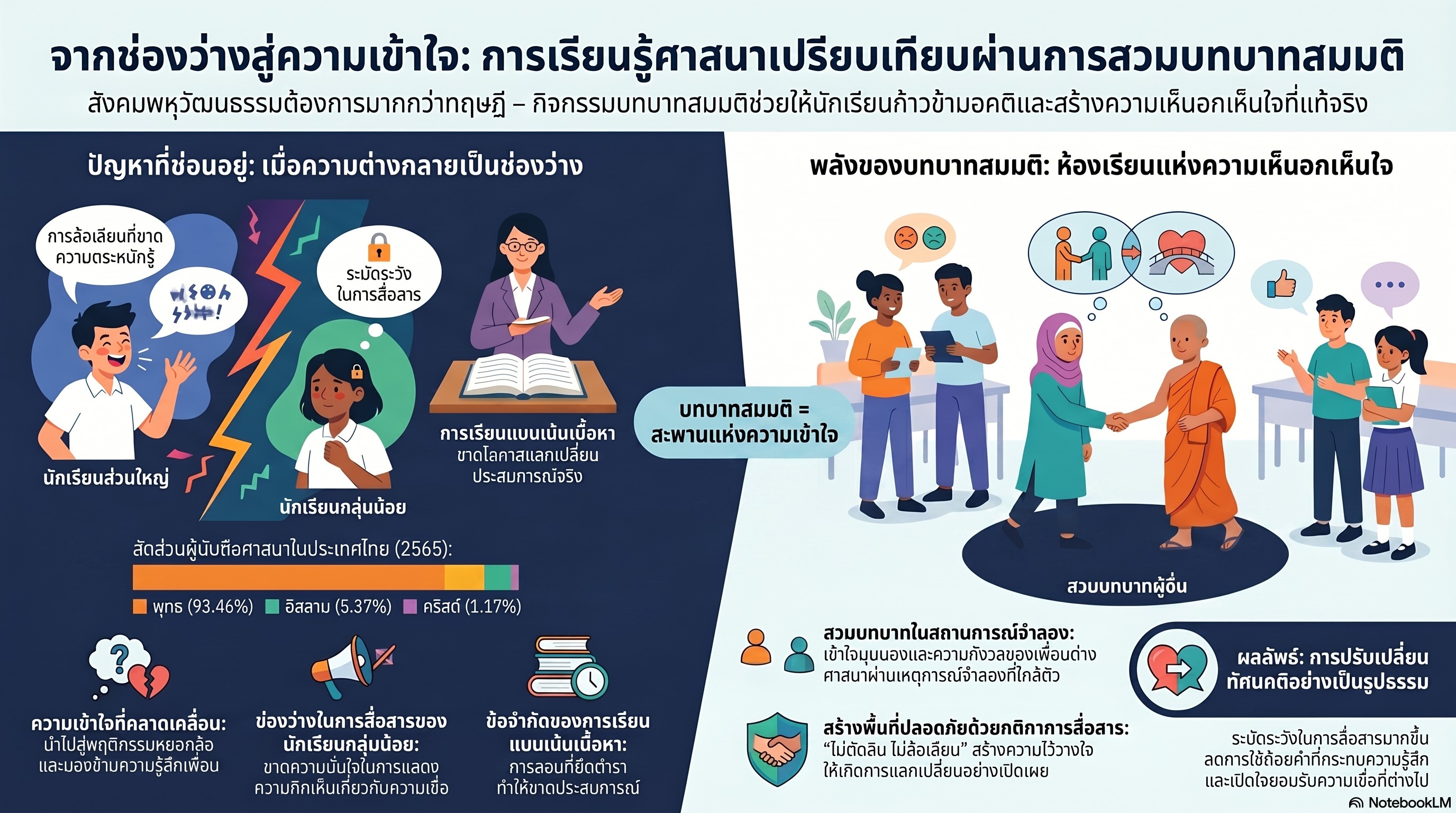
This research aimed to: 1) examine the problems arising from religious differences among Grade 9 students at Surasakmontree School, and 2) develop learning activities using role-playing on comparative religion to enhance students’ empathetic acceptance of differences. This study employed a qualitative research approach. Data were collected through interviews with teachers in the Social Studies, Religion, and Culture Learning Area, as well as Grade 9 students who were the target group of the study. The data were analyzed through thematic categorization based on predetermined research issues, and data triangulation was used to ensure credibility. The research instruments consisted of: 1) a semi-structured interview form, and 2) learning activities using role-playing on comparative religion designed to develop empathetic acceptance of differences skills among Grade 9 students at Surasakmontree School. The findings revealed that 1) Religious differences within the school context led to misunderstandings, lack of confidence in communication, and in some cases teasing behaviors or disregard for the feelings of peers from different religious backgrounds. Although these situations were not severe, they reflected a lack of perspective-taking skills and empathetic responses. 2) The participatory learning activities, which allowed students to assume roles and engage in simulated situations closely related to the real school context, helped students develop a deeper understanding of others’ perspectives. Post-performance discussions and reflective activities played a significant role in connecting theoretical knowledge with emotional experiences. As a result, students demonstrated increased awareness and more concrete adjustments in their attitudes toward religious differences.
References
กระทรวงศึกษาธิการ. (2560). หลักสูตรแกนกลางการศึกษาขั้นพื้นฐาน พุทธศักราช 2551 (ฉบับปรับปรุง พ.ศ. 2560). http://academic.obec.go.th
จิรัสย์ แสนคำภา. (2565). การพัฒนากิจกรรมการจัดการเรียนรู้แบบบทบาทสมมติ เรื่องมารยาทชาวพุทธสำหรับนักเรียนชั้นประถมศึกษาปีที่ 3. วิจัยการศึกษามหาวิทยาลัยเชียงใหม่, 12(4), 234–245.
ดวงกมล อุ่นตาดี. (2565). การศึกษาผลสัมฤทธิ์ทางการเรียนและความพึงพอใจต่อการใช้เทคนิคการสอนบทบาทสมมติในนักเรียนระดับชั้นมัธยมศึกษาปีที่ 2/2. วารสารการศึกษาระดับมัธยมศึกษา, 20(1), 99–112.
นันธิยา สุภากรณ์. (2563). การเปรียบเทียบทักษะการพูดวิชาภาษาไทยของนักเรียนชั้นประถมศึกษาปีที่ 1 โรงเรียนบ้านดงขวางคำโทน จังหวัดอุบลราชธานี. งานวิจัยการศึกษา, 5(3), 15–20.
พิชิตชัย เที่ยงทำ. (2566). การวิจัยเพื่อหาประสิทธิภาพกิจกรรมการเรียนรู้เรื่องสิทธิเด็ก โดยใช้บทบาทสมมติร่วมกับเทคนิคเกมมิฟิเคชัน. วิจัยการศึกษาไทย, 10(2), 78–90.
โรห์มาน ฮิกแมต. (2567). บทบาทสำคัญของความเห็นอกเห็นใจ: การเปิดเผยผลกระทบต่อพฤติกรรมการกลั่นแกล้งของนักเรียน–การทบทวนขอบเขต. วารสารการศึกษา, 47(1), 111–126.
ศูนย์เฝ้าระวังสถานการณ์ทางสังคม. (2564). รายงานสถานการณ์ทางสังคมไทย. https://www.m-society.go.th/
สำนักงานสถิติแห่งชาติ. (2565). สถิติประชากรจำแนกตามศาสนาในประเทศไทย. https://www.nso.go.th/
Brown, S. (2015). Empathy in education: Engagement, values and achievement. Bloomsbury Academic. https://www.bloomsbury.com/
Heathcote, D., & Bolton, G. (1995). Drama for learning: Dorothy Heathcote’s mantle of the expert approach to education. Heinemann.
McSharry, G., & Jones, S. (2000). Role-play in science teaching and learning. School Science Review, 82(298), 73–82. https://www.ase.org.uk/resources/school-science-review
Organisation for Economic Co-operation and Development. (2018). The future of education and skills: Education 2030. https://www.oecd.org/education/2030-project
Downloads
Published
How to Cite
Issue
Section
License
Copyright (c) 2026 Journal of Buddhist Education and Research (JBER)

This work is licensed under a Creative Commons Attribution-NonCommercial-NoDerivatives 4.0 International License.