From Knowledge to Action: Service Learning as a Pathway to Experiential Education in Thai Universities
Abstract
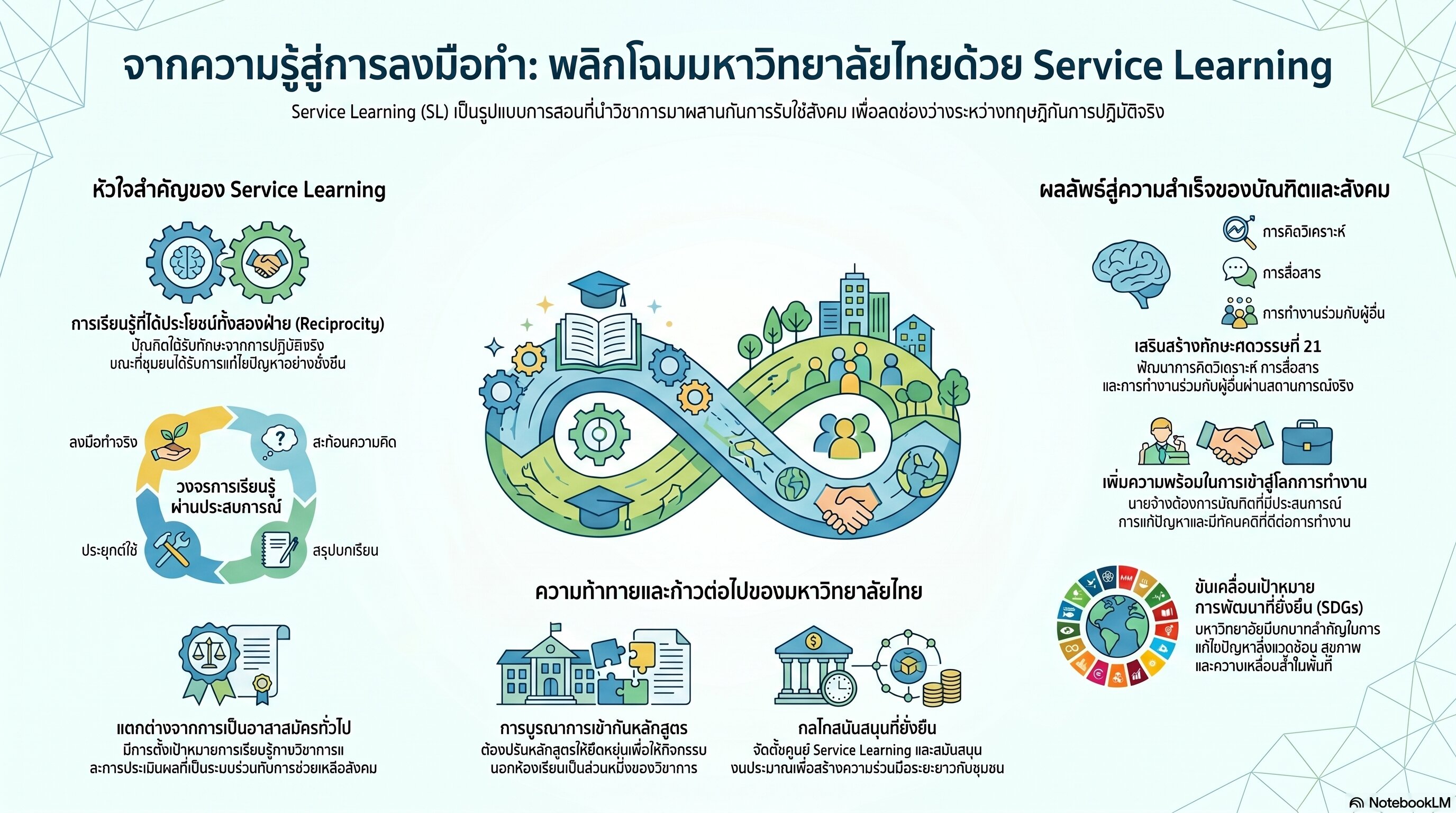
Thailand’s transition toward a knowledge-based, innovation-driven economy has raised expectations for universities to produce graduates who possess not only strong academic knowledge but also practical skills and social responsibility. However, traditional lecture-based teaching methods remain dominant in many higher education institutions, often limiting students' opportunities to apply knowledge in real-world contexts. Experiential learning approaches have therefore gained increasing attention as strategies to bridge the gap between academic learning and practical application. Among these approaches, service learning has emerged as a particularly valuable pedagogical model that integrates academic learning with community engagement.This paper examines the role of service learning in developing student competencies while contributing to sustainable development in the Thai context. Drawing on literature related to experiential learning theory, service learning, and higher education reform, the paper explores how service-learning initiatives help develop critical competencies such as communication, collaboration, critical thinking, and civic responsibility. The study also discusses current service-learning practices in Thai universities and examines challenges related to curriculum integration, institutional support, and community partnerships. Furthermore, the paper highlights policy implications for strengthening service-learning initiatives in Thailand’s higher education system. The findings suggest that service learning provides an effective approach for fostering socially responsible graduates while supporting community development and sustainable development goals.
References
Billett, S. (2011). Vocational education: Purposes, traditions and prospects. Springer.
Bringle, R. G., & Hatcher, J. A. (1995). A service-learning curriculum for faculty. Michigan
Journal of Community Service Learning, 2, 112–122.
Chatsuthipan, W. (2008). The development of a service learning system to enhance civic
responsibility of undergraduate students in business administration programs. ABAC Journal, 28(1), 1–14.
Dewey, J. (1938). Experience and education. Macmillan.
Diong, F. W., Cheah, P. K., & Siah, P. C. (2025). Advancing understanding of service-learning:
A case study of a university in Malaysia. Malaysian Journal of Learning and Instruction, 22(1), 125–146.
Eyler, J., & Giles, D. E. (1999). Where’s the learning in service-learning? Jossey-Bass.
Kolb, D. A. (1984). Experiential learning: Experience as the source of learning and
development. Prentice Hall.
Kolb, A. Y., & Kolb, D. A. (2017). Experiential learning theory as a guide for experiential
educators. Experiential Learning & Teaching in Higher Education, 1(1), 7–44.
Kuh, G. D. (2008). High-impact educational practices: What they are, who has access to them,
and why they matter. Association of American Colleges and Universities.
Leal Filho, W., Shiel, C., & Paço, A. (2019). Integrative approaches to environmental
sustainability at universities: An overview of challenges and priorities. Journal of Integrative Environmental Sciences, 16(1), 1–14. https://doi.org/10.1080/1943815X.2018.1550746
Lin, S., Ngai, G., Kwan, K. P., Chan, S. C. F., & Lo, K. W. K. (2024). Mandatory academic
service learning and continual civic engagement: Which learning outcomes matter? The Asia-Pacific Education Researcher.
Mabborang, J. M., Dumlao, D., & Cusap, K. W. (2024). Effect of service-learning program on
students’ outcomes. International Journal of Research and Innovation in Social Science.
Ministry of Higher Education, Science, Research and Innovation. (2020). Thailand higher
education development plan. MHESI.
Ngai, S. S. Y. (2006). Service-learning, personal development, and social commitment: A case
study of university students in Hong Kong. Adolescence, 41(161), 165–176.
Office of the Higher Education Commission. (2017). Thailand qualifications framework for
higher education (TQF). Ministry of Education.
Office of the National Economic and Social Development Council. (2021). Thailand national
strategy and sustainable development framework. NESDC.
Pancharoen, S., & Chorkaew, S. (2022). World of work and employability: A case study of
generation Z graduates. KKU Research Journal (Graduate Studies) Humanities and Social Sciences.
Puncreobutr, V. (2016). Education 4.0: New challenge of learning. St. Theresa Journal of
Humanities and Social Sciences, 2(2), 92–97.
Tan, E. (2009). Service learning in Asia: Engaging students and communities. International
Journal of Civic Engagement and Social Change, 1(1), 1–14.
Thatong, S. (2018). Accounting graduate employers’ expectations and the accounting
curriculum: The case of Thailand. Human Behavior, Development and Society.
Wimonchong, P. (2021). A comparative study on current Thai graduates’ performance and their
employers’ expectation in Nakhon Si Thammarat. Journal of Southern Technology.
World Bank. (2020). Thailand economic monitor: Productivity for prosperity. World Bank.
Downloads
Published
How to Cite
Issue
Section
Categories
License
Copyright (c) 2026 Journal of Buddhist Education and Research (JBER)

This work is licensed under a Creative Commons Attribution-NonCommercial-NoDerivatives 4.0 International License.