Learning Management Model for the Continuation of the Cultural Identity of the Tai So Ethnic Group in Sakon Nakhon Province for Grade 6 Students
Abstract
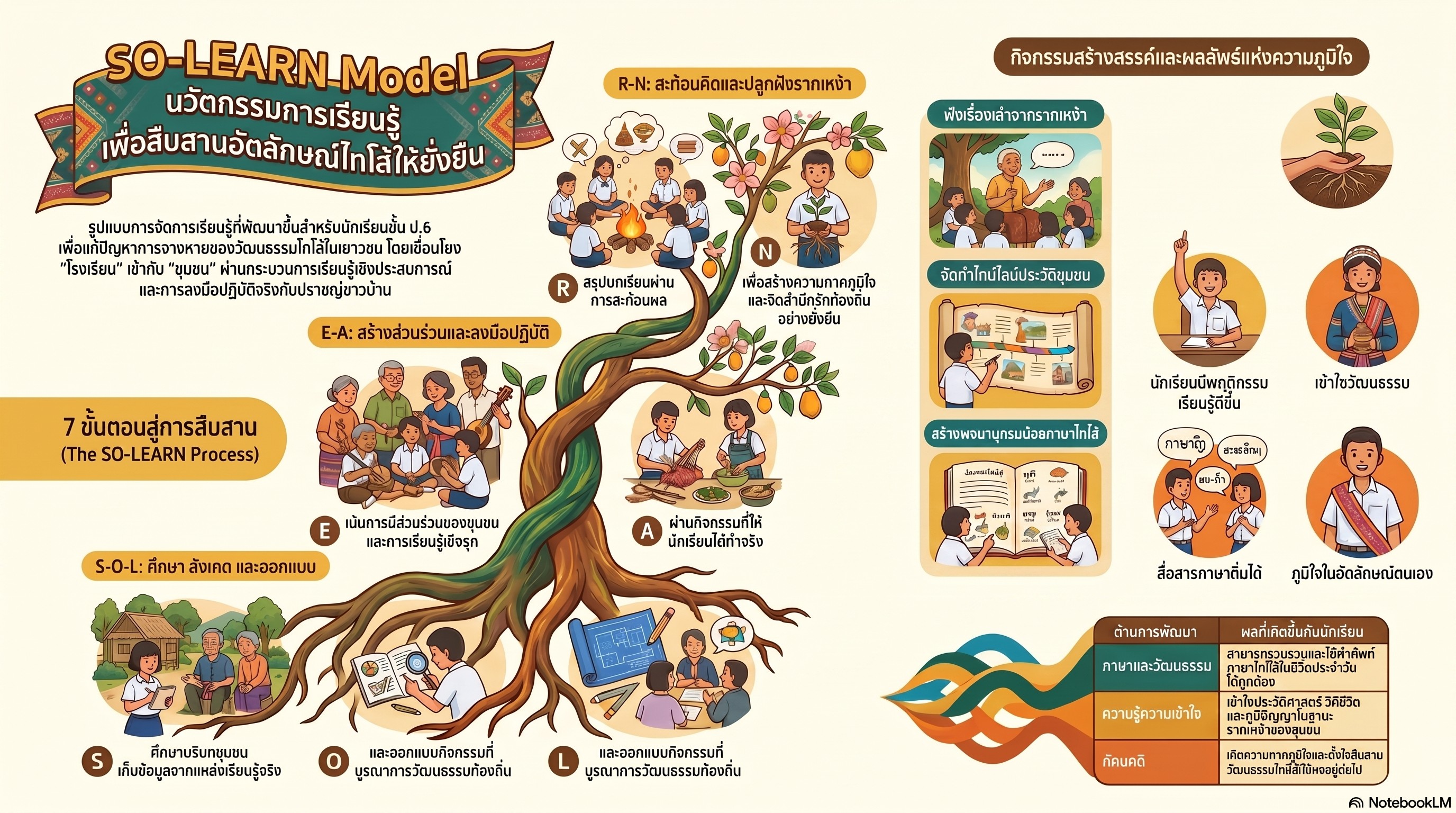
This qualitative research aimed to develop a Learning Management Model for sustaining the cultural identity of the Tai So ethnic group in Sakon Nakhon Province for Grade 6 students. The sample consisted of 30 Grade 6 students from Ban Kut Sakoi School, selected through purposive sampling. Data were collected through in-depth interviews, participant observation, and field notes, and analyzed using content analysis and thematic analysis. The findings indicate the development of the SO-LEARN Model based on the concept of community-based learning. The Model consists of seven stages: S – Study Context, O – Observe and Collect Data, L – Learning Design, E – Engagement, A – Active Learning, R – Reflection, and N – Nurture Local Identity. It emphasizes learning from cultural bearers through community-based activities, including listening to local narratives, constructing a historical timeline, and creating a mini Tai So dictionary. The implementation of the Model enhanced students’ learning in four aspects: learning behavior, knowledge and understanding, language and culture, and attitudes toward local identity. Students demonstrated active participation, developed a deeper understanding of local culture, were able to use Tai So vocabulary in appropriate contexts, and showed pride in their cultural identity. In conclusion, the SO-LEARN Model provides an effective approach for integrating community cultural identity into school learning and supports the sustainable preservation of local culture.
References
กรมศิลปากร. (2561). มรดกภูมิปัญญาทางวัฒนธรรม. กรมศิลปากร.
กระทรวงศึกษาธิการ. (2560). หลักสูตรแกนกลางการศึกษาขั้นพื้นฐาน พุทธศักราช 2551 (ฉบับปรับปรุง พ.ศ. 2560). โรงพิมพ์ชุมนุมสหกรณ์การเกษตรแห่งประเทศไทย.
คณะกรรมการวัฒนธรรมแห่งชาติ. (2553). นโยบายและแผนวัฒนธรรมแห่งชาติ. กระทรวงวัฒนธรรม.
ชัยยงค์ พรหมวงศ์. (2556). การออกแบบการเรียนการสอน. สำนักพิมพ์แห่งจุฬาลงกรณ์มหาวิทยาลัย.
นวลน้อย ทีฆะสิทธิ์. (2561). การเปลี่ยนแปลงทางวัฒนธรรมในสังคมไทย. สำนักพิมพ์แห่งจุฬาลงกรณ์มหาวิทยาลัย.
รัตติยา บุญมี. (2561). อัตลักษณ์และวิถีชีวิตของกลุ่มชาติพันธุ์ไทโส้ในภาคตะวันออกเฉียงเหนือ. มหาวิทยาลัยราชภัฏสกลนคร.
สุปราณี กิ่งแก้ว. (2556). การจัดการเรียนรู้จากแหล่งเรียนรู้จริง. สำนักพิมพ์มหาวิทยาลัยศรีนครินทรวิโรฒ.
สุวิทย์ มูลคำ. (2558). กลยุทธ์การจัดการเรียนรู้เพื่อพัฒนาทักษะการคิด. ห้างหุ้นส่วนจำกัด ภาพพิมพ์.
สำนักงานวัฒนธรรมจังหวัดสกลนคร. (2563). ข้อมูลวัฒนธรรมจังหวัดสกลนคร. กระทรวงวัฒนธรรม.
ธวัชชัย ไพใหล. (2562). กลุ่มชาติพันธุ์ไทโส้ในแอ่งสกลนคร. วารสารบัณฑิตศึกษา มหาวิทยาลัยราชภัฏสกลนคร, 16(74), 225–234.
Dewey, J. (1938). Experience and education. Macmillan.
Eriksen, T. H. (2002). Ethnicity and nationalism: Anthropological perspectives (2nd ed.). Pluto Press.
Geertz, C. (1973). The interpretation of cultures. Basic Books.
Hall, S. (1990). Cultural identity and diaspora. In J. Rutherford (Ed.), Identity: Community, culture, difference (pp. 222–237). Lawrence & Wishart.
Kolb, D. A. (1984). Experiential learning: Experience as the source of learning and development. Prentice Hall.
Smith, M. K. (2002). Community-based learning. The Encyclopedia of Informal Education. https://infed.org/mobi/community-based-learning/
Downloads
Published
How to Cite
License
Copyright (c) 2026 Journal of Buddhist Education and Research (JBER)

This work is licensed under a Creative Commons Attribution-NonCommercial-NoDerivatives 4.0 International License.