Learning Management of Pali III Based on the SU–JI–PU–LI Principles in the Pali Department of Phrapariyattidhamma School, Sanommakhaya Temple Educational Center, Ubon Ratchathani Province
Abstract
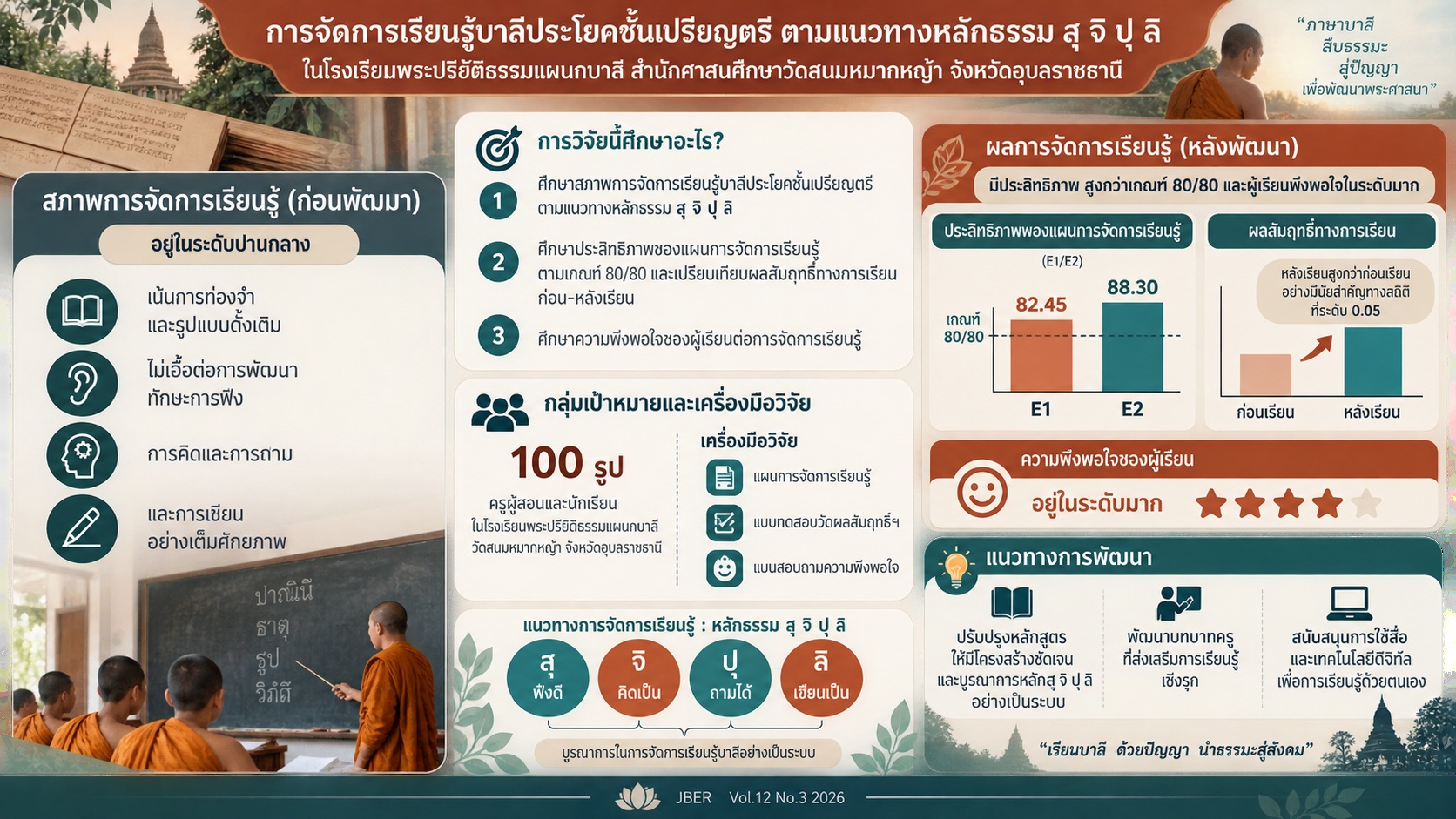
This research aimed to: (1) study the current state of learning management in Pali III based on the Su–Ji–Pu–Li principles in the Pali Department of Phrapariyattidhamma School, Sanommakhaya Temple Educational Center, Ubon Ratchathani Province; (2) examine the efficiency of learning management plans based on the Su–Ji–Pu–Li principles according to the 80/80 criterion and compare students’ learning achievement; and (3) propose guidelines for developing learning management based on the Su–Ji–Pu–Li principles. The target group consisted of 100 teachers and students. The research instruments included a five-level rating scale questionnaire and semi-structured interviews with 10 key informants. The developed learning management plans were implemented and evaluated using pre-test and post-test assessments, as well as a satisfaction questionnaire administered to 20 participants. Data were analyzed using mean, percentage, and standard deviation.
The research results were as follows:
The overall state of learning management in Pali III was at a moderate level. Instruction was primarily based on memorization and traditional approaches, which did not sufficiently support the development of listening, thinking, questioning, and writing skills. The developed learning management plans achieved the efficiency criterion of 80/80. Students’ post-test scores were significantly higher than pre-test scores at the .05 level, and students’ overall satisfaction with the learning management was at a high level.
Guidelines for improving learning management include restructuring the curriculum to ensure clarity and systematic integration of the Su–Ji–Pu–Li principles, enhancing teachers’ roles in promoting active learning, supporting the use of digital media and technology for self-directed learning, and improving assessment methods based on authentic evaluation to reflect students’ holistic development.
Keywords: Pali III, Su–Ji–Pu–Li Principles, Phrapariyattidhamma School (Pali Department)
Downloads
Published
How to Cite
Issue
Section
License
Copyright (c) 2026 Journal of Buddhist Education and Research (JBER)

This work is licensed under a Creative Commons Attribution-NonCommercial-NoDerivatives 4.0 International License.