Buddhism and Environmental, Social, and Governance (ESG): An Institutional Conceptual Framework for Corporate Sustainability in Thailand
Keywords:
ESG, Buddhist Institutional Capital, Institutional Transmission Mechanism, Corporate Sustainability, Sufficiency Economy Philosophy, Informal InstitutionAbstract
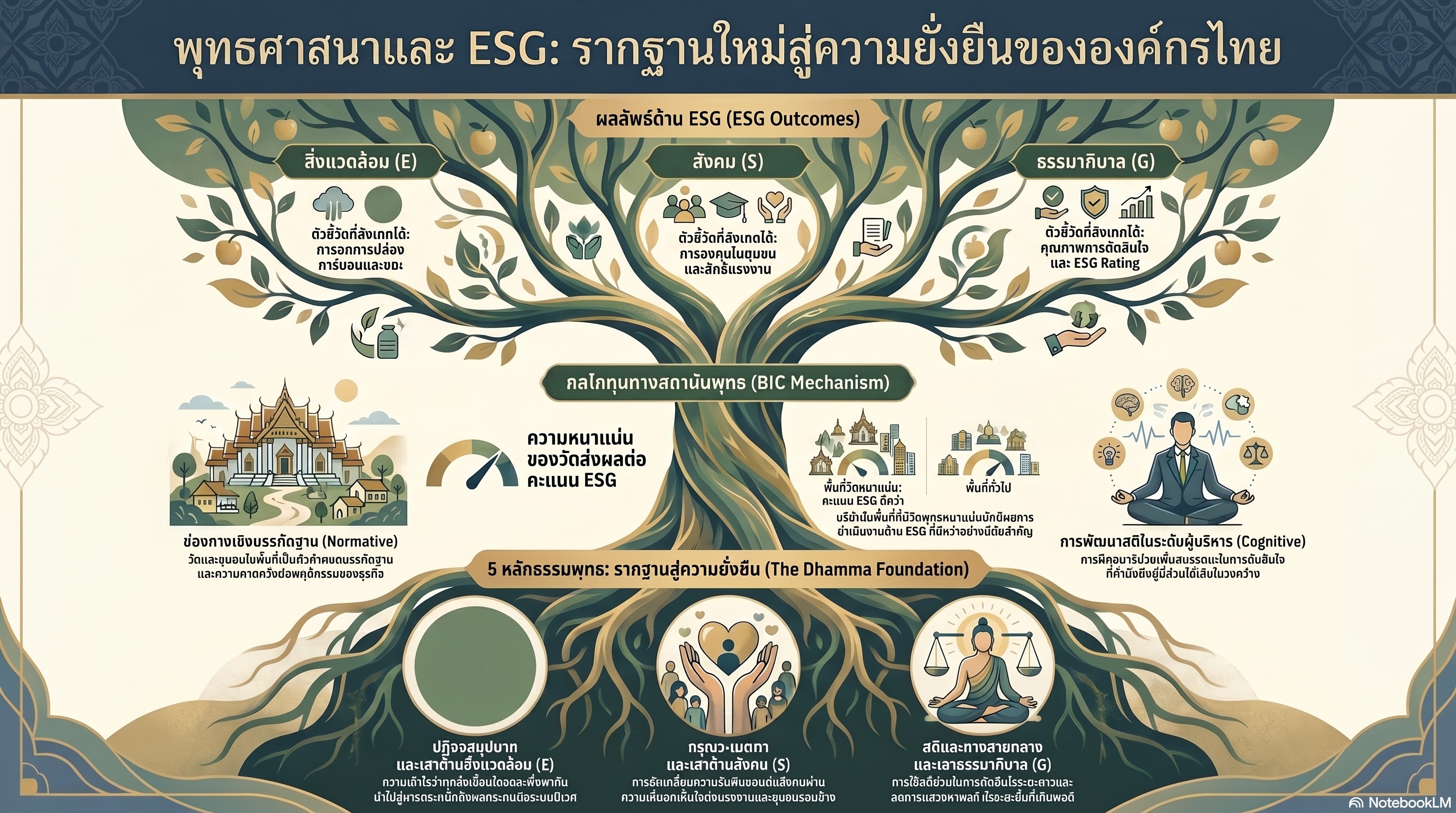
This article presents an institutional framework that links core Buddhist principles to the three pillars of Environmental, Social, and Governance (ESG) in the Thai corporate context. It examines four thematic issues. First, five dhamma tenets — Dependent Origination (paṭicca-samuppāda), the Middle Way (Majjhimā Paṭipadā), Mindfulness (sati), Compassion (karuṇā), and Non-self / Impermanence (anattā / anicca) — correspond directly to each ESG pillar and translate systematically into operational mechanisms. Second, the win-win paradigm in corporate sustainability has a fundamental philosophical weakness: it treats sustainability as an instrument for profit rather than as an intrinsic value. Buddhist ethics offers an alternative grounded in obligation toward all sentient life rather than in returns calculation. Third, the Buddhist Institutional Capital (BIC) framework operates through three institutional channels — normative, cognitive, and regulative — drawing on DiMaggio and Powell (1983) and North (1990). The framework explains why firms located in areas with higher Buddhist temple density exhibit significantly stronger ESG performance, even after firm- and region-level controls. Fourth, the integrative framework developed here provides a basis for empirical research that links ESG integration with Buddhist principles and the sufficiency economy philosophy to strengthen corporate governance. It also informs the design of ESG standards and policy instruments suited to the Thai cultural context.
References
Abeydeera, S., Kearins, K., & Tregidga, H. (2016). Buddhism, sustainability and organizational practices: Shedding light on a growing phenomenon. Journal of Corporate Citizenship, 61, 44–70.
Becker, C. U., & Hamblin, J. (2021). Conceptualizing personhood for sustainability: A Buddhist virtue ethics perspective. Sustainability, 13(16), 9166. https://doi.org/10.3390/su13169166
Daniels, P. L. (2010). Climate change, economics and Buddhism — Part I: An integrated environmental analysis framework. Ecological Economics, 69(5), 952–961. https://doi.org/10.1016/j.ecolecon.2009.12.002
Dena, A. M., & Haque, K. W. (2024). Ethical leadership and cultural values: The role of Buddhism in shaping modern business. Asian Review of Social Sciences, 13(1), 17–22. https://doi.org/10.70112/arss-2024.13.1.3909
DiMaggio, P. J., & Powell, W. W. (1983). The iron cage revisited: Institutional isomorphism and collective rationality in organizational fields. American Sociological Review, 48(2), 147–160. https://doi.org/10.2307/2095101
Edmans, A. (2023). The end of ESG. Financial Management, 52(1), 3–17. https://doi.org/10.1111/fima.12413
Fu, P., Ren, Y.-S., Tian, Y., Narayan, S. W., & Weber, O. (2024). Reexamining the relationship between ESG and firm performance: Evidence from the role of Buddhism. Borsa Istanbul Review, 24(1), 47–60. https://doi.org/10.1016/j.bir.2023.10.011
Gupta, P. P., Lam, K. C. K., Sami, H., & Zhou, H. (2022). Do religion and politics impact corporate governance diversity policy? Asian Review of Accounting, 30(1), 1–30. https://doi.org/10.1108/ARA-09-2021-0181
Henisz, W., Koller, T., & Nuttall, R. (2019). Five ways that ESG creates value. McKinsey Quarterly. https://www.mckinsey.com
Kim, J., & Daniel, S. J. (2016). Religion and corporate governance: Evidence from 32 countries. Asia-Pacific Journal of Financial Studies, 45(2), 281–308. https://doi.org/10.1111/ajfs.12130
Kovács, G. (2014). The theoretical foundation of Buddhist management practices. Journal of Management Development, 33(8/9), 751–762. https://doi.org/10.1108/JMD-09-2013-0120
Li, Y., Chen, X., Li, W., & Xu, X. (2021). How does Buddhism affect corporate cash holdings? International Journal of Emerging Markets, 18(9), 2086–2106. https://doi.org/10.1108/IJOEM-08-2020-0902
Martiny, A., Taglialatela, J., Testa, F., & Iraldo, F. (2024). Determinants of environmental, social and governance (ESG) performance: A systematic literature review. Journal of Cleaner Production, 456, 142213. https://doi.org/10.1016/j.jclepro.2024.142213
Nelson, J. A. (2018). Buddhist economics: An enlightened approach to the dismal science. Feminist Economics, 24(3), 184–187. https://doi.org/10.1080/13545701.2018.1455986
North, D. C. (1990). Institutions, institutional change and economic performance. Cambridge University Press.
Nyberg, D. (2021). Corporations, politics, and democracy: Corporate political activities as political corruption. Organization Theory, 2(1). https://doi.org/10.1177/2631787720982618
Office of National Buddhism. (2022). Statistics on Buddhist temples in Thailand. Government of Thailand. http://binfo.onab.go.th/Temple/Dashboard.aspx (in Thai)
Porter, M. E., & Kramer, M. R. (2011). Creating shared value. Harvard Business Review, 89(1/2), 62–77.
SCG. (2022). Sustainability Report 2022: Rise through ESG integration. Siam Cement Group. https://file.scgsustainability.com/wp-content/uploads/2023/03/07170810/SCG-Sustainability-Report-2022.pdf
Song, H. (2021). Buddhist approach to corporate sustainability. Business Strategy and the Environment, 30(7), 3040–3052. https://doi.org/10.1002/bse.2787
Speece, M. W. (2019). Sustainable development and Buddhist economics in Thailand. International Journal of Social Economics, 46(5), 704–721. https://doi.org/10.1108/IJSE-08-2018-0405
Stirling, K. (2014). Buddhist wisdom as a path to a new economic enlightenment. Journal of Management Development, 33(8/9), 812–823.
Stock Exchange of Thailand. (2023, November 6). SET announces SET ESG Ratings for 193 listed companies (SET News 97/2023). https://www.set.or.th/en/market/news-and-alert/newsdetails?id=84240400&symbol=SET
Tan, F., & Dipendra, K. C. (2024). Tensions between materiality assessments and stakeholder engagements in Thai corporate sustainability leaders. Sustainability, 16(17), 7711. https://doi.org/10.3390/su16177711
Terzani, S., & Turzo, T. (2021). Religious social norms and corporate sustainability: The effect of religiosity on environmental, social, and governance disclosure. Corporate Social Responsibility and Environmental Management, 28(1), 485–496. https://doi.org/10.1002/csr.2063
van den Muyzenberg, L. (2014). The contribution of Buddhist wisdom to management development. Journal of Management Development, 33(8/9), 741–750. https://doi.org/10.1108/JMD-10-2013-0128
Vu, M. C. (2018). Skilful means — A Buddhist approach to social responsibility. Social Responsibility Journal, 14(2), 321–335. https://doi.org/10.1108/SRJ-05-2016-0084
Xiong, L., Xiao, L., Bai, M., Qin, Y., & Yang, L. (2022). The religion effect on corporate cash holding in China: Buddhism and Taoism. International Journal of Finance and Economics, 28(4), 4420–4457. https://doi.org/10.1002/ijfe.2658
Zaman, R., Roudaki, J., & Nadeem, M. (2018). Religiosity and corporate social responsibility practices: Evidence from an emerging economy. Social Responsibility Journal, 14(2), 368–395. https://doi.org/10.1108/SRJ-10-2017-0204
Downloads
Published
How to Cite
License
Copyright (c) 2026 Journal of Buddhist Education and Research (JBER)

This work is licensed under a Creative Commons Attribution-NonCommercial-NoDerivatives 4.0 International License.