พุทธศาสนาและแนวคิดด้านสิ่งแวดล้อม สังคม และธรรมาภิบาล: กรอบแนวคิดเชิงสถาบันสำหรับความยั่งยืนองค์กรในประเทศไทย
คำสำคัญ:
ESG, ทุนทางสถาบันพุทธศาสนา, กลไกการส่งผ่านเชิงสถาบัน, ความยั่งยืนองค์กร, ปรัชญาเศรษฐกิจพอเพียง, สถาบันที่ไม่เป็นทางการบทคัดย่อ
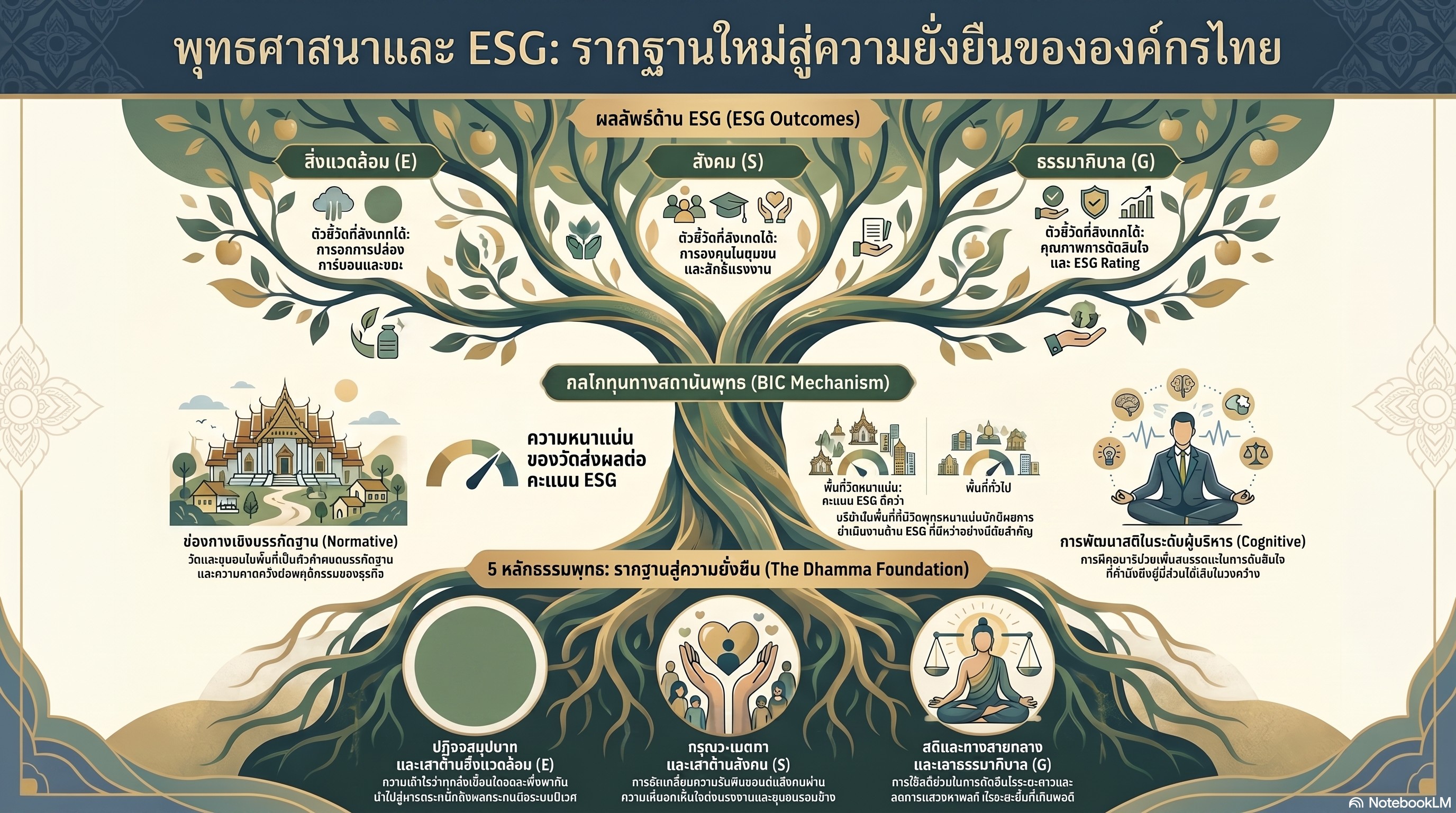
บทความวิชาการนี้นำเสนอกรอบแนวคิดเชิงสถาบันที่เชื่อมโยงหลักธรรมของพุทธศาสนาเข้ากับเสาหลักด้านสิ่งแวดล้อม สังคม และธรรมาภิบาล (ESG) ในบริบทองค์กรไทย ครอบคลุม 4 ประเด็นหลัก ประการแรก หลักธรรมพุทธ 5 ประการ ได้แก่ ปฏิจจสมุปบาท ทางสายกลาง สติ กรุณา และอนัตตา สอดคล้องโดยตรงกับเสาหลัก ESG ทั้ง 3 ด้าน และสามารถแปลงเป็นกลไกสู่การปฏิบัติได้อย่างเป็นระบบ ประการที่สอง กระบวนทัศน์ของการได้ประโยชน์ทั้งสองฝ่าย (win-win) มีข้อจำกัดเชิงปรัชญาที่สำคัญ เพราะมองความยั่งยืนเป็นเครื่องมือมากกว่าคุณค่าในตัวมันเอง ขณะที่หลักธรรมพุทธให้รากฐานทางจริยธรรมซึ่งตั้งอยู่บนพันธกรณีต่อสรรพชีวิต มิใช่การคำนวณผลตอบแทน ประการที่สาม กรอบทุนทางสถาบันพุทธศาสนา (Buddhist Institutional Capital: BIC) ทำงานผ่าน 3 ช่องทางสถาบันตามทฤษฎีของ DiMaggio and Powell (1983) และ North (1990) ได้แก่ ช่องทางเชิงบรรทัดฐาน ช่องทางเชิงความรู้ และช่องทางเชิงกฎระเบียบ กรอบนี้อธิบายว่าเหตุใดบริษัทในพื้นที่ที่มีความหนาแน่นของวัดพุทธสูงกว่าจึงมีผลการดำเนินงาน ESG ดีกว่าอย่างมีนัยสำคัญ ประการที่สี่ กรอบแนวคิดบูรณาการที่พัฒนาขึ้นเปิดเส้นทางการวิจัยที่เชื่อมโยง ESG กับหลักธรรมพุทธและปรัชญาเศรษฐกิจพอเพียงเพื่อยกระดับธรรมาภิบาลองค์กร พร้อมเสนอแนวทางการออกแบบนโยบายและตัวชี้วัด ESG ที่เหมาะสมกับบริบทวัฒนธรรมตะวันออก
เอกสารอ้างอิง
Abeydeera, S., Kearins, K., & Tregidga, H. (2016). Buddhism, sustainability and organizational practices: Shedding light on a growing phenomenon. Journal of Corporate Citizenship, 61, 44–70.
Becker, C. U., & Hamblin, J. (2021). Conceptualizing personhood for sustainability: A Buddhist virtue ethics perspective. Sustainability, 13(16), 9166. https://doi.org/10.3390/su13169166
Daniels, P. L. (2010). Climate change, economics and Buddhism — Part I: An integrated environmental analysis framework. Ecological Economics, 69(5), 952–961. https://doi.org/10.1016/j.ecolecon.2009.12.002
Dena, A. M., & Haque, K. W. (2024). Ethical leadership and cultural values: The role of Buddhism in shaping modern business. Asian Review of Social Sciences, 13(1), 17–22. https://doi.org/10.70112/arss-2024.13.1.3909
DiMaggio, P. J., & Powell, W. W. (1983). The iron cage revisited: Institutional isomorphism and collective rationality in organizational fields. American Sociological Review, 48(2), 147–160. https://doi.org/10.2307/2095101
Edmans, A. (2023). The end of ESG. Financial Management, 52(1), 3–17. https://doi.org/10.1111/fima.12413
Fu, P., Ren, Y.-S., Tian, Y., Narayan, S. W., & Weber, O. (2024). Reexamining the relationship between ESG and firm performance: Evidence from the role of Buddhism. Borsa Istanbul Review, 24(1), 47–60. https://doi.org/10.1016/j.bir.2023.10.011
Gupta, P. P., Lam, K. C. K., Sami, H., & Zhou, H. (2022). Do religion and politics impact corporate governance diversity policy? Asian Review of Accounting, 30(1), 1–30. https://doi.org/10.1108/ARA-09-2021-0181
Henisz, W., Koller, T., & Nuttall, R. (2019). Five ways that ESG creates value. McKinsey Quarterly. https://www.mckinsey.com
Kim, J., & Daniel, S. J. (2016). Religion and corporate governance: Evidence from 32 countries. Asia-Pacific Journal of Financial Studies, 45(2), 281–308. https://doi.org/10.1111/ajfs.12130
Kovács, G. (2014). The theoretical foundation of Buddhist management practices. Journal of Management Development, 33(8/9), 751–762. https://doi.org/10.1108/JMD-09-2013-0120
Li, Y., Chen, X., Li, W., & Xu, X. (2021). How does Buddhism affect corporate cash holdings? International Journal of Emerging Markets, 18(9), 2086–2106. https://doi.org/10.1108/IJOEM-08-2020-0902
Martiny, A., Taglialatela, J., Testa, F., & Iraldo, F. (2024). Determinants of environmental, social and governance (ESG) performance: A systematic literature review. Journal of Cleaner Production, 456, 142213. https://doi.org/10.1016/j.jclepro.2024.142213
Nelson, J. A. (2018). Buddhist economics: An enlightened approach to the dismal science. Feminist Economics, 24(3), 184–187. https://doi.org/10.1080/13545701.2018.1455986
North, D. C. (1990). Institutions, institutional change and economic performance. Cambridge University Press.
Nyberg, D. (2021). Corporations, politics, and democracy: Corporate political activities as political corruption. Organization Theory, 2(1). https://doi.org/10.1177/2631787720982618
Office of National Buddhism. (2022). Statistics on Buddhist temples in Thailand. Government of Thailand. http://binfo.onab.go.th/Temple/Dashboard.aspx (in Thai)
Porter, M. E., & Kramer, M. R. (2011). Creating shared value. Harvard Business Review, 89(1/2), 62–77.
SCG. (2022). Sustainability Report 2022: Rise through ESG integration. Siam Cement Group. https://file.scgsustainability.com/wp-content/uploads/2023/03/07170810/SCG-Sustainability-Report-2022.pdf
Song, H. (2021). Buddhist approach to corporate sustainability. Business Strategy and the Environment, 30(7), 3040–3052. https://doi.org/10.1002/bse.2787
Speece, M. W. (2019). Sustainable development and Buddhist economics in Thailand. International Journal of Social Economics, 46(5), 704–721. https://doi.org/10.1108/IJSE-08-2018-0405
Stirling, K. (2014). Buddhist wisdom as a path to a new economic enlightenment. Journal of Management Development, 33(8/9), 812–823.
Stock Exchange of Thailand. (2023, November 6). SET announces SET ESG Ratings for 193 listed companies (SET News 97/2023). https://www.set.or.th/en/market/news-and-alert/newsdetails?id=84240400&symbol=SET
Tan, F., & Dipendra, K. C. (2024). Tensions between materiality assessments and stakeholder engagements in Thai corporate sustainability leaders. Sustainability, 16(17), 7711. https://doi.org/10.3390/su16177711
Terzani, S., & Turzo, T. (2021). Religious social norms and corporate sustainability: The effect of religiosity on environmental, social, and governance disclosure. Corporate Social Responsibility and Environmental Management, 28(1), 485–496. https://doi.org/10.1002/csr.2063
van den Muyzenberg, L. (2014). The contribution of Buddhist wisdom to management development. Journal of Management Development, 33(8/9), 741–750. https://doi.org/10.1108/JMD-10-2013-0128
Vu, M. C. (2018). Skilful means — A Buddhist approach to social responsibility. Social Responsibility Journal, 14(2), 321–335. https://doi.org/10.1108/SRJ-05-2016-0084
Xiong, L., Xiao, L., Bai, M., Qin, Y., & Yang, L. (2022). The religion effect on corporate cash holding in China: Buddhism and Taoism. International Journal of Finance and Economics, 28(4), 4420–4457. https://doi.org/10.1002/ijfe.2658
Zaman, R., Roudaki, J., & Nadeem, M. (2018). Religiosity and corporate social responsibility practices: Evidence from an emerging economy. Social Responsibility Journal, 14(2), 368–395. https://doi.org/10.1108/SRJ-10-2017-0204
ดาวน์โหลด
เผยแพร่แล้ว
รูปแบบการอ้างอิง
สัญญาอนุญาต
ลิขสิทธิ์ (c) 2026 Journal of Buddhist Education and Research (JBER)

อนุญาตภายใต้เงื่อนไข Creative Commons Attribution-NonCommercial-NoDerivatives 4.0 International License.