Global Meets Local: Blind Box Consumption as Cross-Cultural Ritual among Bangkok Youth
Abstract
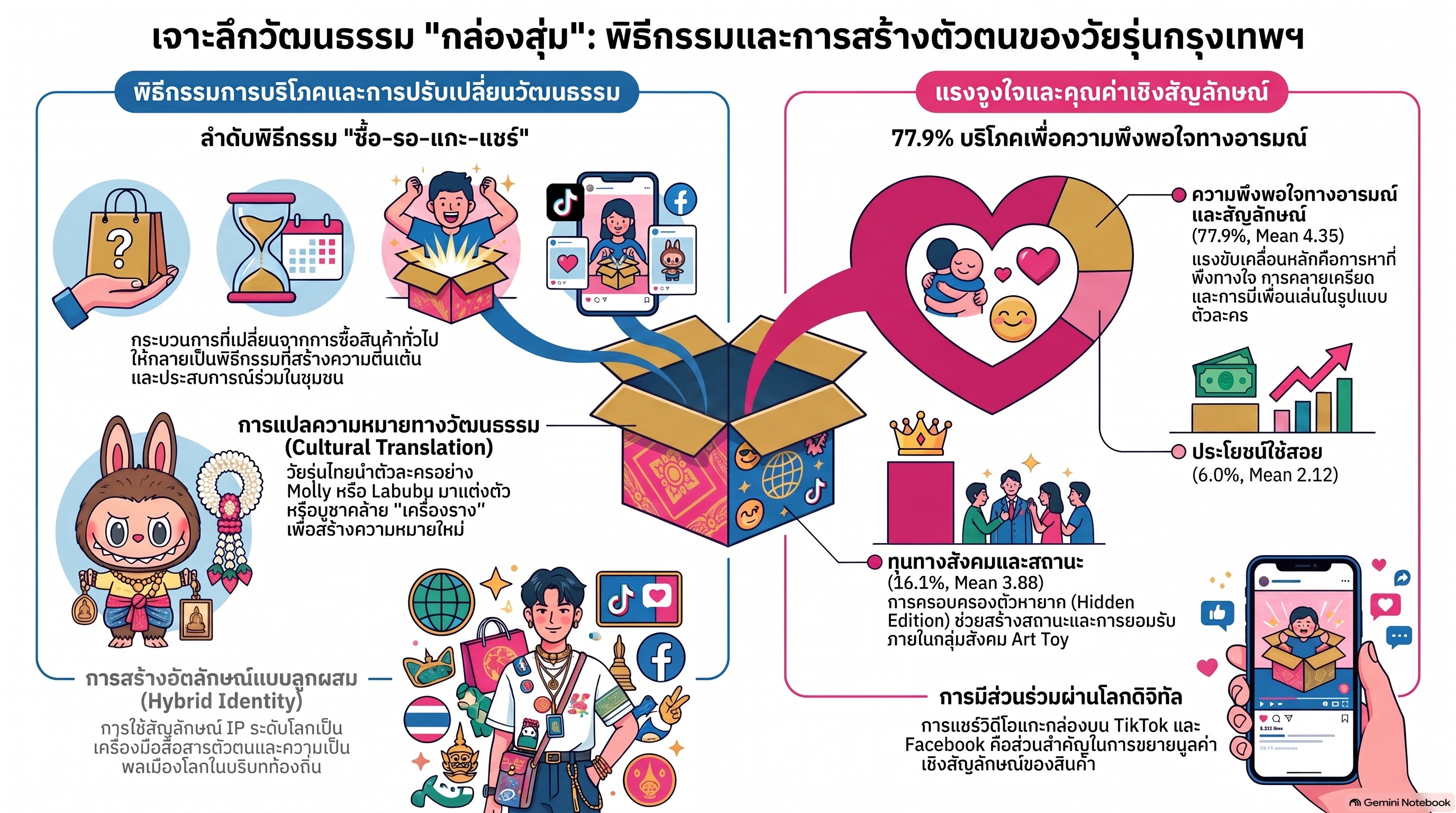
This study adopts a theoretical perspective of cross-cultural communication to delve into the consumption practices of the Chinese brand Pop Mart's blind box products among the youth demographic in Bangkok, Thailand. Utilizing a mixed-methods research approach that combines questionnaire surveys (385 valid samples), in-depth interviews (30 core consumers), focus group discussions (2 groups of 6–8 people each), and a three-month digital ethnography observation, it systematically analyzes the consumption behaviors, cultural adaptation, and identity construction processes of Bangkok youth within the context of global cultural flows. The research finds that Bangkok youth are not passive recipients of global cultural products; instead, they transform blind box consumption into a communication ritual with local characteristics through creative cultural practices. Specifically, the study reveals three key findings: First, consumers creatively integrate global IP symbols with local Thai cultural elements through a “cultural translation” mechanism, forming unique cultural hybrids. Second, the behavioral sequence of “purchasing–waiting–unboxing–sharing” constitutes a complete ritual process, which not only satisfies individual emotional needs but also constructs a shared system of meaning at the community level. Finally, the core driver of consumption is the pursuit of symbolic value (including social capital, cultural identity, and emotional solace), a finding that deepens our understanding of contemporary youth consumption motivations. This study contributes at both theoretical and practical levels: theoretically, by proposing a “bottom-up glocalization” analytical framework, it enriches cross-cultural communication theory; practically, it provides actionable strategic recommendations for the international development of the cultural and creative industries.
References
Akhmad, U. S. M., & Astuti, B. (2026). Consumer behavior and marketing strategies in blind box commerce: A systematic literature review. Equivalent: Journal of Economic, Accounting and Management, 4(1), 431–446. https://doi.org/10.61994/equivalent.v4i1.1554
Amelia, R., Nasib, N., & Rahman, A. (2025). Driving repurchase intention in e-commerce: The synergistic role of uncertainty and product appeal on repurchase intention in blind box toys. Cogent Business & Management, 12(1), 1–17. https://doi.org/10.1080/23311975.2025.2506613
Baudrillard, J. (1970). The consumer society: Myths and structures. SAGE Publications.
Carey, J. W. (2005). Communication as culture: Essays on media and society. Routledge.
Durkheim, É. (2006). The elementary forms of religious life (J. Ward, Trans.). Oxford University Press. (Original work published 1912)
Frost & Sullivan. (2023). Global trendy toy market analysis report. Frost & Sullivan Global Research Center. https://www.frost.com
NPD Group, & The Toy Association. (2024). Global toy market trends report. The Toy Association Publications. https://www.toyassociation.org
Strauss, A., & Corbin, J. (1998). Basics of qualitative research: Techniques and procedures for developing grounded theory (2nd ed.). SAGE Publications.
Yamane, T. (1967). Statistics: An introductory analysis (2nd ed.). Harper & Row.
Zhang, R., & Zhang, Y. (2022). The effect of blind box product uncertainty on consumers' purchase intention: The mediating role of perceived value and the moderating role of purchase intention. Frontiers in Psychology, 13, Article 946527. https://doi.org/10.3389/fpsyg.2022.946527
Downloads
Published
How to Cite
Issue
Section
Categories
License
Copyright (c) 2026 Journal of Buddhist Education and Research (JBER)

This work is licensed under a Creative Commons Attribution-NonCommercial-NoDerivatives 4.0 International License.